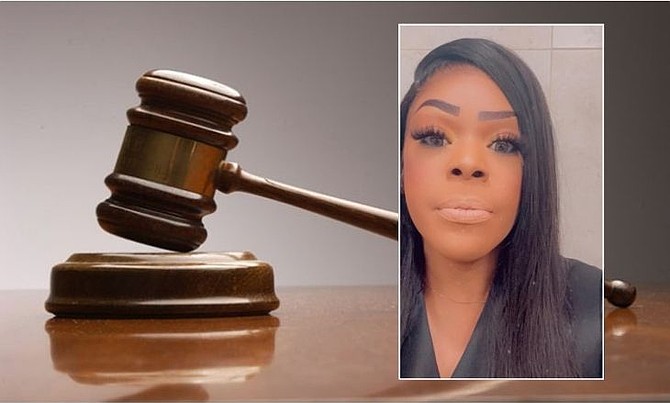
Director of Public Prosecutions Cordell Frazier
By LYNAIRE MUNNINGS
Tribune Staff Reporter
lmunnings@tribunemedia.net
THE collapse of a murder case tied to the killing of an eight-year-old sparked a rare and forceful public response from the Director of Public Prosecutions yesterday, who said claims that prosecutors were complacent ignore years of procedural setbacks and distort what actually went wrong.
Cordell Frazier spoke out after the Supreme Court Justice Dale Fitzpatrick directed acquittals for Perry Pickering and Lloyd Minnis, who had been charged with a 2017 double murder that included the death of eight-year-old Eugene Woodside. The case fell apart this month after the court refused to allow prosecutors to revive a late application for an anonymous witness, prompting the crown to call no evidence.
“When you're talking about complacency, that is not a fair comment, because if you look at what transpired, one cannot conclude that the prosecution was complacent,” Ms Frazier said yesterday.
Pickering and Minnis had each faced two counts of murder and consistently pleaded not guilty. Their joint trial, years in the making, never reached a jury.
Minnis was first arraigned in January 2018 after being served with a Voluntary Bill of Indictment. From there, the case lurched through a series of adjournments as trial dates were set and then abandoned, first because of court scheduling pressures and later because of the COVID-19 pandemic, which sharply curtailed Supreme Court operations in 2020.
As the courts reopened, progress was further slowed by a congested criminal calendar dominated by lengthy trials.
Pickering, meanwhile, was not before the Bahamian courts for much of that period. He remained outside the jurisdiction until his extradition from the United States in December 2024. He was arraigned two months later, in February 2025, on two murder charges. Prosecutors allege he was the principal offender and shooter.
In September 2025, the prosecution consolidated the cases against Pickering and Minnis into a single Voluntary Bill of Indictment, setting the matter down for trial the following month.
The crown intended to rely on a witness known as “Alpha”, whom it sought to have testify anonymously. While the witness had been referenced in earlier indictments, a formal application for anonymous testimony was not filed until the morning the trial was due to begin in December 2025.
By then, court-imposed deadlines for such an application had passed. The judge ruled that if the prosecution wished to call the witness, it would have to do so without anonymity.
On December 1, 2025, the day jury selection was scheduled to begin, prosecutors asked the court to reconsider and hear the application. Defence attorneys objected, arguing the request was out of time and would further prolong a case that had already stretched across nearly eight years, with both accused in custody.
Justice Fitzpatrick refused the request, pointing to repeated missed deadlines and the prejudice further delay would cause. When the matter returned to court, the prosecution called no evidence and acquittals were directed.
Ms Frazier said the ruling was widely circulated without sufficient context, fuelling what she described as an unfair narrative about the prosecution’s role.
She said the matter was originally managed by Justice Cheryl Grant-Thompson and was shaped by factors largely outside the crown’s control, including the pandemic, limited court capacity and the demands of other long-running trials.
She cited cases such as the Richard Bevans and Raquel Johnson matter and the Adrian Gibson prosecution, which ran for about two years, as examples of the strain on the court system.
She stressed that Pickering’s extradition only occurred in late 2024 and said it was misleading to characterise delays before that point as prosecutorial failings.
She said Justice Grant-Thompson later fixed a trial date for March 2026 with full knowledge that, at the time, no Supreme Court in The Bahamas had facilities capable of accommodating anonymous witness testimony.
That limitation, she said, was central to how the case was scheduled.
She also addressed the aborted trial dates in late 2025, saying the October fixture failed because of issues transporting the accused from prison, while the November date did not proceed because the court was not sitting. The December date, she said, was fixed by the court.
According to Ms Frazier, prosecutors consistently alerted the court to difficulties locating their witness and never concealed those challenges.
Rejecting suggestions that the Crown lacked diligence, she said it would be unreasonable to press ahead with a trial that could not properly be heard.
“I think the public ought to know that they don’t have to lose confidence in the system or the prosecution, because in relation to that case, the prosecution took all the necessary steps and when we cannot locate the witness, and in this case we are talking about an anonymous witness, we always intimate to the court the difficulties,” she said.
“And so in that case, the court was not blindsided as to the difficulties we were having, but equally, we were aware that you cannot set a matter down knowing that you cannot hear it. That would be unreasonable.”
Ms Frazier said Justice Grant-Thompson set the March 2026 trial date on the expectation that appropriate facilities for anonymous witnesses would be in place by then.
She confirmed that the prosecution has since filed appeals against both the directed acquittals and the refusal to hear the anonymous witness application.
The collapse of the case has drawn public anger, including from Eugene Woodside’s mother, who has expressed frustration that the matter was thrown out after years of delay, without her being present.




Comments
moncurcool 3 months, 2 weeks ago
DO the DPP knows that no Supreme Court has the facilities to accomodate anonymous witness testimony, but yet request it? And then claim they didn't do prosecutorial complacency?
Just unbelievable.
Sign in to comment
OpenID