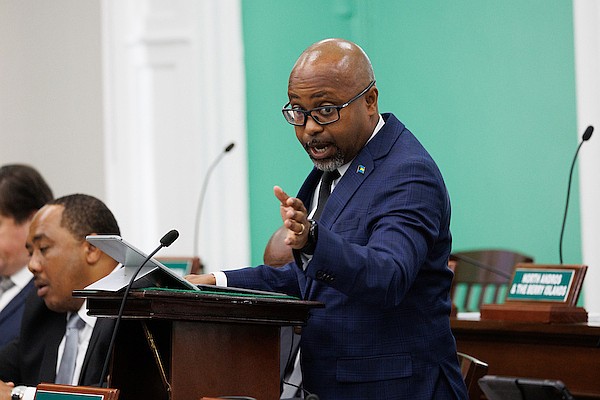
East Grand Bahama MP Kwasi Thompson in the House of Assembly. Photo: Dante Carrer/Tribune Staff
By NEIL HARTNELL
Tribune Business Editor
nhartnell@tribunemedia.net
The Opposition’s finance spokesman yesterday renewed demands for the Government to “stop governing in the dark” while arguing that the International Monetary Fund (IMF) had further backed concerns over public-private partnership (PPP) agreements.
Kwasi Thompson, the east Grand Bahama MP, speaking after the Fund unveiled its Article IV consultation report with The Bahamas, told Tribune Business that it had “pretty much confirmed there’s a degree of hidden liabilities in these” arrangements that the Davis administration has entered into on critical infrastructure projects.
In particular, he asserted that the Fund’s warning about “the risk of under-estimating liabilities” created by so-called PPPs had confirmed both previous concerns raised by the Free National Movement (FNM) as well as The Bahamas’ independent Fiscal Responsibility Council.
“You have two independent parties raising those concerns,” Mr Thompson told this newspaper. “I think it speaks to the validity of those concerns. I think all the issues that the Opposition previously pointed out with those PPPs, the breach of the Government’s own PPP policy, the way I know I would put it is: Stop governing in the dark.
“The Government must be more transparent and justify to the public the spending of millions and millions of dollars, which they have not. The IMF’s confirmation, the Fiscal Reponsibility Council’s confirmation, only further raises the concerns the Opposition spoke about.
“It speaks to our concerns wirh respect to the Procurement Act, with respect to granting these direct awards for millions and millions of dollars. How can you guarantee we are getting the best deal, justify you are getting the best value for money?”
The Washington D.C based Fund called for heightened “oversight and governance” of PPP deals especially given recent Inter-American Development Bank (IDB) findings that this nation will need to find an extra $450m annually by 2030 to meet its needs for investment in roads, healthcare, airports, water and renewable energy. The Bahamas’ requirements for new water and telecommunications infrastructure, and maintenance and replacement, have been pegged as equal to 3.2 percent of gross domestic product (GDP) or economic output alone.
“The authorities have prioritised PPPs in providing this incremental investment, building on recent efforts to upgrade airports and improve the electrical grid,” the IMF wrote. “The 2023 Public Procurement Act provides a regulatory framework for these investments.
“Caution, though, is warranted given the risk of underestimating the liabilities associated with PPPs. Effective PPP implementation requires robust governance including in contract bidding, procurement and the monitoring of projects.”
The IMF is urging The Bahamas to initiate “a clear process to govern the preparation and procurement of PPP projects, drawing on expertise in the Ministry of Finance” along with “dedicated and proactive fiscal risk management of PPPs”.
It also called for “proper budgeting, accounting and reporting standards that ensure full fiscal transparency and accountability, with potential liabilities quantified and reported”, and “a clear and consistent enabling legal framework”.
Expanding further on these themes, the Fund urged: “The increased use of public-private partnerships to develop infrastructure should go hand-in-hand with stronger PPP oversight and governance. Using this tool effectively will require a strengthening of the institutional framework to clarify risk-sharing arrangements, improve monitoring and enforcing of private partners’ obligations, and ensure transparent fiscal reporting.
“An immediate priority should be to improve fiscal reporting and enhance the overall institutional framework for PPPs. It would be important to quantify and report potential liabilities associated with ongoing energy sector investments.”
The Government itself acknowledged the need for improvement.“While highlighting that risk-sharing arrangements under PPPs are carefully designed, they agreed that more efforts could be made to reinforce the PPP institutional framework,” the IMF said of the Davis administration’s response.
Michael Pintard, the Opposition leader, has previously seized on the IMF’s statement as “exonerating” FNM concerns that several PPPs touted by the Government, such as the Eleuthera and Exuma roadworks deals with the Bahamas Striping Group of Companies and its affiliates worth a combined $160m, are really structured as “off-the-books” loans designed to keep hundreds of millions of dollars in debt liabilities off the Government’s balance sheet.
Accusing the Government of effectively “hiding” how much spending, borrowing and debt it is incurring, the Opposition leader called on the Davis administration to publish its own PPP policy if it was not going to follow the one introduced by its Minnis-led predecessor - which remains government policy and has never been repealed or replaced.
PPPs are typically designed to reduce the financial stress on cash-strapped governments by contracting the private sector to provide the funding, development and expertise to construct much-needed infrastructure or run public services.
The Government’s cash flow pressures are eased by requiring the private sector to finance the up-front capital costs, with the latter earning a return on investment - and paying back any lender - from the revenue streams generated by infrastructure assets they develop or services provided.
The Opposition has previously argued, though, that several projects touted by the Davis administration as PPPs do not fit this model or meet this criteria. In particular, several sources have pointed to the sudden appearance in the Government’s 2025-2026 Budget, under ‘public debt servicing - interest and other charges - of a $33.93m, ten-year loan due to PPP Investments & Construction Company.
Tribune Business records confirm this is the company that secured a deal with the last Christie administration to construct the Eight Mile Rock government administrative complex in Grand Bahama. The agreement was signed off on May 9, 2017, one day before the general election that brought the Minnis administration and FNM to office.
The arrangement was touted as a PPP, and this newspaper’s archives show PPP Investments & Construction Company sought to raise the necessary financing via a $25m bond placement. A further $9m was obtained from Sygnus Capital, the Jamaican investment house, and the deal was structured as a lease-to-own where the Government would pay back the company and lenders via rental payments.
However, it has now appeared in the Government’s books as a “loan” that has to be repaid by Bahamian taxpayers. Some $2.308m is due to be paid in 2025-2026, with payments of $2.094m and $1.874m due in 2026-2027 and 2027-2028, respectively.
Opposition sources suggested this represents a “smoking gun” showing that many projects touted by the Government as PPPs are really “off-the-books” loans designed to keep borrowings, spending and debt from showing up in the public finances for as long as possible.




Comments
ExposedU2C 1 day, 19 hours ago
Corrupt crooks like Tony Ferguson and his Greek master, and Snake and his cronies, just love PPPs which leave them with all the upside investment gains while taxpayers bear all the downside investment losses.
Sign in to comment
OpenID