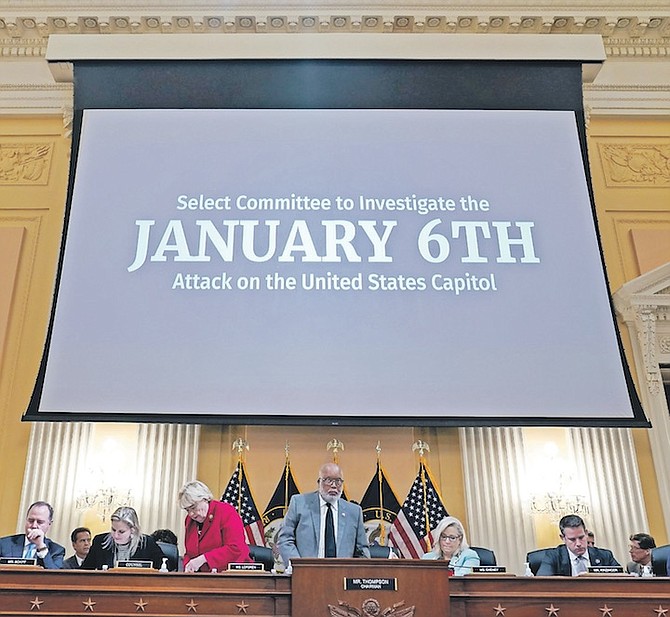
The House select committee investigating the January 6 attack on the US Capitol continues to reveal its findings of a year-long investigation, at the Capitol in Washington, on Monday. Photo: Susan Walsh/AP
With Charlie Harper
WERE you watching last week when the US House of Representatives January 6 select committee held the first of its several planned TV expositions of what they have found in the 18 months since a mob attacked the US capitol building and threatened to overrun the US Congress? The first session was televised in prime time by the major American networks (ABC, CBS and NBC) plus most cable outlets. Fox passed, but seemed to regret the decision afterwards, because they did carry live the second of the committee’s hearings on Monday during the day.
One of the committee’s key witnesses in these early sessions was former Attorney General Bill Barr – the same Bill Barr who was appointed to the job by former President Donald Trump specifically because of his expressed belief that a sitting President is sufficiently protected by executive privilege and other traditions and legislation that the President can basically do anything he wants to do, so long as it’s not proven to be illegal while he remains in office. Such an interpretation of the American constitution and traditions would be music to the ears of any President. For quite a while, Barr and Trump seemed to work in reasonable harmony.
But now? Barr was at pains to tell the committee he had many times warned Trump that the then-President’s claims of massive voter fraud in the 2020 election were “nonsense” and without any foundation in fact. This is the same Bill Barr who issued a misleading, even deceitful summary of the Mueller Report three years ago that had the effect of blunting whatever measured criticism the respected special counsel offered of Trump and his administration.
Ivanka Trump and Jared Kushner were also among the witnesses whose testimony was referenced and televised by the committee. Much more is to come, for at least the remainder of the month of June.
To what purpose? There is a lot of speculation that the committee, which consists of a handful of Democrats and two Republicans who obviously hate Trump, is essentially serving as a grand jury for a potential series of criminal charges against Trump and cronies like Rudy Giuliani and lawyer John Eastman. The “prosecutor” in this potential case would be the current Attorney General - cautious and methodical Merrick Garland. The political ramifications of any potential trial of Trump would have to be weighed with utmost care by the Biden administration.
It’s not at all clear that any potential prosecution of Trump by his political opponents would be a wise political move. As we have seen with our own commissions of inquiry in The Bahamas, evidence gathered after an administration leaves office is interesting and colours the public perception of that administration’s overall performance. But beyond that… what, exactly?
It is highly probable that most Americans have by now figured out how they feel about Trump. From among the vast archival trove of brazen outlandishness that characterized the 45th US President, it’s hard to imagine what new outrages the committee could unearth and reveal that would substantially change the minds of many American voters.
At the same time, court cases against Trump and his 2020 campaign continue apace in, most prominently, Atlanta and New York City. Local and state prosecutors are driving onward in their efforts to persuade judges and juries to convict Trump & Company of various electoral and other offences. This makes news for the liberal media. It is routinely dismissed by conservative media.
Trump has been at the centre of the American media news cycle for seven years and counting. From his political exile in Palm Beach, he issues lamely vindictive rebuttals to the January 6 committee and other critics. He sallies forth to hold rallies in deep red, Trumpian venues around the country. His fundraising machine, reportedly harvesting well north of $250m since his failed re-election bid, continues to underpin his many legal defence costs and perhaps further indemnifies him and his companies against civil misconduct fines, poor business decisions and loans coming due.
Trump keeps score on the success of his endorsed GOP primary election candidates, using a formula that elicits constant liberal second-guessing. Polls occasionally report the rise of “Trump fatigue,” a phrase used to describe a pervasive weariness of the steady back and forth over this charismatic but deeply flawed demagogue. He remains nonetheless front and centre on the American political scene.
Republican politicians continue to offer public deference out of an abundance of self-interest. National Democrats display little of the success and acumen that will be needed to dispatch Trump from the national political scene. Until that changes, expect more of the same.
Russians feel the pinch but it’s not really hurting
Economic sanctions have been the centrepiece of the Western response to Russia’s invasion of Ukraine since well before Russian troops crossed the Ukrainian border on February 24. Nearly four months later, statistical evidence is accumulating as to how effective those sanctions have been.
There’s been a lot of coverage of the recent reopening of many of the 840 McDonalds stores in Russia – minus the secret sauce, of course. And the golden arches are gone. The owner of the old McDonalds restaurant chain is – who else? – a Russian oil mogul from Siberia. Interestingly, his purchase of the sprawling McDonalds enterprise in Russia is somewhat reminiscent of how many of the Russian oligarchs close to Putin accumulated their fortunes decades ago.
Many of Putin’s chums enterprisingly arranged to take control of former Soviet-era gas, oil and other state monopoly enterprises after the collapse of the Communist Soviet empire. They often gained control via highly leveraged purchases of these invaluable assets at depressed prices in the social, economic and political chaos of Russia in the 1990s. Since people within and outside Russia need energy, this opportunism was rewarded with the stupendous fortunes we now see being at least partially dismantled by eager Western investigators and enforcement officials. These lucky oligarchs were able to basically acquire licences to make money risk-free. No wonder they’re so wealthy.
Now McDonalds is taken over by the Siberian mogul. We’ll see how he and his management team do with the Russian remains of one of the world’s great commercial franchises. Fast-food hamburgers aren’t exactly in the same category as oil and natural gas when you’re looking to heat your family home in the winter. But still: McDonalds has sold an awful lot of hamburgers. It will be interesting to compare McDonalds’ profit margins with those of the Siberian mogul and his team.
Meanwhile, how is the Russian economy actually doing since the sanctions were imposed? Inflation is currently estimated at around 17 percent – about twice as high as the current rate in the US – but the Russian inflation rate appears to be slowing somewhat since a 20-year high rate in April. According to the Standard & Poors Global Purchasing Managers index, Russian manufacturing increased last month for the first time since the war began.
Media reports from correspondents based in Russia indicate that despite some shortages, stores in Moscow and other cities are still pretty well stocked with goods. This is apparently due partly to pre-invasion planning and partly to the invigoration of normally secondary trade and supply routes through nearby countries like Turkey and Kazakhstan. Russian consumers are reportedly also tightening their belts and making fewer purchases overall.
A respected analyst of the Russian economy told The New York Times that in his opinion, “sanctions are not going to stop the war. The Russian public will bear it and adapt because Russians understand that they have no way to influence the state.” This kind of analysis at least partly relies on traditional views of the average Russian as still basically self-like, unaccustomed to the freedoms of the democratic and sometimes chaotic West and at least subliminally craving the authoritarian yoke of the tsars, Soviet commissars and now, Putin. Perhaps. We’ll see.
But overall, according to Chris Weafer, a macroeconomic consultant who has long focused on Russia and who also spoke to the Times, “some of our previous assumptions were wrong. Inflation, and the economy’s contraction, turned out to be less severe than expected.”
It doesn’t look like the economic pinch of sanctions is going to compel Putin to call off the dogs anytime soon.




Comments
Use the comment form below to begin a discussion about this content.
Sign in to comment
OpenID