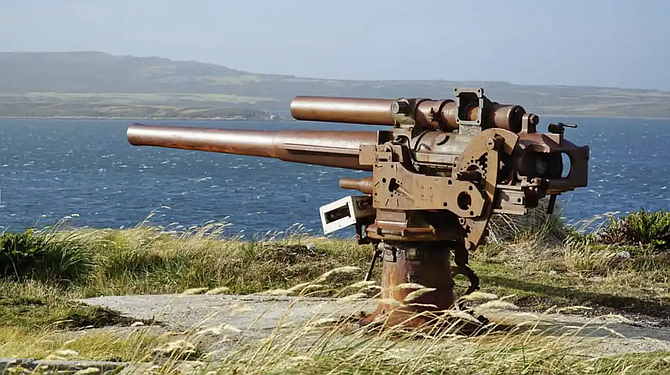
One of the coastal defence guns in the Falklands.
“Lest we forget”. How familiar those words are in the aftermath of war. The emphasis is always on remembrance in honouring and respecting the fallen. For it is said that to be recognised and appreciated by others in never-ending tribute for individual acts of achievement or sacrifice – however long ago that may be – fulfills a profound human need.
The Royal British Legion’s words of remembrance and exhortation, often recited at memorial services, are poignant. “They shall not grow old, as we that are left grow old: Age shall not weary them, nor the years condemn. We will remember them.”
Such thoughts are uppermost in my mind at this time of year because of the anniversary of the Falkland Islands War that occurred as long ago as 1982.This is of particular interest personally because of working after the conflict in the then Foreign and Commonwealth Office on the reconstruction and redevelopment of the Islands. This included a familiarisation visit to the islands courtesy of the RAF.
In any country, an international conflict involving its armed forces and loss of life and equipment will, of course, be regarded as hugely significant and should be remembered officially as an important part of its history.
Nonetheless, as the participants in war and their families fade away with the passage of time, public interest inevitably wanes even if those of today’s older generation still, for example, know details about the Second World War since they were exposed to war stories during their childhood. But, in the face of society’s changing attitudes, all too often it seems that people forget about their history as young people are encouraged to concentrate on keeping up with the times and modern developments during their own lives.
So it is invariably left to historians to remind people of the past and to encourage the honouring of those who lost their lives on a massive scale in recent wars, not least when veterans, and, for example, civilians who suffered from German bombing raids during the Second World War, still survive. Many believe that people should know what happened in the past in their own country because history has a habit of repeating itself, directly or indirectly.
For the sake of history, therefore, the facts of the Falklands war are worth repeating.
On April 2, 1982, Argentina mounted a seaborne and aerial attack on the Falkland Islands, which it calls the Malvinas, some 200 miles east of the mainland. The invasion was all the more shocking because such action by the military junta in Buenos Aires was unexpected in Britain given that bilateral diplomatic negotiations about the future of the Islands were taking place at the time.
It had been the case, of course, that the UK’s sovereignty over the Falklands had been fundamentally contested by Argentina. But the British government had no doubts about the legitimacy of its sovereignty, both because of its long and continuing administration of the Islands (nearly 150 years) and in accordance with the basicl principle of democracy – the will of the people – as contained in the UN Charter.
In reaction to the invasion and occupation of this remote place with a population of less than 3,000 who had for years been vociferously opposed to any interference in their lives by Argentina, Britain quickly sent a naval task force. Predictably, this was attacked en route by Argentine aircraft, and six ships were lost.
UK troops landed on the island of East Falkland on May 21 and, after fierce fighting, the Argentinians surrendered on June 14. The cost of the war was heavy. 649 Argentine, and 255 British, service personnel were killed and many wounded. Among numbers of Argentinian aircraft and ships lost, the cruiser called the “General Belgrano” was sunk by a British nuclear submarine. Three islanders also lost their lives during the hostilities.
Interestingly, historians now argue that Britain’s success in assembling a task force at short notice and sending it 8,000 miles to the South Atlantic, followed by a successful military campaign, surprised policy-makers in Buenos Aires who had underestimated the political will and resolve in London to mount such a forceful response in an effort to retake the Islands.
The Falklands remain a remote South Atlantic archipelago home to sheep farming and abundant birdlife. Its current population is still only about 3,500. During the reconstruction period, a new airport was built and a fisheries licensing regime was imposed to try to make the Islands economically independent. This soon became profitable and in due course the export of fish products was begun.
Now, reportedly, the Islanders are surprised to be on Trump’s “worst offenders” tariff list and have been slapped with a 42 per cent tariff on their fish exports to the US. It will be interesting to see how the British government reacts to that.
Politically, the population has stuck to its anti-Argentina stance. In a referendum in 2013, it voted overwhelmingly to remain as a British Overseas Territory. Specifically, in a turnout of 92 percent, 99.8 percent voted to remain British. This was aimed at settling tensions as Argentina was beginning to step up its claim to the islands again.
A familiarisation visit during the redevelopment period soon after the conflict generated for me a certain pride that my own country was prepared to stand up to international aggression and send a task force to the far-off South Atlantic to protect such a small number of its own citizens.
Although the Falklands conflict was top of the world’s news agenda at the time, memories have now, of course, faded. But not for those directly affected by the conflict – most importantly, those still suffering from wounds sustained during the fighting and the families left behind to grieve the loss of those who died.
Germany starting to rearm
Amidst all the current hullabaloo over the Trump tariffs and the collapse of stock markets that it is claimed could lead to a global recession, it is hard to take in the extent of the economic turmoil around the world, including in the US itself.
It seems that the US has now rejected the globalisation process that it had championed and profited from. So much has been written about it already and the situation seems to be changing constantly. But a recent BBC report summed up the present situation by saying “Trump has turned his back on the foundation of US economic might – the fallout will be messy”. Yesterday, there was further turmoil in the markets which continued to drop sharply.
The publicity over all this has taken the spotlight away from the earlier controversy over NATO and Trump’s insistence that Europe should now be contributing more to its own defence; and, specifically, that each member state should increase its own defence spending. One aspect of this that has attracted limited media scrutiny, but which, to my eye, is significant relates to Germany’s plans under a new coalition government now being formed following February’s election in the country.
The conservative centre-right Christian Democratic Union party under Friedrich Merz, won that election, having gained the largest share of the vote, and he is expected - when a coalition is formed by Easter - to become the next Chancellor of Germany.
According to reports, a government led by Merz is likely to be more stable and effective than its predecessor, as he takes a more active role in European politics. He is already staking out foreign policy positions in response to Trump embarking on sweeping changes to the US’s own foreign and trade policy. Since Germany is the European Union’s biggest economy and most populous member state - and considered to be one of the main power players in Europe - this is significant in itself.
But one noteworthy aspect that seems to have escaped much media scrutiny so far is Germany’s new acceptance that it must now spend more on defence. For decades, given the country’s history as an aggressor in Europe, the general view in post-war Germany was that it should keep out of any future conflict, partly as atonement for the past, with pacifists feeling that one way of attempting to make up in some way for atrocities committed during the last war was to ensure such conflict would never happen again. So over the years there has been a general wariness of militarism.
It is clear, however, that Europe can now no longer rely on US protection, so the security of individual countries has taken on a fresh importance. It is said that Russia’s invasion of Ukraine has changed attitudes in Germany which now sees Putin as a wider threat, with the country’s military top brass apparently believing that Putin will not stop at Ukraine. They have highlighted Russia’s so-called hybrid warfare including cyberattacks and sabotage as well as unidentified drones over German military sites. Thus, they argue the nation’s armed forces need greater funding so that the country can be better prepared militarily. Merz has made plain that investment in defence has been increased following agreement by parliament shortly before it was disbanded following the February elections. This is claimed to be in line with the growing momentum of public concern that Putin is already a serious threat to European peace and security.
As caution about all things military seems to be fading, there appears to be a growing realisation in Germany that it is up to them alone to protect – and, if necessary, fight for – their own values and freedoms as a country. In light of Europe’s history, the sad reality is that some regard that as a mixed blessing.
Denmark reassures Greenlanders
Having written in this column last week about the controversial visit of the US vice president to Greenland in connection with the White House aim of annexing the country, it was interesting to note that the Danish prime minister, Mette Frederiksen, has also just made a trip there shortly after JD Vance.
Surprisingly, there seems to have been relatively little publicity about her trip last week. But, during it she confirmed that Denmark will not give up Greenland to the US, saying publicly to President Trump “You can’t annex other countries.” She added that Denmark was fortifying its military presence in the Arctic and offered closer collaboration with the US in defending the region.
It was also reported separately that at a high-level NATO meeting in Brussels last week the US secretary of state, Marco Rubio, reaffirmed to the Danish foreign minister the strong relationship between their two countries.
It surely cannot be clearer to the White House that Greenland is “not for sale” and that the Greenlanders themselves do not want to be under the aegis of the US. But both they and the Danes are willing to talk about closer cooperation in all spheres, including military requirements. Their reaction may or may not be having any effect on the White House. But in the midst of the global concern about the new Trump tariffs it looks as though the president may have at least backed off temporarily, though he is surely likely to return to the charge at some point.
According to reports in the UK press, it appears to many that of all the world’s current problems this is one that can be solved swiftly. Trump ought simply to agree to negotiate with Denmark and Greenland instead of continuing to indulge in his hallmark bullying method of getting what he wants by riding roughshod over everyone else.




Comments
Use the comment form below to begin a discussion about this content.
Sign in to comment
OpenID