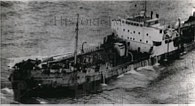
On the night of March 7, 1968, the Greek tanker General Colocotronis was on a laden voyage from Aruba to Palm Beach with oil when she suffered an engine failure in heavy weather and was stranded on the eastern shore of Eleuthera.
The ship, built in 1955 by Smith’s Dock Co, UK, was refloated, had the balance of her cargo discharged, and was sunk, or scuttled, in deeper water nearly two months later, on April 30.
Owned by Astro Constante Navigation of Piraeus, Greece, the tanker ran onto the reef about 1.5 miles east of Governor’s Harbour due to engine failure in bad weather, with a cargo of Venezuelan crude oil.
According to the US environmental agency NOAA, “chemical dispersants were first used successfully in the cleanup of the oil spill after the tanker ship General Colocotronis struck a reef outside Eleuthera and spilled 37,500 barrels.
Equipped with a diesel motor, the tanker was 11,916 gross tons, 555’ long by 71.5’ wide and made of steel.
The failed engine was a 7-cylinder 2SCSA diesel made my John Kincaid of Greenock, Scotland with a single shaft and propeller which pushed her at 14 knots.
The incident was caused by “a dead engine caused by a broken fuel line compounded by a flooded engine room”.
A casaulty report stats that “at the time of the impact, she was carrying nearly six million gallons in heavy seas. Twenty eight crew members made it to shore. One rescue boat from Hatchet Bay was overturned by a wave, dumping its four [occupants] into the sea. A US Coast Guard helicopter dropped a life raft, into which three of the men were able to climb, although the fourth man (crew member Stratos Mastroitainis) was washed away. …General Colocotronis began to split at the seam, and oil leaking from the tanker quickly washed onto a three-mile stretch of beach near the wreck”.
A tug boat stood by, waiting for 20-foot ocean waves to subside. Detergents were flown in from Florida to emulsify the spill.
Over six weeks, Esso Margarita and Rescue pumped 3.5 million gallons of sticky and gummed-up oil, using heating coils to make it easier to pump.
The violence of the grounding so seriously damaged the hull that about 37,000 barrels escaped the ship.
Most of the roughly 2.5 million gallons lost washed out to sea or was caught in the reefs, reducing the quanity of oil that reached Eleuthera’s beaches.
A photo taken on the first day from a helicopter shows waves running over the top deck and crashing over the hull.
The captain described how he “and a radio operator remained on board the ship, which is spilling oil on remote beaches of this Bahamian ‘out island’.” In a stressful salvage effort, “approximately 72,500 barrels of oil were pumped from the vessel. Steam lines were rigged to heat the cargo to facilitate pumping. Moving the salvage vessels into position and offloading …was performed during extremely severe weather. Dive surveys reported that the keel was crushed and buckled, and that there was extensive damage to the hull …the only feasible action was to sink” her.
To carry out this decision, “the cargo tanks were flushed with dispersants to remove the residual oil. The vessel was then towed out to deep water and sunk”.
According to ITOPF, the International Tanker Owners Pollution Fund, the “total amount at risk of spill was 1,550,000 gallons, and oil washed onto the pink beaches of Eleuthera Island today ….on a reef near Point James,” in US Coast Guard District 7. Without its cargo, the tanker was refloated, towed out to sea, and scuttled more than 50 nautical miles east of Eleuthera.
Also known as the Egg Island Wreck, the Arimoroa was a 260-foot freighter that was purposely run aground ablaze in May of 1970.
The wreck still sticks above the surface, its hull in shallow water with marine life aggregating around it.
The Lebanese steel-hulled freighter was en route from South America to Europe when a fire started in her galley, and “spread with such speed and fury that her captain decided to save the crew by heading at full steam toward the nearest visible land, Egg Island”, west of Royal Island and Spanish Wells. Arimoroa was carrying guano-based fertiliser as cargo, and her entire crew were able to land uninjured.
Most of these cargos originate on desolate guano mines on the west coast of Chile, at the windsept dry base of the Andes Mountains. Fires originating in greasy galley vents used around the clock are a common cause of ship fires.
To show the extent of danger posed by the fire, it continued on this vessel for nearly three months after the crew abandoned ship.
Because ocean water flushed in and out of the high-phosphate cargo, the reefs around the wreck were poisoined and toxic for years.
Scientists from Florida Institute of Technology, Rosenstiel School and University of Miami are fascinated by the burgeoning of fish species in unusually high concentrations, including gray angel fish, large parrot fish, yellow stingrays, groupers, and snappers – overall 60 species.
According to diving experts and author Daniel Berg, “some specialists say that it’s due to the organic qualities of her fertilizer cargo”.
The remains of the ship are still visible today, as it sits upright on the sea floor in about 25’ of water. According to Berg’s guide to diving, the ship almost looks serene, with machinery, hull plates and winches on the limestone sea floor around it.
From the nearby settlement of Current, 7 miles away, Arimoroa looked like a ship permanently at anchor, and was a familiar waypoint and sight for two decades.
Then in August 1992 Hurricane Andrew devastated the area, and broke the ship’s hull in half, so that today, only the bow can still be seen above water.
In the intervening years salvors and scrap dealers removed her propeller and other parts. Another name for this dive site is the Freighter Wreck, and some elements lie just three feet underwater, invisible from the surface.




Comments
Use the comment form below to begin a discussion about this content.
Sign in to comment
OpenID