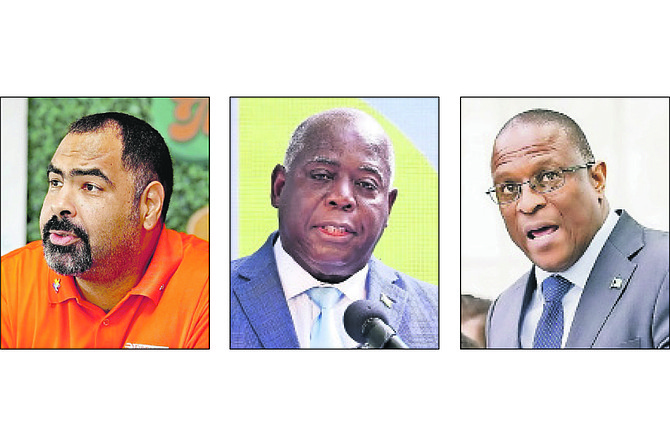
Gowon Bowe Philip Davis KC Michael Pintard
By NEIL HARTNELL
Tribune Business Editor
nhartnell@tribunemedia.net
The controversy over the Government’s $137.5m April deficit reversal was yesterday branded “a tempest in a tea cup” amid fears it will undermine The Bahamas’ credibility with investors and rating agencies.
Gowon Bowe, Fidelity Bank (Bahamas) chief executive, told Tribune Business that Wednesday’s House of Assembly row over the Prime Minster’s flawed fiscal prediction for April is akin to “agonising over something that has no relevance any more” for the likes of Moody’s and Standard & Poor’s (S&P) as well as the wider international capital markets.
He argued that both credit rating agencies, as well as multilateral agencies such as the International Monetary Fund (IMF) and existing holders of The Bahamas’ sovereign debt, will have long moved past April’s performance to focus on the more important 2024-2025 full-year fiscal outcome and any implications for the $75.5m Budget surplus projected for 2025-2026.
Branding the House of Assembly as “the new Shirley Street Theatre”, Mr Bowe told this newspaper that the back-and-forth between Philip Davis KC and Opposition members “really has no bearing” on how the global capital markets views The Bahamas’ creditworthiness while describing events as “poor entertainment because it was not all that entertaining”.
Still, he reiterated his call for “accountability” over how the $135.4m April surplus that was forecast by the Prime Minister in his 2025-2026 Budget communication became a $2.1m deficit in the Ministry of Finance’s April performance report released less than two months later.
Pointing out that Mr Davis, as The Bahamas’ “chief executive and chief financial officer” in his roles as prime minister and minister of finance, “has a fiduciary duty to be accurate in his reports and communications”, Mr Bowe added that the Government needed to explain why there was such a wide variance between the April forecast and outcome.
The Fidelity chief said it must address whether there was an error in the financial information provided to Mr Davis by the Ministry of Finance or if there was a mistake by the writers who crafted the Budget address. And it must also outline what systems and actions it is taking to avoid any repeat as The Bahamas cannot afford for external investors to ignore, or no longer rely on, the financial data it provides.
Mr Bowe spoke out after the Prime Minister, in response to Opposition charges, denied ever saying that “preliminary data” showed a projected $135.4m surplus for April 2025. This was despite him clearly stating this during the end-May Budget presentation, and the fact that both the figure and his words are set out on page 30 of the actual communication which is posed on multiple government websites.
Both Tribune Business and the Nassau Guardian published details of the discrepancy between Mr Davis’ rosy projection and the actual $2.1m deficit outcome once the Ministry of Finance report was published. The Government later blamed the variation largely on not recognising interest payments due on its various debt securities, which it asserted had yet to be posted by the Public Treasury.
However, sources familiar with government debt operations later cast doubt on the validity of this explanation as the Government’s debt servicing costs, the timing of these payments, and on which instruments are well known at the start of every fiscal year. They argued that, even if the Public Treasury had not posted them, the extent of such expenditure would be known by the Ministry of Finance.
Mr Davis, on Wednesday night, appeared to insert a new explanation into the debate by suggesting that the $135.4m figure referred to a “primary” surplus as opposed to a full surplus under the GFS definition employed by The Bahamas.
A “primary” surplus strips out interest payments, or debt servicing costs, from the calculation while the GFS measurement does not. However, the word “primary” was never used by Mr Davis during his end-May Budget communication in reference to the April 2025 fiscal performance, and it does not appear in his written speech either in connection with that month.
Michael Pintard, the Opposition’s leader, yesterday asserted that the Free National Movement (FNM) is “very concerned” that the April variation, as well as the multiple different explanations given by Mr Davis, threaten to undermine The Bahamas’ credibility and reputation with the credit rating agencies and international capital markets. And this, he indicated, could hit the country’s creditworthiness.
“We are very concerned about the impact of his statements both within the country as well as internationally, whether they are multilateral agencies or rating agencies,” Mr Pintard said. “The Prime Minister is not only speaking in his capacity as prime minister but as minister of finance...
“It goes to credibility. It is incredible that he would double down in this way. It’s hurtful to our reputation.” Mr Pintard argued that the situation is “worrisome and tragic”, and alleged that it was part of “a pattern of behaviour” by a Davis administration that never wants to admit publicly that it has made a mistake.
But Mr Bowe, while calling for government “accountability” over the April surplus/deficit controversy, argued that it is being overblown and is unlikely to impact The Bahamas’ creditworthiness or how the international capital markets perceive this nation.
“Our House of Assembly is the new Shirley Street Theatre, and it really has no bearing or substantial significance and interest that investors pay attention to,” he told Tribune Business. “It’s one our politicians need to address. Parliament is where legislation is crafted and policy for the country is to be developed.
“It’s turned it into a theatrical performance with no clear puppeteer because you’re not sure who’s driving what performance.” Mr Bowe described Wednesday’s back-and-forth between the Government and Opposition as “just a comedy show” and “poor entertainment because it’s not all that entertaining”.
Still, he added: “It’s not to downplay the significance of the utterances of the chief financial officer and chief executive officer of the country. He has a fiduciary duty to be accurate in his reporting and communications... It was very clear that, as minister of finance, he made certain statements and this is where there should be accountability.”
Mr Bowe again questioned whether Ministry of Finance officials “in their exuberance” provided inaccurate or misleading data to the Prime Minister for his Budget communications, or if this had been misrepresented by the speech writers who wrote it.
“He needs to be accountable, and he needs to articulate and clarify what the error was in the information provided to him, and how it was woven into his speech,” the Fidelity Bank (Bahamas) chief executive said. “He also needs to say what action is being taken to ensure it never happens again.
“Accountability, where someone’s job performance has been negatively assessed as a result of this. But what systems and processes are being introduced as quality assurance, where the speech is vetted by qualified persons performing, in effect a mini-audit. They should not take this lightly in correcting the error made and demonstrating that it will not reoccur because we’re talking about the public finances.”
Mr Bowe said the April 2025 outcome is likely to have made little impression on investors, creditors and analysts covering The Bahamas given that the fourth quarter of the fiscal year into which the month falls has historically been one in which the Government runs large deficits. The $137.5m reversal, and $2.1m deficit outcome, are thus unlikely to have altered the bigger picture outcome much.
“I don’t think this is a situation more than a tempest in a tea cup,” he told Tribune Business, “but if they don’t consider it misrepresentation, whether it’s intentional or not, there will be a knock-on effect where outsiders disregard or ignore what’s going on in the House of Assembly.
“That will be a dangerous situation as we don’t want outsiders not to rely on information coming out of the country. The Shirley Street Theatre needs to end.” Mr Bowe said the credit rating agencies, creditors and investors - local and foreign - will by now have long moved past April and be more focused on the 2024-2025 full-year outcome and this current fiscal year.
“For most investors this is not even the news lining the garbage can; this is the news already thrown out in the trash,” he added of the April controversy. “They are looking for the full-year results. We are now almost six weeks past year-end.
“There’s going to be great attention on the actual fiscal performance for 2024-2025, and assessment and analysis of lots of factors, including projections for 2025-2026 and whether they can withstand the challenges and cut the mustard.”
Footnote
Reversal Page XX
Headline
Can 2025-2026 surplus
forecast ‘cut the mustard’




Comments
Use the comment form below to begin a discussion about this content.
Sign in to comment
OpenID