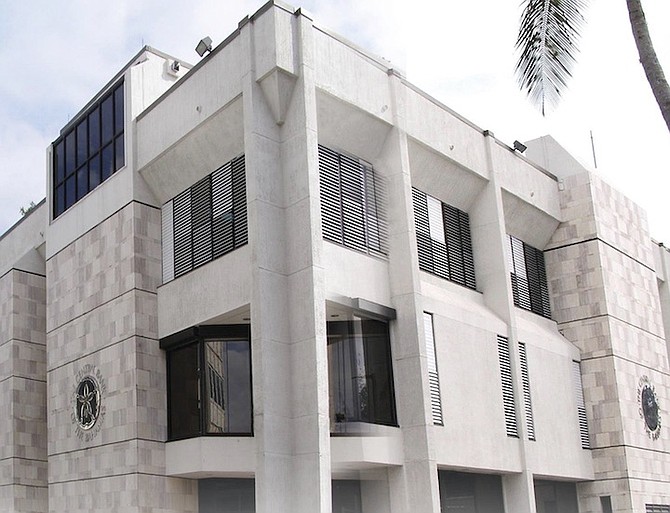
The Central Bank of the Bahamas.
By Neil Hartnell
Tribune Business Editor
nhartnell@tribunemedia.net
Bahamian commercial banks enjoyed a near-$40m year-over-year increase in collective profits during the 2025 second quarter aided by commission and foreign exchange fees “more than doubling” against 2024 comparatives.
The Central Bank, in its quarterly review covering the three months to end-September 2025, disclosed that its commercial bank licensees - the likes of Royal Bank of Canada, CIBC and Scotiabank, as well as Bahamian-owned entities such as Commonwealth Bank and Fidelity - saw their combined net income surge by 381 percent compared to the prior year’s second quarter.
“During the second quarter, the latest period for which data was available, banks’ net income expanded by $39.8m (38.1 percent) to $144.4m vis-à-vis the second quarter of 2024, owing primarily to a rise in non-interest income,” the Central Bank said. “The net interest margin rose by $4.6m (3.1 percent) to $155.1m, reflecting a $4.5m (2.8 percent) increase in interest income, and a $0.1m (1.5 percent) decrease in interest expenses.
“In addition, income from commission and foreign exchange fees more than doubled to $47.4m from $20.9m, resulting in a $31.1m (18.2 percent) growth in the gross earnings margin to $202.5m.” This also occurred amid widening bank interest rate spreads, which expanded by 37 basis points or 0.37 percentage points during the three months to end-September 2025.
Depositors, in general, were earning little to nothing by placing money with the banks. “The weighted average interest rate spread at commercial banks widened by 37 basis points to 10.81 percent in the third quarter. In particular, the weighted average lending rate firmed by 33 basis points to 11.37 percent, while the weighted mean deposit rate declined by four basis points to 0.56 percent,” the Central Bank added,
“On the lending side, the average overdraft rate rose by 43 basis points to 11.46 percent, and for consumer loans by 27 basis points to 12.95 percent. In contrast, the commercial mortgage rate narrowed by 1.1 percentage points to 5.95 percent, and the average residential mortgage rate by three basis points to 5.17 percent.
“With regard to funding, demand deposits rate remained unchanged at 0.25 percent, while the savings deposits rate rose one basis point to 0.27 percent. Conversely, the average range of interest offered on fixed deposits shifted slightly lower from 0.26 percent to 1.5 percent to 0.26 percent to 1.47% percent.”
Some of the banks’ increased profitability appeared to benefit their staff. “Non-interest expenses rose by $3.1m (2.4 percent) to $134.8m,” the Central Bank said of the 2025 second quarter. “Leading this outcome, staff outlays grew by $3.4m (7.8 percent) to $47.3m, while occupancy costs increased by $1.1m (47.8 percent) to $3.5m.
“In contrast, non-staff related costs, including professional and rental fees, declined by $1.4m (1.6 percent) to $83.9m. Further, banks’ other net earnings on their ‘non-core’ activities expanded by $11.9m (18.3 percent) to $76.6m as their provisions for bad debt declined by $6.5m. Meanwhile, other ‘non-interest’ income rose by $5m (7.1 percent), while depreciation costs fell by $0.4m (6.1 percent).”
Citing the boost to bank profitability, the Central Bank added: “As a percentage of average assets, the gross earnings margin firmed by 70 basis points to 6.43 percent as the commission and foreign exchange income ratio rose by 80 basis points to 1.5 percent, while the interest margin declined by 11 basis points to 4.92 percent.
“Further, the net earnings margin firmed by 82 basis points to 2.15 percent, while the operating costs margin narrowed by 12 basis points to 4.28 percent. Overall, the net income (return on assets) ratio rose by 1.1 percentage points to 4.58 percent after accounting for a rise in other income sources, along with an increase in interest income and a reduction bad debt expense.”
Amid the profits increase, Bahamian commercial banks also enjoyed an improvement in their level of bad loans and ratios which was aided by delinquency write-offs. “In particular, total private sector loan arrears decreased by $13.5m (2.9 percent) over the review quarter, and by $32.3m (6.7 percent) on an annual basis to $451.8m,” the Central Bank said.
“The corresponding arrears to total private sector loans ratio fell by 34 basis points over the quarter, and by 1.1 percentage points on a yearly basis to 7.6 percent. An analysis by age of delinquency revealed that short-term arrears (31 to 90 days) reduced by $13.5m (8.9 percent) to $138.7m, while theratio arrears to associated loans narrowed by 27 basis points to 2.3 percent.
“Meanwhile, non-performing loans (NPLs) - arrears in excess of 90 days and on which banks have ceased accruing interest - were relatively unchanged at $313.1m, with the attendant ratio remaining at 5.3 percent. The quarterly reduction in private sector loan arrears was led by an $11.8m (4.1 percent) retrenchment in mortgages, with the corresponding ratio declining by 52 basis points to 10.9 percent,” the regulator added.
“Similarly, consumer arrears declined by $3.1 million (2.5 percent), and the associated ratio by 25 basis points to 5.7 percent. In contrast, commercial delinquencies rose by $1.5m (3.1 percent) with the relevant ratio unchanged at 4 percent of total private sector loans.”




Comments
Use the comment form below to begin a discussion about this content.
Sign in to comment
OpenID