By Neil Hartnell
Tribune Business Editor
nhartnell@tribunemedia.net
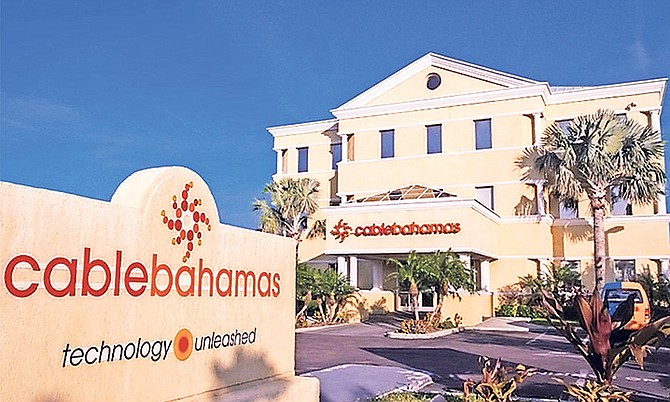
Cable Bahamas’ top executive says he is “unaware” of any proposal for a merger with the Bahamas Telecommunications Company (BTC) and there have been no talks or discussions on such a plan.
Franklyn Butler, the BISX-listed provider’s president and chief executive, told Tribune Business he had no knowledge of any call for a merger, or some form of joint venture, between the two Bahamian communications industry giants to create a so-called ‘national champion’ and better finance the roll-out of fifth generation (5G) mobile technology and services.
“I am not aware of any proposal or discussions,” the Cable Bahamas chief said, declining to comment further because he had not seen the details. Reports on Friday asserted that the proposal had originated from Liberty Latin America, BTC’s ultimate parent and owner of Cable & Wireless Communications (CWC), the latter of which holds a controlling interest in the Bahamian carrier. A BTC spokesperson last night said it had “no comment at this time”.
However, the leaders of both BTC’s management and line staff unions argued that the proposal “doesn’t make sense” because, if approved and implemented, it would mean returning to a communications monopoly and represent the reversal of a decade or more of pro-competition, pro-consumer policies by the Government.
Kenny Knowles, the Bahamas Communications and Public Managers Union’s (BCPMU) president, told this newspaper that he and the union will raise the ‘merger’ proposal in upcoming meetings they are scheduled to have with Prime Minister Philip Davis KC as they were unaware of its existence until Friday.
“I was really curious about it because it was never mentioned anywhere else,” Mr Knowles said. “There’s been no official confirmation or statement about it. There’s been nothing that we’ve heard internally in BTC. I just question that as rumours.
“We had met with the Prime Minister prior to this, and there was no mention about it. At the end of the day, it would result in another monopoly. I don’t think that makes sense. If that’s the direction the Government wants to go, it doesn’t make sense if the Government wants to go into another monopoly.
“We have a follow-up meeting with the Prime Minister coming out of our trade dispute matter, and this is something we intend to ask him about; if this is the direction they are going in,” the union chief added. “This is something the union definitely intends to follow-up on and ask the Prime Minister about when we have the next meeting with him.
“This one is a wait and see, but we definitely will be following to see if this is the direction that the Government wants to go in. It will be interesting to see. We wait to see where the fire’s at.”
Sherry Benjamin, the Bahamas Communications and Public Officers Union’s (BCPOU) president, which represents BTC line staff, echoed similar sentiments to Mr Knowles while adding that any merger would make it easier for the union to represent workers at Cable Bahamas and Aliv.
“We heard the rumours about it, but have not been made aware of any merger between the companies,” Ms Benjamin told Tribune Business. “We have not been informed about it, and cannot speak to anything. I’ve heard rumours about it, but as far as coming from any credible source, it’s just rumours floating around.
“I don’t know if this is likely to happen. We have not heard from any of the companies that there was even a plan of that nature - to have some form of joint venture or anything. I’ve not heard from anyone on the BTC side, anyone in executive management.
“I don’t know what the intent or agenda is, but if there is a merger between these entities we go right back to square one with a monopoly in communications,” Ms Benjamin added. “How it will work, I don’t know.
“But for the people at Cable Bahamas, it would be better because they will not be able to deny them [union] representation any longer. From our standpoint, we’ve had bargaining rights for the staff at Cable Bahamas since the late 1990s, but we’ve been unable to sit at the table and get a contract for them. If they merge, that falls away.”
Asserting that “where there’s smoke, there’s fire; the blaze has not just spread high enough to see”, Ms Benjamin added of the proposal: “It is an interesting idea, plan, whatever, and hopefully they’ll have a sit down with us if it’s something they plan on doing and have that discussion. At this point, we’ve not had that discussion with them and nobody has mentioned this is something they’d like to do.”
The report on Liberty Latin America’s purported proposal, dubbed ‘Project Bond’, was difficult to decode and determine what, if anything, is planned. The article, which appeared in the Bahama Journal, initially described a merger involving BTC, Cable Bahamas and the latter’s mobile affiliate, Aliv, via a holding company, called Liberty Newco, to create one Bahamian communications giant.
However, it then gave the impression that what is being proposed is a joint venture to finance the roll-out of 5G infrastructure and technology. “The combination of BTC, Cable Bahamas and Aliv enables investment into Next Gen (next generation) technology with a faster and wider FTTH (fibre-to-the-home) and 5G roll out than possible if advanced independently,” the proposal to the Government allegedly said.
The rationale in favour of the proposal was cited as improved digital access and inclusion for all Bahamians; enhanced Family Islands services; greater network resilience against hurricanes and climate change-related impacts; and a greater role for the Government, which would enjoy increased income through higher dividend payments.
Among the ownership structures purportedly mulled for Liberty Newco was one where the Government had the largest equity stake of 46 percent; Liberty Latin America would own 33 percent, and Cable Bahamas just 21 percent. “The combination creates a scaled Bahamian-led regional hub with$450m revenue and $150m operating free cash flow post-synergies, generating scale benefits and flexibility,” the proposal allegedly argued.
The article had all the appearances of a ‘government plant’ designed to ‘test the waters’ and gauge both public and industry reaction. Even if the proposal is genuine, and the Government be minded to adopt it in some form, multiple obstacles must be overcome to bring it into effect and significant work would be required from all parties involved.
For starters, such a deal would have to be approved by the Government, the Utilities Regulation and Competition Authority (URCA) and Cable Bahamas’ shareholders. The latter would probably have to vote in favour of it at an extraordinary general meeting (EGM), and are unlikely to accept a minority stake that would leave Cable Bahamas/Aliv as the most junior partner.
This is especially since Cable Bahamas and Aliv are bigger by revenue and market share, having generated a $242m-plus top-line for the financial year to end-June 2025 whereas BTC’s annual revenues are in the $200m range. It is likely that the BISX-listed communications provider would seek a greater equity ownership interest than BTC/Liberty Latin America.
The Government, meanwhile, is also in something of a conflicted position by having ownership interests in all three major communications players. Apart from a minority 49 percent interest in BTC, it also owns a majority 51.75 percent stake in Aliv, albeit Cable Bahamas has Board and management control. And the Government is, in effect, Cable Bahamas’ largest shareholder through the National Insurance Board’s 21.6 percent equity stake.
But, perhaps more important, the creation of a single communications entity would appear to herald a return to the old days of an industry monopoly and not be in the best interests of Bahamian consumers, businesses and the wider economy’s competitiveness in the 21st century digital economy.
The Bahamian experience of communications monopolies, especially in the old BaTelCo days, is of slow, inefficient and unresponsive companies that place the staff above customer needs, while offering high-priced products and services that limit economic growth and competitiveness.
BTC’s privatisation in 2011 was a major step towards liberalisation and deregulation of Bahamian communications, which resulted in Aliv’s November 2016 launch and an end to BTC’s mobile exclusivity. This was designed to offer consumers better choice and pricing, with the ability to switch seamlessly between service providers, while incentivising greater investment in improved products and services.
And the proposal would also appear to run counter to The Bahamas’ own electronic communications sector policy 2024-2027 plus the Communications Act, which sets as one of the Government’s legal policy objectives “encouraging, promoting and enforcing sustainable competition in the sector”. What has been suggested, on the face of it, could be deemed anti-competitive.
And the proposal to create a so-called national communications champion with regional scale would, if implemented, in effect result in different Liberty Latin America subsidiaries competing against each other given that, via CWC, its Liberty Caribbean affiliate is present in other multiple regional territories.
Liberty Latin America’s recent financial results announcements, filings with the US Securities & Exchange Commission (SEC) and its recent news releases also make no mention of the proposal. However, the ‘leak’ will likely fuel speculation that it may be seeking an exit route from The Bahamas and BTC, even though this nation has strategic value as the closest link to the US on fibre optic subsea cables carrying massive data traffic volumes.




Comments
birdiestrachan 2 months, 2 weeks ago
The Fnm papa gave Btc away. And Btc has been in a down fall ever since so many have given up their land phones. So many calls do not go through. The Sim cards do not work then they take the number from you. How long will they last ?? Who knows.
Sign in to comment
OpenID