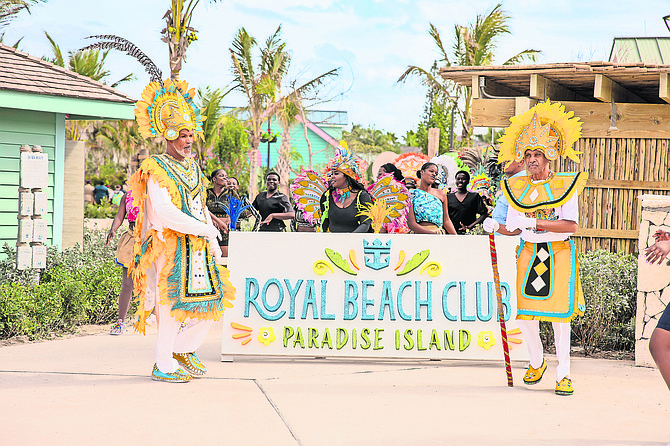
JUNKANOO among the festivities during the opening ceremony for Royal Beach Club on Paradise Island on December 13, 2025.
By Fay Simmons
Tribune Business Reporter
jsimmons@tribunemedia.net
Royal Caribbean’s long-awaited Paradise Island beach break destination has opened employing more than 500 Bahamians in management, hospitality, entertainment and food and beverage operations.
Prime Minister Philip Davis KC, speaking at Saturday’s formal opening, said the project will give Bahamians a tangible equity ownership in the tourism sector - the country’s largest industry. While Royal Caribbean holds a 51 percent majority stake, the Government and Bahamian investors will ultimately own the remaining 49 percent while 1 percent of revenues generated by the project will be directed to the Tourism Development Fund.
“In a first-of-its-kind partnership, the Bahamian people will own 49 percent of the Royal Beach Club Paradise Island. That matters because ownership changes the relationship between a country and a development,” said Mr Davis.
“Ownership means Bahamians are not standing outside watching success pass by. Ownership means the country has a stake that connects performance to public benefit.”
Chester Cooper, deputy prime minister and minister of tourism, investments and aviation, said the project will give Bahamians both employment and a meaningful ownership stake in the success of the Royal Beach Club - the first destination of this kind to be developed by the cruise line.
He added that the development was designed with the interests of the Bahamian people in mind as the local ownership component gives citizens a real and tangible share in its economic benefits.
“Today, we stand on the grounds of a development that represents a new model of partnership in our tourism sector. For the first time, Bahamians will hold a 49 percent ownership stake in a major tourism project of this nation that gives our people a real and tangible stake in the revenues generated here,” said Mr Cooper.
“Bahamians will be owners and beneficiaries, not just observers of economic activity happening around them. Just as important is the fact that every business operating at this site is Bahamian-owned. Local entrepreneurs, vendors, artisans and service providers will have direct access to the opportunities created here.”
Concerns, though, still linger over whether the Royal Beach Club will suck much-needed tourists and passenger spending away from downtown Nassau, Bay Street and other cruise-dependent businesses who rely on the industry for their livelihoods.
Both Royal Caribbean and others, though, have argued that the 2,900 passenger-capacity Royal Beach Club represents just a fraction of both the visitors it will bring to Nassau itself. And, when six ships are in port, there are around 30,000 passengers brought to the city by itself and other cruise lines.
Royal Caribbean’s argument is that there will be sufficient business to go around for all, and the Royal Beach Club effectively locks it into using Nassau as a port of call for decades to come.
Mr Cooper, noting that a portion of the Royal Beach Club’s revenue will be directed to the Tourism Development Fund, said the project “sets the new benchmark” and ensures the benefits of tourism are reinvested directly into local communities, supporting sustainable growth and long-term development.
“This sets the new benchmark for responsible tourism. Importantly, 1 percent of annual growth profits from this development will be directed to the Tourism Development Fund to improve attractions and experiences across the islands of The Bahamas. This ensures that the benefits of tourism are reinvested directly into communities,” he added.
Philip Simon, president of Royal Caribbean Bahamas and its Royal Beach Club project, stressed the project’s commitment to creating meaningful employment opportunities for Bahamians.
He said developers ensured Bahamian contractors were hired during construction and, now that the project is operational, more than 550 locals are employed.
“We said this project would be built by Bahamians and with Bahamians, and we kept that promise. During construction, we hired 100 percent Bahamian contractors, and today, more than 550 Bahamians are now part of the Royal Beach Club, Paradise Island team, working in hospitality, entertainment, food and beverage operations and more,” said Mr Simon.




Comments
truetruebahamian 2 months, 2 weeks ago
The Prime Minister said that this disastrous thing was being built by Bahamians. Wrong, they were and are Mexicans!
TalRussell 2 months, 2 weeks ago
They’re a government in denial. Most popoulaces' are not out looking buying shares in a tangible equity ownership. It's not only the poor hurting. 3 out every 4 families are unable to buy full week groceries' --- *nor be included exceptn - must pay higher prices for lil grocercies they's do has buy are to be included amongst Grocerman's Rupert Roberts, Super Value targeting a 5-10 percent year-over-year increase in Christmas and holiday season groceries' sales
DonAnthony 2 months, 2 weeks ago
Well done. Let this project be the template going forward: always give Bahamians the opportunity to have equity ownership in these tourism projects. The cruise port is a resounding success, half owned by Bahamians and I expect the beach club to be likewise.
TalRussell 2 months, 2 weeks ago
@ComradeDonAnthony, may I query as to:--*"Who exactly are The Port's half owned set Bahamians?"
DonAnthony 2 months, 2 weeks ago
Dearest most esteemed comrade, compliments of the season to you and yours. There are over 3000 Bahamian shareholders in the cruise port.
TalRussell 2 months, 2 weeks ago
True or false? Not a single one of your 3000 Bahamian shareholders, hold even a single share in Arawak Cay's operator itself?
DonAnthony 2 months, 2 weeks ago
False
TalRussell 2 months, 2 weeks ago
"Tis as false is replacement denture." Produce copy Share Certificate, says tis so.
ThisIsOurs 2 months, 1 week ago
I suspect what's being asked is, is there a holding company that "Arawak Port" pays operation "costs" l, previously known as "profits", to. I dont know. But this is a common setup that foreign entities use to understate profit.
Dawes 2 months, 1 week ago
Until Government allows Bahamians to invest in that 49% i won't take this as good news. If the Government keeps that 49% the Bahamian people will not see the benefits
realitycheck242 2 months, 1 week ago
When the IPO takes place it will be the first time a PLP government got the investment formular right. (RCI 51%, Gov/Bahamians 49%) All other times a FNM gov was in power.
Sign in to comment
OpenID