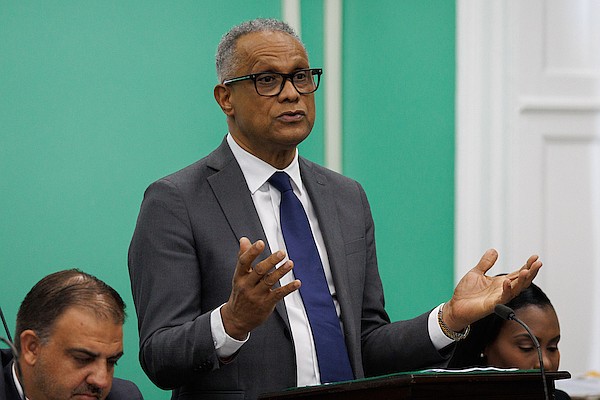
Minister of Health and Wellness Dr Michael Darville speaks in the House of Assembly on July 30, 2025. Photo: Dante Carrer/Tribune Staff
By Neil Hartnell
Tribune Business Editor
nhartnell@tribunemedia.net
Imposing just a “nominal” 50 cent tax on sugary drinks would raise “millions” towards closing The Bahamas’ public healthcare financing shortfall, a Cabinet minister disclosed yesterday, while asserting of the new National Health Strategy: “It’s not a pie in the sky wish list.”
Dr Michael Darville, minister of health and wellness, told Tribune Business via a series of messaged replies to this newspaper that levying extra taxation on alcohol and tobacco products - as well as sugary drinks - “in such a way that they impact the affordability of these vices” - remains one option open to the Government for closing a healthcare funding deficit that is estimated to be at $24m in the upcoming 2026-2027 fiscal year.
He added that studies conducted in partnership with the World Health Organisation (WHO) and World Bank have already been conducted to determine how much revenue could be generated from a tax specifically focused on sugary drinks, which are viewed as significant contributors to the high level of diabetes, obesity and other chronic non-communicable diseases (NCDs) that Bahamians are currently suffering from.
Governments worldwide typically impose relatively high tax rates on so-called ‘sin’ products, such as alcohol and tobacco, both in a bid to curb their consumption on health and social grounds as well as a mechanism to raise revenue because demand will remain high despite the higher cost. Dr Darville, though, said “health insurance contributions” as well as public-private partnerships (PPPs) are other potential tools to close the funding gap.
And, while acknowledging that the National Health Strategy 2026-2030 is “ambitious”, he argued that it had no choice but to be crafted as such given the challenges facing The Bahamas, and described the numerous goals as “practical and achievable” if all stakeholders work together. The minister added that reaching them will also require Bahamians to make “some uncomfortable decisions” about their collective health and well-being.
The full National Health Strategy Report, which was released to the wider Bahamian medical community last week, warned that financing for Bahamian public healthcare is “on an unsustainable track” with a $24m annual deficit predicted by the upcoming 2026-2027 fiscal year, with this shortfall set to worsen due to an increasingly elderly population.
It disclosed that this widening financing gap - which is forecast despite a total $35.3m increase in the Ministry of Health and Wellness’ budget allocation for the current 2025-2026 fiscal year - threatens to expand inequality and “impoverishment” by forcing more families to fund medical care from their own funds.
To address this shortfall, and improve the public healthcare sector’s financial governance and transparency, the Health Strategy Report sets out a number of goals and ambitions - although it does not lay out an implementation road map or timeline. Among the proposals is to “explore innovative and sustainable revenue sources” such as a “carbon tax, sugar tax” and cruise ship departure levies to diversify funding.
This, the report adds, would also help to increase public health funding such that it would improve from the current 4.6 percent of gross domestic product (GDP) to 5 percent of Bahamian economic output - the latter being regarded as the global standard, or benchmark, for sustainably financing universal health coverage (UHC).
Dr Darville yesterday told Tribune Business several healthcare funding options remain at the Government’s disposal. “Regarding closing the funding gap, the Government may need to explore things such as health insurance contributions; deepening PPPs; leveraging fiscal measures such as taxation on SSBs (sugar-sweetened beverages), alcohol and tobacco in such a way that they impact the affordability of these vices,” he said.
“The Ministry of Health and Wellness has done studies with the support of the World Bank and WHO to understand what revenue can be generated from SSB taxes. With a nominal tax of 50 cents, the collection of funds would be in the millions. This can go a long way to supporting health promoting and disease prevention initiatives.:
Dr Darville did not provide any dollar figures for what could be generated, and it is unclear whether the “health insurance contributions” reference relates to National Health Insurance (NHI) which has increasingly become the main mechanism for providing primary care services offered by the public healthcare sector. The recently-passed NHI Act effectively leaves the door open for contributions by employees and employers.
“The National Health Strategy is a five-year plan with practical actions to improve governance, our equity and health profile, and see reductions in NCD mortality and morbidity. It is also intended to spur greater research and innovation, and realise greater system efficiencies and more sustainable health financing,” Dr Darville told Tribune Business.
“While the strategy is ambitious, as it ought to be, I believe our plan is achievable. It is not a pie in the sky wish list. It is a practical and achievable strategy, which requires all us working together and making some uncomfortable decisions about our personal and collective health and well-being. Our indicator metric will outline the specific targets we hope to achieve by 2030.”
The National Health Strategy Report revealed that seven Family Islands currently lack resident doctors. While data showed The Bahamas had around 1,000 doctors in both the private and public healthcare sectors in 2022, the report added that more than 30 percent are over the 65 year-old retirement age while almost 20 percent of nurses are foreign-born.
“Recruitment delays, limited professional incentives and challenges with workplace culture continue to affect job satisfaction and retention in the public health sector. These factors contribute to workforce instability and hinder efforts to strengthen healthcare delivery,” the National Health Strategy conceded.
“Migration further compounds shortages. Many nurses and physicians trained locally leave after graduation to pursue better pay and career opportunities abroad, particularly in the US, UK and Canada. This trend places additional strain on the system. While overall physician density is moderate, critical gaps persist in specialties such as radiology and public health.
“Rural and underserved areas face severe shortages, with seven Family Islands currently lacking any resident physicians. The absence of a national Human Resources for Health (HRH) plan has limited co-ordinated workforce planning, despite progress in infrastructure and legislation,” the report continued.
“Demographic trends also pose sustainability challenges. More than 30 percent of physicians are aged 65-plus, and nearly 20 percent of nurses are foreign-born, leaving the system heavily reliant on international recruitment. The age dependency ratio is projected to rise steadily, increasing the proportion of older adults relative to the working-age population.
“This shift will place added pressure on workforce capacity and financing, as a smaller contributor base supports a growing number of retirees and older patients with complex health needs.”
Dr Darville yesterday said that while The Bahamas’ healthcare workforce ratio, as a percentage of the population, exceeds the benchmarks recommended by the WHO it still needs to be beefed up as he pledged an end to the “haphazard” approach to training and recruiting healthcare workers.
“While The Bahamas' workforce density of 61.18 per 10,000 exceeds the WHO density of 44.5, it still requires augmentation to address our unique health context. While the Ministry of Health and Wellness and its agencies still are aggressively seeking to augment its health workforce complement, the cadre of workers available to us today are skilled to address the needs of the population,” he told Tribune Business.
“Do we need more physiotherapists, ICU (intensive care unit) nurses etc? Yes. But, this has not crippled our capacity to care for those walking through our doors. In the coming year, my Ministry will accelerate a process to understand the key enablers and barriers for addressing our health workforce realities.
“We intend to use this data to formulate an evidence-informed approach to our health workforce recruitment, retention and planning. We will no longer have a haphazard approach to human resources for health, but an approach rooted in the needs of the people and the workers.”
The National Health Strategy also revealed that recent infant and maternal mortality rates in The Bahamas were above Caribbean healthcare indicators. “Certain population groups experience additional barriers,” it said.
“Maternal and child health indicators remain concerning, with maternal mortality peaking at 248.8 deaths per 100,000 live births in 2021 and infant mortality reaching 29 deaths per 1,000 live births in 2022, both above regional benchmarks. Gender-based violence is under-reported and poorly managed due to the absence of formal care pathways and co-ordination.
“Demographic shifts are reshaping health service demand; declining birth rates - from 14.6 per 1,000 in 2010 to 11.5 in 2024 - and an aging population, up 1.9 percent between 2012 and 2023 with a declining demand for obstetric services, while increasing the need for long- term, geriatric and home-based care,” the National Health Strategy Report continued.
“These trends will add pressure on the health system’s ability to prevent and manage non-communicable diseases (NCDs), as older populations experience higher rates of chronic conditions. Overall, health equity in The Bahamas is challenged by geographic dispersion, financial fragility and service gaps that disproportionately affect rural and vulnerable populations.
“Yet progress is taking shape. NHI is expanding access, digital health tools are advancing, and reforms are laying the groundwork for change. With continued investment in transport, workforce distribution and technology-enabled care, The Bahamas can close critical gaps and build a health system that delivers for every community.
Dr Darville said: “Regarding the health challenges, more than 75 percent of the disease burden and 80 percent of deaths in the country are related to NCDs. Additionally, the elderly population is increasing. And with aging comes specific health needs. That said, the manifestation of NCDs in our population is more about the choices made during life to protect and maintain health.”




Comments
bahamianson 2 months ago
It can raise millions to do what with . These politicians keep getting more money and the Bahamian people keep getting chitty roads, chitty bus service, chitty electricity, chitty WiFi, chitty corrupt politicians, chitty political deals, chitty water service, chitty government worker service, chitty increase taxes, chitty hospital service with chitty long waits etc. stop talking foolishness politician and go home!
whatsup 2 months ago
You are correct, Gov keep taxing us but never solve any problems. Just more corrupt excuses to line their pockets. Nothing ever improves in this country, just gets worse and more expensive
Seaman 2 months ago
How about all MPs taking a damn salary cut.....He needs some sugar...How much more bullshit these fools will come up with.
ThisIsOurs 2 months ago
Lol. This the same argument they push with everything. Just raise the price, we'll make B-illions possibly gazillions.
Sign in to comment
OpenID