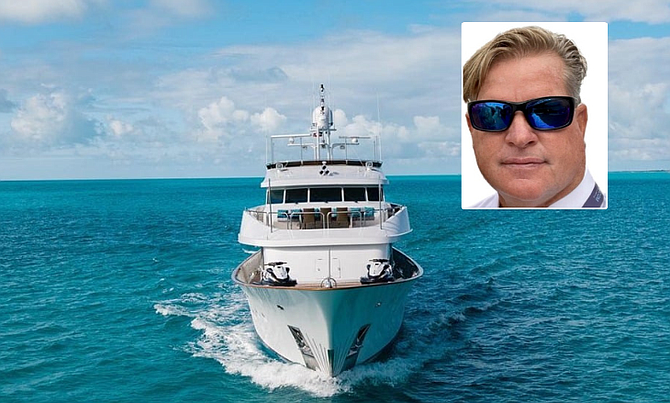
Peter Maury, Association of Bahamas Marinas (ABM) president
By Neil Hartnell
Tribune Business Editor
nhartnell@tribunemedia.net
Bahamian marinas have warned the Prime Minister that up to 1,500 Bahamian jobs are “at risk” from the 40 percent decline in boating traffic amid signs of progress towards an acceptable compromise for both the Government and private sector over the Budget fee hikes.
Peter Maury, president of the Association of Bahamas Marinas (ABM), in a letter to Philip Davis KC’s office that has been seen by Tribune Business, called for reforms that will slash the time taken for visiting vessels to clear Customs and Immigration by up to 87.5 percent as he urged “swift corrective action” to maintain this nation’s competitiveness.
Asserting that more than 60 percent of visiting yacht captains surveyed by the ABM said they were choosing alternatives to The Bahamas because of “the complexity and length of the clearing process”, Mr Maury argued that this nation needs to cut the time required to complete this from up to eight hours down to one by “simplifying and digitising” its systems.
The Association weighed in amid ongoing negotiations between the Ministry of Finance and tourism industry over adjustments to the new and increased fees, as well as cruising permit changes, that accompanied changes to the 2025-2026 Budget and were implemented on July 1. While all sides were last night tight-lipped, and not commenting publicly, this newspaper understands progress is being made following the second of two meetings yesterday.
Well-placed sources confirmed that yesterday’s encounter was a follow-up to last Thursday’s meeting between Simon Wilson, the Ministry of Finance’s financial secretary, and multiple private sector representatives who included Jackson Weech, the Bahamas Hotel and Tourism Association’s (BHTA) president; Don Williams, the Bahamas Chamber of Commerce and Employers Confederation’s (BCCEC) chairman; and Chantelle Sands, the Abaco Chamber of Commerce president.
With boating business “looking quite dismal” for the Christmas/New Year period and peak winter season, this newspaper understands that the private sector supplied a number of recommendations for changes to the two-year frequent digital cruising card (FDCC) and one-year cruising permit. There were also suggestions that the Government introduce a six-month and 30-day cruising permits to accommodate more short-stay visitors.
One contact, speaking on condition of anonymity, added that “a new fee structure” was proposed along with suggestions that the present framework be “suspended” while new levies are slowly rolled-out during the 2026 first quarter. It is unclear, though, whether the Government would accept such a strategy given the precious revenue that would be foregone by the Public Treasury.
Tribune Business understands that the back-and-forth negotiations between Mr Wilson and the same private sector representatives continued yesterday. The meeting is thought to have ended with the tourism and Chamber executives now set to present the outcome of what was discussed to their respective members as early as last night.
They will then report back to Mr Wilson and the Ministry of Finance today and see if an agreement with the Government on any fee and regulatory revisions, plus the way forward for the boating industry, can be sealed. However, even if a consensus is reached, it will likely require the approval of the Davis administration’s Cabinet which, with the Christmas holiday intervening, is unlikely to occur before next week.
“The meeting was very positive,” one source, speaking on condition of anonymity, said of yesterday’s encounter. “The Government is willing to move on what makes sense.” Another added: “There is movement but still can’t comment while negotiating.”
Tribune Business understands that the two sides are seeking to strike a balance, or find the proverbial ‘sweet spot’, where the Government generates sufficient revenue from the boating sector to help finance environmental preservation, marine resources management and ensure visitors pay their fair share in taxes. The private sector, while backing these goals, wants to ensure the level of the fees and how they are introduced does not scare boaters away.
While The Bahamas’ new two-year frequent digital cruising card (FDCC) has gained traction with boaters, others have pointed out that The Bahamas has gone from charging $600 for a cruising permit, which included a fishing permit and no anchorage fee, to a $1,000 cruising permit fee, $350 anchorage fee and $300 per month fishing permit fee.
The ‘temporary’ 12-month cruising permit fee for a vessel below 50 feet in length has risen from $300 to $500, a two-thirds or 66.67 percent rise, with those between 50 feet and 100 feet seeing an increase of similar magnitude from $600 to $1,000. And the new anchorage fees range from $200 to $1,500 “for foreign pleasure vessels not mooring at a marina”, and are again linked to vessel size.
Mr Maury, in his letter to the Prime Minister, warned that the “economic ripple effect” from the $25m revenues lost by Bahamian marinas due to the decline in boating traffic will also slash government taxes by up to $10m from reduced VAT, Business Licence and other income sources.
“I write on behalf of the Association of Bahamas Marinas and the Bahamian-owned marinas, boat yards and marine service businesses we represent to bring to your immediate attention a critical issue that is severely impacting our industry and the broader Bahamian economy,” the ABM president told Mr Davis.
“Recent industry data and marina operator reports indicate that The Bahamas is losing approximately $25m in annual direct marina revenue due to the combination of high taxes, fees and an excessively complicated and time-consuming clearing-in process for cruising yachts and charter vessels.
“This figure does not include the additional multiplier effect on local employment, fuel sales, provisioning, repairs and other marine-related spending and supportive businesses.” Mr Maury said charter yacht calls “at major Bahamian marinas” had declined by 38 percent between 2019 and 2024, with cruising yacht arrivals falling by 42 percent over the same five-year period.
He added that cruising yachts spend an average $18,000 to $22,000 for a seven to 14-day stay at Bahamian marinas, including for the provision of dockage, power, water, fuel, repairs and provisions. And charter yachts spend an average $45,000 to $60,000 per week.
Based on the spending declines, and the 40 percent reduction in boating traffic, Mr Maury wrote: “With approximately 1,800 fewer cruising yachts and 450 fewer charter yachts visiting Bahamian marinas annually compared to 2019, the direct revenue loss to marinas alone is conservatively estimated at $24.5m to $26.3m per year and more in the local economy….
“The $25m direct marina revenue loss translates to approximately 1,200 to 1,500 direct and indirect jobs at risk in the marine sector; $8m to $10m in lost government tax revenue (VAT, Business Licenses and other levies) from reduced visitor spending; a weakened competitive position against regional neighbours, threatening The Bahamas’ status as the premier yachting destination.”
Mr Maury argued that the 10 percent VAT rate imposed on marina dockage, fuel and services “is among the highest in the Caribbean”. He added: “Competing destinations such as the British Virgin Islands, St Maarten and Antigua charge 0–5 percent VAT on similar services.
“The $300 to $2,000 annual cruising permit fee (depending on vessel length), combined with mandatory Immigration and Customs processing fees, anchorage fees and fishing permits adds significant cost.”
Asserting that price is not the only concern, Mr Maury called for a more efficient, seamless and less lengthy clearance process into The Bahamas for visiting boats and yachts.
“Average clearing-in time in The Bahamas is four to eight hours, sometimes requiring overnight stays, compared to 30–90 minutes in competing jurisdictions,” the ABM president argued.
“Over 60 percent of surveyed yacht captains report choosing alternative destinations due to the complexity and length of the clearing process. This results in lost overnight stays, fuel purchases, and provisioning revenue.”
Mr Maury urged the Government to “reverse this trend” by targeting a “maximum one-hour” clearance time by simplifying and digitising the process, as well as the payment of charter licences and fees “at a competitive rate” such as 6 percent. He also called for a “tiered cruising permit fee” with a discount for vessels which spend a minimum number of days in The Bahamas, and a “temporary VAT exemption on marina services for the next 18-24 months to stimulate recovery and regain market share”.
The ABM chief concluded: “The $25m annual revenue loss is not sustainable, and corrective action now will protect jobs, restore competitiveness and ensure that The Bahamas remains the world’s leading yachting destination.”




Comments
birdiestrachan 2 months ago
Mr Maury will find that he is dealing with a wise intelligent Goverment who will look at the facts and do what is best for the Bahamas and it's people.
FreeportFreddy 2 months ago
THAT is one of the most untrue statements EVER typed! Birdie is so far gone its unreal!
whatsup 2 months ago
Birdie got a bird brain
Jetflt 2 months ago
He has no clue what he's talking about. Talk crap all day long!
whatsup 2 months ago
HA HA HA......laughing bird brain birdiestrachan
Jetflt 2 months ago
Mr. Maury will find that he is dealing with an ill informed unintelligent government who has no clue what they're doing and the irreparable harm they are causing to Bahamians. birdiestrachan you must be part of the government.
birdiestrachan 2 months ago
OCTOBER 2025. JAMES FINKl 126 FOOT YACHT.THE ODIN IN Bimini was found with 1000rounds of amunation high powered weapons pistols and shot guns But it seems Maury has problems with clearance. What does Mr maury say about that incident and how many are incidents like this one. Talk about that Neil
Porcupine 2 months ago
Neil is a reporter. He reports, not comments. Many people have a problem with clearance, according to this article. Maybe try and improve on all levels. That's what a professional would do birdie. That's what educated people will do birdie. Maury is not advocating for more guns, he would just like to see Bahamians have jobs. Do you have a job birdie? You certainly couldn't work for me. Too dense and idiotic. Why are our nurses and teachers fleeing this country birdie? Because we have smart leaders who pay these essential workers what they're worth? Clearly not birdie. The smart people have already left and are leaving because there are far too many people like you. People who refuse to use their God given brains.
Porcupine 2 months ago
Hey birdie, Did you miss the article about who is in US custody for importing guns and drugs? Hint; they ain't foreigners. Such a tool.
Porcupine 2 months ago
birdie, You are one clueless, ignorant citizen. Your IQ must rank among the lowest possible and still manage to cross the street unaccompanied. Your comments drag the level of discourse to lows unimaginable to primary school graduates. Clearly, we have one of the most selfish and corrupt leaderships in the western hemisphere. Do you travel birdie? Or, do you stay right here amongst the truly bewildered? This government couldn't care less about its people and are obviously wholly uneducated, from the top on down to someone like yourself. It truly is sad to see that education is the answer to many of our problems and you have less than most every commenter on this site. It doesn't take a genius to see this. Do you not know anyone who can spell, such that maybe someone could take you seriously. No grandkids or neighbors who can spell and make complete sentences? But, you are allowed to vote.
FreeportFreddy 2 months ago
Truth!
DWW 1 month, 3 weeks ago
strawman argument anyone? any takers? oh! ok.
birdiestrachan 2 months ago
Wisdom is far better than all else. There are many educated fools. When will you flee the Bahamas. You came here after 45 years why? Before you flee you Neil and maury check those yatch . It is possible that many guns come into the country on these Yatchs.smarty pants smarter than everybody else. The education one
Porcupine 2 months ago
Ah birdie, And where would that wisdom lie? With you? You make me laugh birdie brain. Are the wise intelligent people fleeing or not birdie? Yes or no. Obviously, you are a political hack. Ignorant, but a hack. Merry Christmas, lovely birdie. Probably call yourself a Christian, too.
Porcupine 2 months ago
Next time you need a doctor, lawyer, or teacher, try a person with no education, but who has your so-called wisdom. That's where we are now, with people like you. And then, we wonder why we are failing on every metric.
ThisIsOurs 2 months ago
"Yatchs"?? Twice? Can a "yatch" carry a gun? Is it cousin to the Yeti?
birdiestrachan 2 months ago
Can you imagine just a few yatchs brining in that amount of fire arms. Of course Neil can address that. If he was not so busy kissing up to maury the want to be bully. The intelligent government will look into the matter and make a wise decision .
birdiestrachan 2 months ago
Stickey one when you are ready to flee let us know by boat.or by plane there will be a rush out and bands to wish you farewell. Glad to see the last of you. Do the Bahamas a favor and flee.
Porcupine 2 months ago
You really think that The Bahamas profits from ignorant people like yourself? Get out more birdie. Do a little reading. it won't hurt you. You do nothing but slow this country down. Just can't see it, can you? Not surprised.
Porcupine 2 months ago
Cat get your tongue, birdie? Still waiting for your well thought out answers. Or, did you leave the country?
Porcupine 2 months ago
Just a few more days for my New Years resolution, birdie. No more spending time commenting with idiots. Then, you can post your stupidity without my opposition. Understand those words, birdie? Your intelligent posts will help this country move forward, onward and upward. Hey birdie, why can't you answer my question? Why are the nurses, teachers and educated people fleeing this country? Come on birdie, answer. Why did we lose 50 nurses in 4 months? Why do we have such a brain drain? Because our smart PLP government would rather import those foreigners? Come on birdie, you can do it. Answer the question in an intelligent manner. Or, ask someone who has gone to primary school. I'll wait.
Jetflt 2 months ago
Government doing what they do best............make life miserable for people by implementing stupid ill informed bureaucratic processes. Just so they can justify someone's government job.
DWW 1 month, 3 weeks ago
always interesting when a failed business model is blamed on relatively minor govt fees. Abaco harbours are full of cruisers. the marinas? not so much. maybe the prices high end marinas are charging are the problem? I saw a post on social media showing dozens of mega yachts hanging on anchor in Exumas. maybe they just bypassed crappy nassau and the crappy marinas and went straight to Exuma? I honestly don't see why the big fuss over a few hundred dollars. US tourist visa fee just went up to $500 per person. For a family of 4 that is $2,000 to visit the USA. but we worried about the billionaires complaining about an extra $500. lets focus on the real issues here like PMH and the high ranking elected govt official that is being sought for massive drug smuggling operation!
DWW 1 month, 3 weeks ago
Hey Maury, what about the libel law suit that disappeared. my friend who blew the whistle on some shenanigans going on in the henhouse maybe wasn't libeling?
Sign in to comment
OpenID