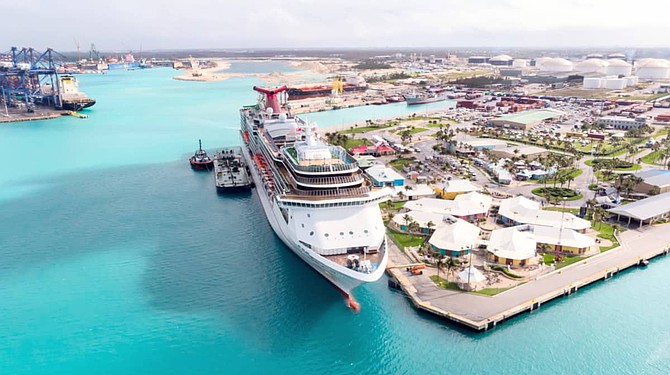
Grand Bahama Cruise Port
By MALCOLM STRACHAN
TALKING about easing immigration rules in The Bahamas is dangerous territory – yet that is where Rupert Hayward ventured last week.
During the Grand Bahama Business Outlook, he spoke of Freeport being held back by excessive red tape, strict immigration policies and regulatory changes, as well as the slow pace of government approvals for projects in the pipeline.
It was the immigration talk that caught the headlines, but overall it was a considered contribution for a man who has been persistent in speaking up for Grand Bahama.
Hayward is an executive director of the Grand Bahama Port Authority – so speaking up for the island is something that should be expected – but he continues to ask questions and raise points that put the island’s needs front and centre.
Recently, he talked about there having been missed opportunities to restore Freeport. He said: “Freeport, unlike other islands, was and needs to be an international, commercial hub for diverse foreign direct investment, which is why ‘ease of doing business’ is important.”
That need could hardly be more timely. Our international landscape is shifting, with US President Donald Trump’s fondness for using tariffs as a blunt tool to get what he wants likely to affect our cost of living here.
A Tribune article last week noted the obvious outcome for example of a rise in the cost of egg prices – with bakeries looking to pass on the increased costs they face to consumers as well. One high price inflates another, and another and so on.
The cost of eggs is not coming from tariffs, but from a shortage caused by cases of bird flu. But it is a daily pointer to the consequences of the effects of price rises.
Wait until those tariffs on Mexico and Canada kick in and see the effect on a range of goods that we import that originate from those nations and pass through the US before coming to us.
If Grand Bahama had developed into that thriving international hub, we would have had some measure of insulation from such turbulence, as well as the extra opportunities that such a port could offer. We’re not there – but maybe we should be.
As for the immigration aspect, Grand Bahama has singular potential that other islands do not.
There is land, there is a measure of infrastructure that would allow significant new construction – but what is notably lacking is the quantity of manpower that major new businesses would need.
Is it such a bad thing to consider bringing in wholesale entire industries? Offering Grand Bahama as a perfect location for remote or outsourced working? And if we do not have the technical skills in our workforce, permitting the necessary immigration while ensuring Bahamians can make the most of offering a support structure and put in the building blocks education-wise to fill such roles in the future?
It’s not an easy question – people might say fine to a handful of permits, but what if it took thousands to launch such businesses? Economically, that might kickstart the island financially, but politically, it might kickstart a riot.
According to Mr Hayward, despite the vocal disagreement between the GBPA and the government, there is a lot of word going on together. He said: “I think politics is often a lot of fanfare. And I think behind the scenes there is a willingness collectively to turn Freeport around.”
He did, however, think it “important that people see big stakeholders in Grand Bahama working together – not just behind the scenes, but also in public”.
These are not words being said for the first time – but have been spoken over and over. Potential. Close cooperation. Removing regulatory hurdles. It’s not new.
In 2023, in an editorial article, Mr Hayward talked of creating “a regulatory framework capable of attracting new large investments and generating countless employment and entrepreneurial opportunities for the island”.
He said: “This abundance of new jobs and opportunities would draw thousands of Grand Bahamians currently living away back home, in turn reversing the notorious ‘brain-drain’ that has cost the island so much in terms of lost skills and initiative”.
He added: “A larger population would mean more people to share the cost of running the island, meaning lower fees and taxes for all. This would attract even more new businesses and licensees, residents and large developments, leading to even more jobs for workers and more tax revenue for the island, not to mention a vibrant marketplace for Grand Bahamian products and services, in a self-reinforcing loop of ever-increasing prosperity and opportunity.”
As it stands – and this is not a single government to blame – Grand Bahama has been dwindling. Sure, there are spikes of opportunity, but it is a long way from the Magic City it once was. Economically and, importantly, culturally, it is not the force it once was, or the force it could be. Being our second city does not mean it should be a second-class city.
As a society, we have a strange relationship with immigration. How many of us have or know family or friends who have a Haitian gardener, say, or a Filipino cleaner, and so on? And yet despite our regular dependence on immigration to fill such roles, we talk hard about clamping down on migration to make sure Bahamians get the opportunities, even those they are not interested in.
If some changes in our approach to immigration could unlock more opportunities for Bahamians, is that better than not having those opportunities at all, or is it so politically unpalatable that we cannot consider what could be if we loosen the reins just enough?
The answer may be no, but the conversation is well worth having. What has been happening for Grand Bahama over many years is not enough – so asking the hard questions and working out how we can truly turn the island around is not just welcome, but necessary.
We are not getting anywhere by continuing to pour money into the Grand Lucayan while waiting, waiting, waiting for the next promise on a buyer. We are not getting anywhere by an approvals process that operates in slow motion. We are not getting anywhere with the drip-drip of slow sales to straw vendors.
Ask the big questions. Not just Mr Hayward, but all those who say that Grand Bahama is important to them, politicians and business people alike.




Comments
Use the comment form below to begin a discussion about this content.
Sign in to comment
OpenID