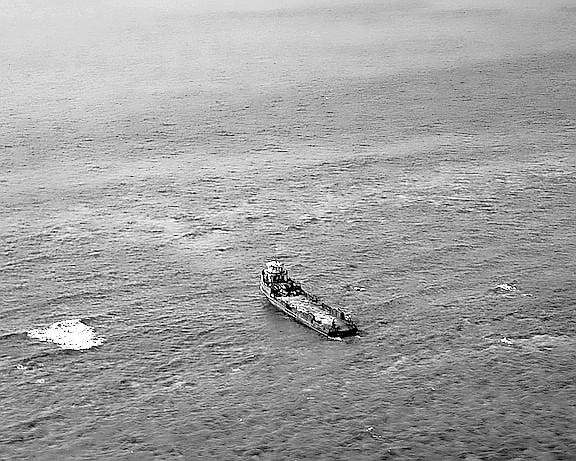
Wrecks on remote Hogsty Reef in the southeastern Bahamas, between Great Inagua and Acklins, are so numerous – at least 115 documented in the past 250 years, and probably over 150 – that here we focus on just those since the 1960s. The most visible is the Yugoslav freighter Trebišnjica, a former Liberty ship whose previous names included SS Richmond P. Hobson, which wrecked on the northern part of the reef on 17 July, 1963. Built by North Carolina Shipbuilding Company and operated by Isbrandtsen Lines as a wartime troop carrier in 1943, by 1947 she was sold and flew the Panamanian flag as Nueva Esperanza. In 1953 she was sold to New York owners, who sold it on to London, and in 1961 her final owners were Jugoslavenska Slobodna Plovidba, of Polce, Yugoslavia. Thus, Trebišnjica was the ship’s final name, under which she drove up on Hogsty Reef, so to refer to her by previous names would be incorrect.
On her final voyage from Naples to Havana in ballast the 441-foot ship hit Hogsty at 1.45 am and was abandoned, high and dry, on the northern coast a week later. As the hull sits on just two feet of water at low tide, it could be mistaken as being under way. A year later two yachtsmen on a sailboat named Poseidon were able to find fresh rain water and shelter on Trebišnjica. The owners of Deep Six Salvage told the Miami Herald in 1970 that they were confidently setting out to Hogsty Reef to find “a Russian freighter to be blown up.” This team claimed that “under international law, abandoned ships are fair game for salvagers,” believing that this foreign flag ship in a foreign nation was theirs for the taking – or as they said “blown up.”
Another prominent wreck atop Hogsty is Lady Eagle, much smaller, sunk after 1988. This supply vessel was built by Bollinger Gulf Repair in 1967 and last sailed under the Bahamian flag. Formerly named Cheramie Bo-Truc No. 14, it was about 130 feet long. It now sits upright and level on the rim of the atoll, very firmly aground, about halfway from the deep to the shallow water and a rust-red colour one of the two most visible wrecks on Hogsty Reef.
In 1991 a much smaller and less visible wreck took place on a wild night – that of the Swedish-flagged sailing vessel Alba. The Orlando Sentinel reported that “eight swedes were plucked from their life raft near The Bahamas, and a Soviet sailor suffering from appendicitis was hoisted from his ship off Cuba on Tuesday, 11 June.” A Coast Guard helicopter temporarily based in the Bahamas was called to evacuate an injured crewman from the 600-toof Soviet ship Vasily Koval. [However] while heading to the ship, the helicopter was called to assist the 55-foot sailboat Alba which carried eight Swedes. Alba’s captain reported taking on water near Hogsty Reef, and all aboard were abandoning ship. ‘The boat sank. They ran aground on a reef or something. They had just enough time to call their mayday,’” said the Coast Guard spokesperson, named Dye.
The Palm Beach Post amplified that “eight were rescued from life raft: the helicopter located the group in a life raft and airlifted them to Great Inagua. After dropping off the Swedes, the helicopter then returned to its original rescue mission… to the Soviet ship.” Alba was a classic wooden schooner on passage from Denmark to Spain, the Caribbean, and was en route back to Sweden through The Bahamas when they lost their bearings at night and in heavy current, and were wrecked on Hogsty Reef.
The crew spent a week or so in a US base before being repatriated. While constrained in how much I can add to the story, I was assigned by consular officials to inventory what was left of the yacht, and had the opportunity to study papers, books and photo albums. The voyage began in wintry Scandinavia, followed by their crossing the Atlantic to the Caribbean in the Trade Winds and then meandering through the tropics. It is a pity the yacht never made it back to Sweden, but a blessing that all her people did. Apparently no sooner had they called in a Mayday than the lights of a helicopter appeared overhead, like Les Etoiles; the stars, for which Hogsty Reef’s tiny islets were named many years ago.
Recently my young son, brothers, cousins and I were in the bridge of a mailboat going to Inagua, talking of faraway islands, and I asked my son to pull up a picture of Hogsty Reef, which I had enjoyed so much fishing and camping on in the Island Expedition. He showed me an online photo of the small lighthouse tower there, and then laughed at the photo credit, since I had submitted it to the database of lighthouses. Hogsty is also a destination in the smuggling, Nazi-gold-themed fiction book Bahamas Passage, written by a Nassau-based expatriate pilot James Frew.
We also learn in the Tampa Bay Times of August, 1997 that “Treasure hunters at Seahawk Deep Ocean Technology Inc. told of a joint venture with Spanish Main Treasure Co. of Tavernier ‘to explore as many as 25 shipwrecks on the reef known as ‘Dragon’s Teeth,’ on early Spanish maps and ‘Hogsty Reef’ to modern mariners. Seahawk will provide financing and equipment to explore ‘some 25 wrecks they identified on the atoll. Over eight years they said they recovered $1.2mm worth of treasure from a Spanish galleon wreck.’” In 2003 South Florida Sun Sentinel wrote about a 45-foot sailing yacht from Florida named Mickey and the skipper; a father who lost his son at age 50 to cancer. David Clark, the then set off towards Hogsty Reef to scatter his ashes there, since they had bonded during a father-son adventure trip there in 1995. However weather conspired against Clark; his sails were shredded and he had to be rescued off Mayaguana, never making it back to the atoll.
The Nassau Tribune of August 2019 reported that sailors aboard a wooden 57-foot Haitian trading vessel named Shamu Too were en route to Haiti from New Providence when mechanical failure sent them aground on Hogsty Reef. As a result, eight Haitian national were rescued by the Royal Bahama Defence Force vessel HMBS Durward Knowles. The RBDF reported that none of the men were injured, and that an Operation Bahamas, Turks and Caicos (OPBAT) helicopter airlifted food supplies to them and assisted with their rescue and return to Nassau. Overall Hogsty Reef has always been a place of grief to property and cargo, a place of beauty and also injury and suffering, yet surprisingly few perished there, compared to the number cast ashore and the paucity of dry sand. They found mystery in the teeth of dragons and stars from the sky, but more marvel than harm. Like Mr. Clark and his son, none who go to Hogsty Reef, a large swathe of water with a tiny patch of sand, forget the experience.




Comments
Use the comment form below to begin a discussion about this content.
Sign in to comment
OpenID