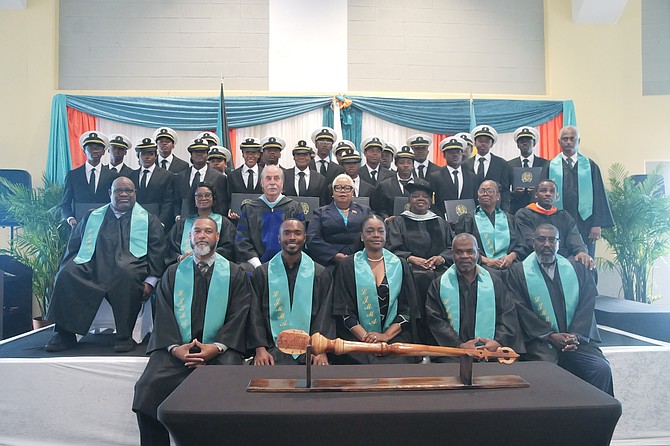
LJM Maritime Academy held a commencement ceremony at Andre Rodgers Baseball Stadium on July 24, 2025. Photo Nikia Charlton
By KEILE CAMPBELL
Tribune Staff Reporter
kcampbell@tribunemedia.net
MORE than 40 graduates from the LJM Maritime Academy marked the completion of their training during a formal ceremony held at the Andre Rodgers Baseball Stadium on Thursday morning.
The event celebrated the Academy’s Class of 2025 under the theme “Charting New Horizons: Navigating the Future With Confidence” as cadets and their families gathered alongside education officials, industry leaders and members of the Royal Bahamas Defence Force (RBDF) to witness the formal passing out of the graduates, who completed a rigorous programme of academic instruction, physical training and onboard experience.
Dr Richard Wiefelspuett, president of the LJM Maritime Academy, addressed the graduates during his first official commencement as head of the institution. He said the maritime industry offered not only viable employment but also presented a rapidly changing and increasingly technology-driven career landscape that required continuous learning.
“Technology is constantly evolving,” Dr Wiefelspuett said. “We have new fuel types, like LNG replacing diesel, and automation is a big development. That means more knowledge in IT and electronics is now required than it used to be.”
He said graduates must stay adaptable and committed to learning as changes in fuel systems, environmental regulations and digital systems continue to alter ship operations globally.
Dr Wiefelspuett also pointed to opportunities beyond sailing, noting that maritime engineers and captains often transition into shore-based leadership roles in power plants and port management.
Jacqueline Simmons, chairman of the Bahamas Maritime Authority, echoed those sentiments in her keynote address, saying the future of the maritime industry in The Bahamas was “vast and full of opportunity” but would demand more from the next generation of mariners.
“Today’s vessels are more sophisticated and technologically advanced than ever before,” Mrs Simmons said. “They require a new generation of minds equipped not only with traditional seamanship but also with cutting-edge technical knowledge.”
She said that while the sea remains central to many careers, graduates are increasingly being called to land-based roles in logistics, ship inspection, marine insurance and regulatory affairs.
Mrs Simmons advised cadets to guard their reputations, be punctual, stay teachable and develop resilience.
“Your certificate gets you on board,” she said, “but your character keeps you invited.”
The ceremony concluded with a musical performance by the academy’s chorale and the formal presentation of diplomas by academic dean Bridget Hogg.
Among some graduates was Engine Cadet Andrew Rahming, who served as the class valedictorian, told The Tribune how the training held high standards for physical requirements, which he said was the most challenging aspect of his training. However, he said the most rewarding part was getting out into the field and described the moment of stepping onto a working vessel as “magical”.
Mr Rahming said he intended to work with Carnival Cruise Line as an engine cadet before advancing to the rank of third engineer.
Joshua Poitier, another graduate, told The Tribune he had already applied to Carnival, Disney Cruise Line, Campbell Shipping and Norwegian Cruise Line.
“I have very high hopes,” Mr Poitier said. “Really, in truth, it does not matter to me where I go—I just want to be out there gaining experience.”
The academy, established in 2014, provides training certified under international STCW standards set by the International Maritime Organization. Dr Wiefelspuett said these credentials ensure Bahamian cadets are prepared for global careers, but added that local success will depend on staying in tune with industry developments.
“An open mind to learning is very important,” he said.




Comments
Use the comment form below to begin a discussion about this content.
Sign in to comment
OpenID