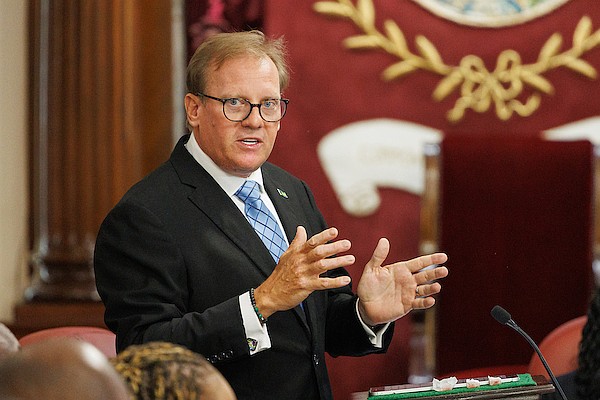
Attorney General, Senator and Minister of Legal Affairs Ryan Pinder speaks in Senate yesterday. Photo: Dante Carrer/Tribune Staff
By LEANDRA ROLLE
Tribune Chief Reporter
lrolle@tribunemedia.net
ATTORNEY General Ryan Pinder said yesterday the government is targeting the first quarter of 2026 to begin land adjudications, marking a step toward overhauling the country’s outdated land ownership system.
Mr Pinder made the announcement during a Senate debate on the Land Adjudication and Registered Land Bills, which aim to modernise how land is claimed, recorded, and transferred in The Bahamas.
He noted that the push for a registered land system has been stalled for more than 60 years, despite several previous draft bills. No administration, he said, had moved the initiative forward until now.
“Consistent with the FNM way, they are good at talking, but not good at doing. The PLP does, and when it comes to land adjudication and registration we will do,” Mr Pinder said.
He described the current state of land holdings in The Bahamas as “precarious” and plagued by uncertainty. Citing the 2010 Land Use Policy and Administration Project (LUPAP) report, he said at least 15 percent of all land parcels were in dispute, a number he believes could be even higher.
The proposed Land Adjudication Bill would establish adjudication panels consisting of an experienced conveyancing attorney and two other people. These panels would evaluate and determine ownership claims in areas designated by the responsible minister.
Once adjudicated, claims would be entered into a newly created Land Registry, an upgrade from the current system of recording deeds in the Registry of Records under the Registrar General’s Department.
The Registered Land Bill, which complements the adjudication legislation, would create a central land registry with unique parcel identifiers and provide government-backed Land Certificates or Certificates of Lease.
Together, the bills are designed to streamline and digitise land administration across The Bahamas. Mr Pinder said the legislation draws on models used in Barbados and the Cayman Islands, but will implement a compulsory system, rather than a voluntary one, to ensure momentum.
“Systematic adjudication allows us to commence land registration in areas of the country where there may be fewer land disputes because much of the surveying required has been done and lots identified,” he said.
He added that the government intends to issue a request for proposals (RFP) soon for the development of a digital platform to support the registration process. Several developers have already expressed interest.
Mr Pinder acknowledged the scale and complexity of the undertaking but said the government is undeterred.
“Yes, we know this is a big project and we know it’s a complex project and the implementation will be complex, but we’re not scared of complex things. We are confident we can get it done,” he said.
“In fact, my goal would be to start land adjudications in quarter one of 2026. That means we have six months to build the registry, to develop the platform, to train our staff and to get adjudication panels formulated and to start the process.”




Comments
Use the comment form below to begin a discussion about this content.
Sign in to comment
OpenID