By Desiree J Major-Corneille
When last week’s article called out the “silent sabotage” of environmental crime, the response was immediate: readers wanted to know, Who is responsible for stopping this? The answer is both straightforward and complicated. Environmental protection in The Bahamas isn’t the job of any one agency. It is shared by a patchwork of ministries, regulatory and compliance agencies, law enforcement, and non-governmental organisations. While this should mean robust protection, in practice, it often breeds confusion, bureaucracy fatigue, and, most dangerously, inaction.
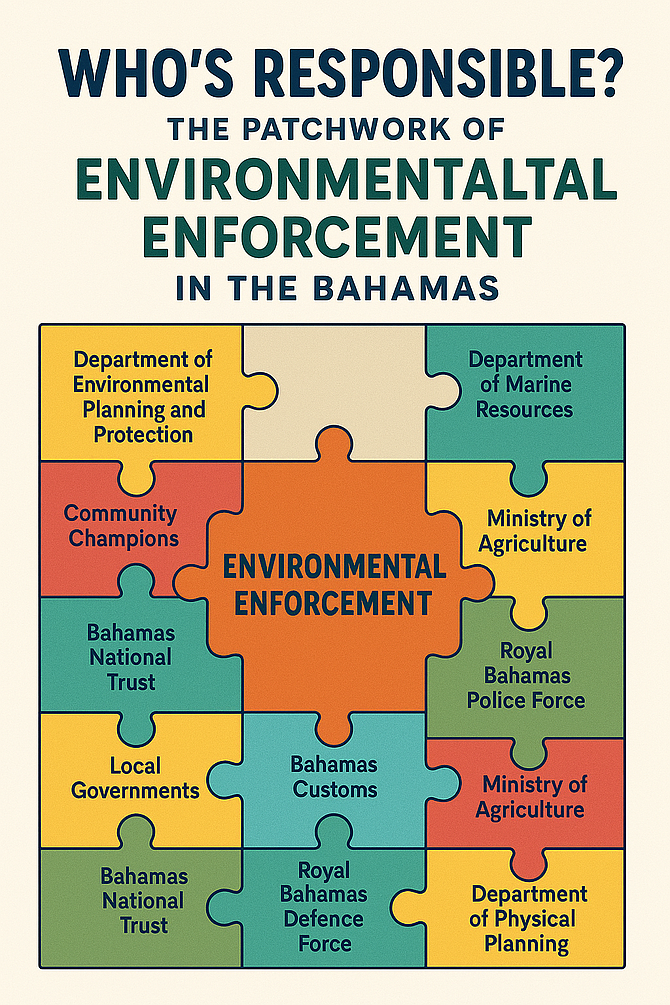
A patchwork of responsibility
The Department of Environmental Planning and Protection (DEPP), Department of Environmental Health Services (DEHS), Department of Marine Resources, Forestry Unit, Ministry of Agriculture, Ministry of Works, Royal Bahamas Police Force, Bahamas Customs, Royal Bahamas Defence Force (RBDF), Department of Physical Planning, local governments, and the Bahamas National Trust (BNT) all bear some responsibility for differing pieces of the environmental enforcement mandate.
Each covers a slice: broadly speaking, DEPP oversees Environmental Impact Assessments and Certificates of Environmental Clearance; DEHS handles waste management, sanitation, and environmental health complaints; Marine Resources governs fisheries and marine products; Forestry Unit protects forests; Ministry of Agriculture oversees agricultural lands and animal health and animal import/export permits; Ministry of Works manages infrastructure and oversees some dredging/development; RBDF patrols territorial waters and Exclusive Economic Zones (EEZs); BNT manages jurisdictional national parks.
When an environmental crime occurs—whether illegal dredging, mangrove clearing, poaching, or pollution—jurisdiction is rarely clear-cut. There has been some effort for joint missions, however, most agencies default back to “collateral duty” mode, with environmental enforcement squeezed in between other competing priorities. Offenders learn to exploit these gaps.
The foreign factor — and enforcement gaps
The RBDF is critical in defending maritime boundaries, but their reach—considering the expansive territorial waters and the dispersement of our islands—is stretched. Foreign fishing crews, particularly from the Dominican Republic and Cuba, and perhaps closer in Southern Florida are notorious for timing illegal forays to avoid detection, knowing that enforcement patrols are limited.
But it’s not just outsiders. Locals exploit gaps too. Turtle fritters, ‘hush-hush’ soup, illegal charcoal kilns, unlicensed sand and limestone mining, and unauthorized dumping operate openly, confident a fragmented system gives them a good chance of escaping prosecution.
Beyond what’s seen— the need for real investigations
Most enforcement remains reactive: a seized shipment of fisheries here, an illegal quarry mine there, the occasional truck of cascarilla bark or poached iguanas intercepted. What’s missing is investigation that digs deeper—who is financing the poaching, buying shark fins, exporting flamingos, smuggling orchids, or running the black-market trade in snakes and coral? Enforcement must evolve from “catch and release” to coordinated, evidence-based cases that dismantle trafficking networks, not just punish one-time offenders.
No centralised reporting, no easy access
A critical barrier remains: there is no easily recognised, centralised place for the public to report environmental crime. While tip lines exist—BahWILD is a step forward—they’re not well-publicised as yet, and most Bahamians don’t know whom to call, what information to provide, or what will actually happen after a report is made. Cases fall between the cracks, and the public loses faith in the system.
The revolving door of NGOs and bureaucracy fatigue
Adding to the complexity is the revolving door of non-governmental organisations. Many well-meaning NGOs step in to fill enforcement advocacy gaps, running education campaigns, clean-ups, or monitoring efforts. But after several years, their staff can experience burn out fighting the same bureaucratic hurdles, enduring sometimes long waits for permits, or seeing victories reversed by red tape and slow government response. As personnel change, institutional memory is lost, and the cycle begins again.
Scientists — not always part of the solution
Complicating the picture further, some scientific researchers—granted access through official permits—fail to respect local access and benefit-sharing protocols (as outlined under the Nagoya Protocol on Access and Benefit-sharing), or harvest more than agreed or do so for their own commercial gain, undermining community trust and sometimes damaging the very resources they are supposed to study. In recent years, communities have raised concerns about foreign researchers extracting samples or specimens without proper consultation or benefit-sharing, fueling skepticism and resistance.
When and where does it stop?
Where is the tipping point for public concern? It’s easy to blame agencies, but the real answer lies with society at large. Poaching, trafficking, and habitat destruction don’t only threaten scientists’ data or conservationists’ projects—they undercut national stability, food security, clean water, community safety, and the long-term future of every Bahamian.
When do we move from “preaching to the choir” to a true national movement for protection? Is it when flooding destroys homes in Coral Harbour, when mangroves disappear from Andros, or when beloved species—turtles, flamingos, sharks—are gone from our shores? Or will it take something more?
Community champions: The real front line
Hope remains, thanks to Bahamian communities that refuse to stand idly by. Residents in places like Red Bays, Andros fiercely defend traditional rights and habitats, setting a standard for others. Fishermen in Spanish Wells have mobilised for sustainable practices. Yet, these champions cannot win alone.
The cost of confusion and inaction
As long as responsibilities are fragmented, accountability is blurred, and reporting is unclear, environmental crimes will continue. Offenders will “play the system,” NGOs will cycle through the same battles, and scientists may not always be allies. What’s needed is a shift from siloed responses and “collateral enforcement” to sustained, joint investigations, transparent reporting, and true public engagement, perhaps from a centralised or standalone agency where this is the primary duties.
Where do we go from here?
Until we untangle this web, even our strongest laws will remain “paper tigers”—impressive on the books, but toothless in practice. The future of environmental enforcement in The Bahamas will depend not just on what’s written in law, but on building a culture of collaboration, dedicated resources, intentional enforcement, and clear, accessible channels for the public and partners to take action.
This silent sabotage can only be stopped if we demand unity, dedicated enforcement, and true accountability—from every agency, every leader, and every citizen.
• Desiree K Major-Corneille is a CITES specialist, and policy advisor on wildlife, environmental, and natural resource enforcement in The Bahamas and the wider Caribbean.




Comments
Use the comment form below to begin a discussion about this content.
Sign in to comment
OpenID