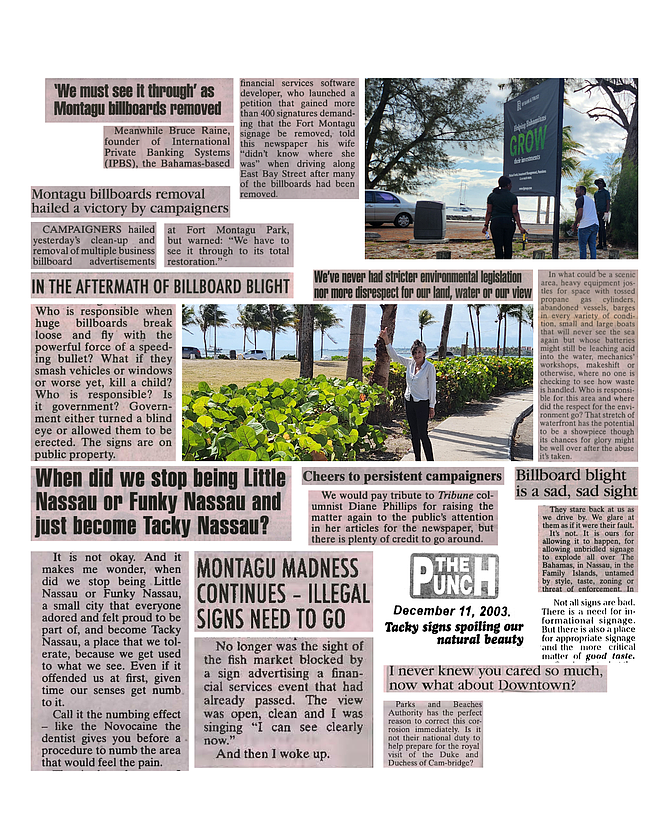
Just when I thought I could not find another single word or way in which to plead, beg, urge or beseech those in charge to remove the mass of 17 billboards blocking the view of Montagu Bay, voila! There was the crew from Parks & Beaches Authority, taking them down, one by one, revealing the view we all missed so much.
I wasn’t alone in this fight to remove the signs that had grown from one or two to so many you could no longer see the water and it wouldn’t have happened if others had not cared so much, but I will say that I might take home the honours for stubbornness, waging the battle till I was weary (and afraid readers were as well) yet never giving up.
Just the other day, I came across a letter to the editor I wrote in 2003, Tacky Signs…With the lead graf that went like this: “An inner-city disease called ‘signusitis’ is sweeping Nassau like an epidemic. And the only cure is a change in how we feel about our environment, and in the end, ourselves.”
That was 22 years ago.
In 2008, I prepared a paper for a meeting with Ministry of Works, the Department of Physical Planning and the Ministry of Tourism outlining a plan for period signage for Historic Nassau. It included every detail of every step along with information from other historic districts like Charleston, South Carolina that had branded themselves so successfully.
That was 17 years ago.
Not much has changed in the way we treat signage and a national acceptance of physical environment mediocrity since that first letter about the disease I labelled “signusitis” in 2003.
The world has swirled around us, a whirlwind of change. Consider the number of times Apple has introduced a new iPhone or Americans have elected a new president or The Bahamas has swapped one political party for another to run the country.
Through all of those years, through 9/11 and COVID, through however many Olympics and Carifta Games Bahamian athletes have flown to and returned bearing grins and Gold, through the explosion of online banking and digital wallets and easier ways of doing lots of other things, through believing Facebook was a fad that would fade and later accepting AI as the new way of completing a sentence, through all of those game-changing impacts and influences, we who live in one of the most beautiful places on the planet continue to abuse it.
We plant billboards where flowers should grow. We block views others would give anything to enjoy. We trash grounds that should give life to fruit trees and food-bearing bushes but instead become carpets of KFC boxes, Kalik beer bottles and Wendy’s bags. We should be proud but we are dirty. And messy and if we only gave a you-know-what we could do so much and it would take so little.
Imagine streets where yellow elder blossomed, one tree with its arms out wide after another in full bloom, and another where Royal Poinciana, proud in red, showed its colour, roundabouts with annuals and backdrops of silver buttonwood and deep Nitida or Benjamina.
Imagine historic Nassau where you could IG selfies in front of signs telling the story of a building that is 200 years old or a warehouse used by pirates plundering Nassau in the early days and by bootleggers during US Prohibition.
We are not restrained by lack of resources. We are paralysed by lack of imagination.
So take this lesson of what we have learned from Montagu. We, the people, can make the right thing happen if we put our collective minds and hearts to it. We are bigger than crass commercialism and stronger than those who would defile our beautiful land and our unparalleled views. We are patient and we shall win.
AND ON TO PART TWO
Twenty-two years after that first letter to the editors of all the media about tacky signs and a condition I labelled “signusitus”, we are far from where we need to be. Let us not get so caught up in patting ourselves on the back that we forget where our feet need to be planted next and the direction we need to take as a group. And this includes original interested parties like Peter Bates (Sign Man) who has tried so hard to get government to listen to the idea of proper signage standards, and Loretta Butler-Turner, Bruce Raine, Bobby Bower, who helped design historic signage, so many others who at some point along the way recognised how one single component – signage – could have such a powerful impact on how a place looks.
Imagine if all the signs in Historic Nassau reflected an historic colour and style. Imagine the statement that would make about the pride of being part of a city about to celebrate its 300th birthday. Just picture what that would look like driving east on Bay Street instead of glaring signs blaring messages about everything from sugar to cheap t-shirts and how much cleaner and finer it would be instead of rum cake posters on column after column in case you could not read rum cake the first time you saw it.
But, as I said, getting it right is not hard. Examples of sensible signage standards for different areas abound. I have files filled with such samples and detailed notes from conversations with experts over the years. All it takes is two things and they may be the hardest two things of all. The first is WILL. The will to change, to accept the fact that clean beats trashy and the knowledge that environment impacts social behaviour. Clean environments enjoy less crime. The second is IMAGINATION.
If we are beginning to get it right at Montagu and Saunders Beach, imagine what New Providence could look like if we got it right clear across this island of New Providence, if we became the land of sea, sun, sand, flowers and shrubs and trees and fruit and plants and everything that says we care about this place we call home. Just IMAGINE. An island devoid of billboard blasphemy and in its place all things green and growing and available for all to enjoy and inhale. Just IMAGINE.




Comments
Use the comment form below to begin a discussion about this content.
Sign in to comment
OpenID