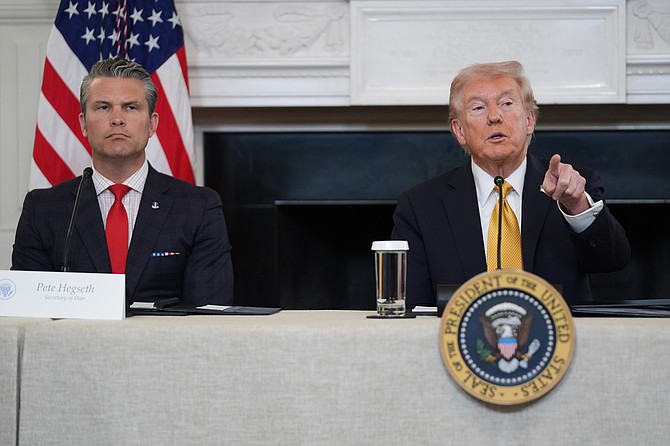
President Donald Trump answers questions from reporters during a roundtable on criminal cartels in the State Dining Room of the White House, Thursday, Oct. 23, 2025, in Washington, as Defense Secretary Pete Hegseth listen. (AP Photo/Evan Vucci)
By AVA TURNQUEST
Tribune Digital Editor
aturnquest@tribunemedia.net
THE Bahamas National Reparations Committee (BNRC) has issued a strongly worded open letter condemning recent US military actions in the Caribbean, warning that the region is “not a battlefield” and denouncing what it calls a continuation of colonial power dynamics.
The letter, titled “The Caribbean Is Not a Battlefield,” expresses “grief and rising anger” over reports that US missile strikes have killed at least 57 people on vessels in Caribbean waters since September — including nationals from Venezuela, Colombia, and Trinidad and Tobago.
The BNRC criticised what it described as the “silence” of Caribbean leaders amid these developments, calling on governments to defend the region’s sovereignty and uphold international law.
“The presence of foreign warships in Caribbean waters is not a neutral act,” the letter read. “It is a continuation of colonial logic: occupation under the guise of protection and violence disguised as diplomacy.”
The committee said the interventions “executed beyond the bounds of international law” mirror historical imperialist behaviour and threaten the “rule-based order” that leaders like Barbados Prime Minister Mia Mottley have urged Caribbean nations to defend.
“When unilateral force replaces multilateral consensus,” the statement continued, “small island nations become collateral in great-power theatrics – their sovereignty eroded under the illusion of partnership and their dignity bartered in the name of protection.”
The BNRC urged regional leaders to take a firm stand against militarisation and foreign interference, arguing that such actions undermine ongoing reparations efforts and betray the principles of justice and accountability.
“We cannot call for reparations in one breath and ignore imperialist military aggression in the next,” the group said. “Neo-colonial actions are antithetical to the spirit of reparatory justice. We are the descendants of resistance. We are the product of revolutions against foreign rule, military occupation, and economic exploitation. We do not forget that war has never served us.”
Declaring solidarity with Trinidad and Tobago and all nations “being drawn into military conflict,” the BNRC reaffirmed its commitment to regional unity and anti-war advocacy.
“The Caribbean is not neutral ground,” the letter read. “The Caribbean is not for sale. And the Caribbean is not a battlefield for imperial agendas.”
At a CARICOM meeting last month, regional leaders reaffirmed the bloc’s long-standing declaration of the Caribbean as a zone of peace, urging all external powers to respect sovereignty and international law amid rising tensions.
While most member states backed the call for restraint, Trinidad and Tobago defended its cooperation with U.S. military operations as part of counter-narcotics and maritime security efforts — a move that some leaders view as undermining CARICOM’s united front.
In his column for The Tribune last week, Antigua and Barbuda’s Ambassador to the United States Sir Ronald Sanders warned that such actions expose the “fragile shield” of small-state sovereignty, describing the moment as “not the birth of a new world order, but the formal admission of the old: an order in which might makes the rules.”




Comments
Use the comment form below to begin a discussion about this content.
Sign in to comment
OpenID