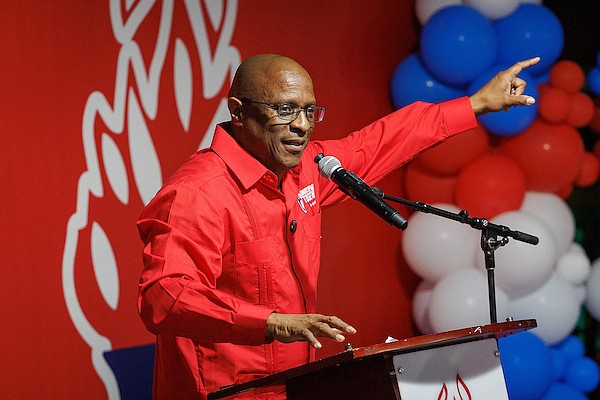
Marco City MP and Opposition Leader Michael Pintard speaks during a Free National Movement (FNM) Carmichael Constituency Association meeting at Gerald Cash Primary School on February 25, 2025. Photo: Dante Carrer/Tribune Staff
By KEILE CAMPBELL
Tribune Staff Reporter
kcampbell@tribunemedia.net
FREE National Movement leader Michael Pintard has pledged that an FNM government would build up to 2,000 homes each year if elected, promising visible results within six months of taking office.
Mr Pintard said construction would begin almost immediately through partnerships already in place and designs ready to go. “Within the first six months of being in office we would have commenced hundreds of homes,” he said yesterday on Morning Blend on Guardian Radio. “It’s just that simple. We are that far along in our discussions with local and international partners. We’ll do all the pre-qualifications, and you are able to walk into a house in less than three months. We’re not taking six, seven, eight months to build.”
He said his plan would make government-led housing construction more efficient and affordable, arguing that if private developers can build entire subdivisions with limited state support, the government should be able to do so at a lower cost. Mr Pintard said successive administrations have failed to use existing technologies and systems to speed up development, adding that regional neighbours are “dramatically” increasing housing production while The Bahamas lags behind.
According to him, the FNM’s plan would combine modern and traditional methods to boost output and cut costs. “That means using panel construction methods where you can produce the majority of the components right here at home, and then assemble them quickly on site,” he said. “We are still using eight-inch block, wood and metal framing where it makes sense. The point is that there are a variety of systems that can work side by side, and the government has to use all of them efficiently instead of being stuck on one old model.”
Mr Pintard said the party’s housing policy would emphasise design diversity, with seven architectural models already prepared and local architects encouraged to compete with new concepts reflecting Bahamian tastes and community needs.
He said the plan also includes multi-storey condominiums and apartment-style units in densely populated areas like Nassau and Grand Bahama. “The key is responsible condominium associations — people who will pay their service charges, maintain common areas, upgrade where necessary, and carry out repairs after hurricanes. It’s about creating a culture of ownership and accountability so that these properties remain strong assets for the long term.”
Mr Pintard said an FNM administration would end what he called politically driven contracting, where housing contracts are awarded to people with no building experience or to major financiers who later subcontract real builders. “What ends up happening is that they turn around and subcontract to real builders, and you get subdivisions full of houses in varying stages of completion and quality. We will not follow that system,” he said.
He said his government would work closely with private developers, offering concessions and guarantees on building materials in partnership with local suppliers. “Yes, they might make less money per unit, but they make it back in volume,” Mr Pintard said. “You don’t destroy your construction supply sector—you work in tandem with it.”
Mr Pintard said an FNM government would also overhaul the approvals process, cutting delays by outsourcing some inspections and ensuring agencies work simultaneously rather than sequentially. He said private engineers could be used to help the government meet deadlines. “Too long there’s a delay because of Physical Planning or Environmental Health. Those two departments ought to be talking with each other in real time so that plans can be looked at simultaneously, not one after the other. We have to cut the time people are waiting on approvals.”
He said the housing plan would be tied to a broader effort to decentralise economic growth and population away from Nassau, with new developments in the Family Islands built through public-private partnerships and streamlined approvals.
“We are that far along,” he said. “This is not wishful thinking. Within six months, Bahamians will see hundreds of homes started, built by Bahamians, on Bahamian land, with systems already ready to go.”




Comments
Use the comment form below to begin a discussion about this content.
Sign in to comment
OpenID