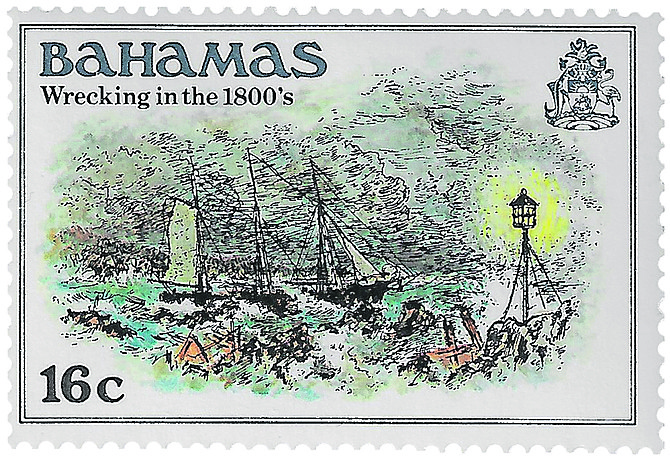
Blockade Running, American Civil War - 1980 Scott 470
By ERIC WIBERG
Grand Bahama Museum
Few chapters in Bahamian maritime history capture the tension between survival and morality like the era of wrecking. From the 17th to early 20th centuries, the shallow banks and reefs around The Bahamas shaped a unique industry that influenced island life, community identity, and seafaring traditions.
The Bahamas can be both beautiful and treacherous. For centuries, these islands located between the Atlantic Ocean and the Caribbean lay on vital trade routes connecting Europe, Africa, and the Americas, requiring ships to navigate tight channels and unpredictable currents.
With limited tools and unreliable charts, many vessels wrecked along the coasts of Abaco, Eleuthera, Bimini, Grand Bahama, and other islands. In 1846, records show that over 2,000 ships passed Abaco Light — not all of them reached their destinations. Poor charts, sudden squalls, and shifting sandbanks made Bahamian waters both a graveyard and a source of livelihood.
The Eleutherian Adventurers, settlers from Bermuda in the mid-17th century, sought religious freedom and new beginnings. Their hopes for agriculture faltered against this soil and harsh island life. Survival required adaptation, and wrecks offered unexpected help.
The salvaging of shipwrecks, or “wrecking,” supplied vital goods to remote Bahamian communities. Over time, this need developed into a unique occupation, deeply rooted in Bahamian identity and folklore.
Although some accounts accused wreckers of intentionally luring ships onto reefs—an accusation often exaggerated by outsiders and rivals—their actions were more frequently acts of salvage and rescue rather than deceit.
By the 18th and 19th centuries, wrecking had developed into a regulated and taxed maritime industry. The British colonial administration, aiming to reduce lawlessness and generate revenue, implemented licensing systems and salvage laws. Every wrecker and crew member was required to have an official license. Additionally, the number of crew members was linked to the tonnage of their vessel.
Salvaged goods, rope, fine wines, clothing, and livestock were taken to Nassau for auction. Customs duties were paid before the sale, and the money was split among the shipowners, captain, and crew. In 1856, 302 ships with 2,679 men were licensed as wreckers, making up about 10% of the 27,000 Bahamian residents.
The industry supported related trades, from shipbuilding to sail making. Between 1855 and 1864, Harbour Island alone produced 26 “sloops purposely built for wrecking,” elegant vessels averaging 47 tons, designed for speed and shallow-draft manoeuvring. Abaco and Ragged Island were other notable hubs for boat building.
Wrecking accounted for approximately one-third of Bahamian imports in the mid-19th century, indicating its significant economic impact.
The 19th century transformed global commerce. American trade through New Orleans and the Gulf increased maritime traffic, creating more opportunities—and risks—for Bahamian wreckers. During the Civil War (1861–1865), blockade-running revitalised Nassau’s economy, though wartime restrictions decreased wrecking.
Even during these turbulent years, salvage continued to be a crucial source of income. Reports from 1865 indicate that the value of salvaged goods was £28,000. By 1870, the annual value of salvaged goods had increased to £154,000.
Acts of Rescue and Humanity
Beyond commerce, the history of wrecking in The Bahamas is characterised by episodes of extraordinary humanitarian efforts.
In 1816, a Spanish slave ship wrecked near Green Turtle Cay, and Bahamian wreckers rescued over 300 African captives bound for Cuba. Under British law, all were freed in Nassau, showing how wrecking supported abolitionist goals and compassion. Sadly, rescue did not guarantee complete freedom everywhere.
Throughout the 1850s, wreckers rescued hundreds of European emigrants fleeing famine and poverty. The wrecks of the Cato, Ovando, Osborne, and William and Mary all occurred in Bahamian waters, where local schooners transported survivors to Nassau.
Robert Sands, a Bahamian mariner described as “a man of colour,” was awarded the silver medal of the National Life-Boat Institution for rescuing 160 passengers from the William and Mary in 1853. Governor Gregory later praised the wreckers of Abaco, commending their shipbuilding and seamanship skills, and recognising their “humanity and courage” in saving both cargo and lives.
As the century progressed, technological advances brought an end to the wrecking era.
The construction of 37 Imperial Lighthouses across the Bahamas, along with improved Admiralty charts and the rise of steam navigation, significantly reduced maritime disasters.
Unlike sailboats, which were at the mercy of wind and current, steam vessels stayed in deeper waters to avoid reefs and banks. With safer routes, there were fewer wrecks, leading to the decline and eventual disappearance of the industry that had supported many, much like how horse-drawn carriages disappeared after the rise of the automobile.
The last major Bahamian wrecking operation occurred in 1905, when 500 men recovered cargo from the steamer Alicia, earning a total of $17,690. By 1920, the last local wrecking company had been absorbed by an American firm, ending nearly 250 years of Bahamian wrecking tradition.
Although wrecking decreased with the rise of modern shipping, its legacy continues to influence Bahamian identity. Wreckers’ skills—boatbuilding, seamanship, diving, and navigation—continue to be part of local culture. Some reputations were damaged by stories spread by competing wreckers and shipowners trying to shift blame for their own mistakes.
The values of resilience and cooperation endure from the wreckers' way of life. Living by the sea, these men and women faced uncertainty with courage and community—a reminder that loss and survival depended on determination and skill, both on land and at sea.
Wrecking in the Bahamas was more than an occupation—it was an adaptation to geography, a response to hardship, and ultimately, a reflection of the Bahamian spirit itself. Wreckers transformed calamity into opportunity, mastering the same seas that once threatened their existence.
The Grand Bahama Museum invites readers to explore its online exhibit, Wrecking in the Bahamas, at https://www.grandbahamamuseum.org/exhibits/maritime-and-aviation/wrecking-in-the-bahamas.




Comments
Use the comment form below to begin a discussion about this content.
Sign in to comment
OpenID