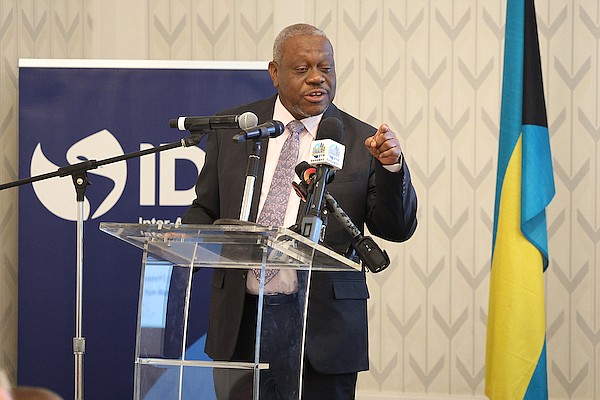
National Development Plan Secretariat Chairman Felix Stubbs speaks during an event to discuss a National Development Plan hosted by the Inter American Development Bank (IDB) at The Island House on August 16, 2024. Photo: Dante Carrer/Tribune Staff
By NEIL HARTNELL
Tribune Business Editor
nhartnell@tribunemedia.net
Draft legislation to place the National Development Plan on a legal footing is expected by end-November, the initiative’s chairman disclosed yesterday, adding that the effort will “stop this one step forward, two steps back” cycle on Bahamian progress.
Felix Stubbs, the former IBM (Bahamas) principal who is heading the plan’s steering committee, told Tribune Business that the bid to revive the plan as a lasting ‘road map’ for the country’s development is “just getting moving” with the reformed body having held its first formal meeting earlier this month on October 3.
Revealing that the legislation will be called the National Planning Institute Bill, with a body of the same name to be established with “a bit of autonomy from the Government”, he argued that there is “a big gap” between The Bahamas’ potential as a nation and the present reality because “political differences” too often get in the way and impede national progress that would benefit all citizens.
The Plan is designed to break this by providing a long-term, non-partisan road map that will guide national development in critical areas such as the economy, the environment, social progress, health and education regardless of which administration is holding the Government. Mr Stubbs confirmed to this newspaper that the initiative is set to be assisted by some $120,000 in financial assistance from the Inter-American Development Bank (IDB).
The IDB, in a paper seen by Tribune Business, said updating and implementing the National Development Plan will give a “clear, long-term vision for the economy, environment and society”. It added of its involvement: “The specific objectives are to strengthen governance frameworks through institutional strengthening and capacity building, and conduct sectoral studies for social development planning at a national level.
“Despite a high Human Development Index (HDI), The Bahamas needs to protect and expand human capital by addressing poverty, education, health, violence, the environment and infrastructure, particularly in the Family Islands.
“Institutional capacity, rule of law, climate change, gender and diversity issues, and data collection are cross-cutting themes that must be addressed to unlock the country's full development potential. Strengthening institutions, promoting climate resilience, ensuring fair development for all and improving data transparency are essential steps.”
The IDB added that the nine years that have passed since the National Development Plan was first drafted “poses a risk to stakeholder confidence and buy-in, as well as potential unwillingness to re-engage”
“To mitigate these risks, a change-management and communications strategy will be implemented to address stakeholder concerns and ensure broad consultation with the private sector and civil society, especially throughout the Family Islands,” it said.
Mr Stubbs, meanwhile, said the Plan’s steering committee is in the process of forming itself into sub-committees that will focus on different aspects of the initiative. “The IDB has given us funding to support us in various aspects the will complement the budget the Government has given us to get started,” he told Tribune Business.
“Once we get rolling, we will determine what additional funding we need. We’re just getting moving. The major focus for now is to ensure we get a good draft [of the legislation] from the Attorney General’s Office. They’re calling it the National Planning Institute Bill. They want to make sure the Planning Institute has a bit of autonomy from the Government. We’re waiting on that, and hoping to have that in hand by the end of November so that we can review it before we start to circulate it for public comments.”
The Government pledged, in the 2023 ‘Speech from the Throne’ that launched Parliament’s current legislative session, to bring forward a Bill that would give the National Development Plan legal standing. Dr Nicola Virgill-Rolle, who played a key role in drafting the Plan’s 2016 version, told the October 3, 2025, committee meeting that the original process then “was deliberately non-partisan and technocratic to build public trust and buy-in”.
Edison Sumner, the former Bahamas Chamber of Commerce chief executive, questioned during the meeting why the Plan’s previous implementation was “derailed”. The explanation given was “political changes, shifting priorities and staffing constraints”, with clearer structure and consistency required over public consultation plus staff continuity and consistency.
Mr Stubbs told Tribune Business yesterday that, due to the Christmas holidays and the need to involve public consultation, it was unlikely that the National Planning Institute Bill will make it to Parliament before January 2026. “The plan is that we first get this draft Bill, we get the MPs from all parties to agree to it, get it debated in Parliament and, once we do that, it will give us some momentum,” he added.
“It’s not the Government’s plan but a national plan. I think it’s extremely important because it would give us a vision of where we want to be in the future, and help us map out a plan to get there. It will stop this ‘one step forwards, two steps back’ business that we’ve been in and get everyone focused on the same thing. There might be different methods to get there, but there is one goal and we are all focused on that goal….
“I think we have a lot of potential,” Mr Stubbs continued, “but too often we don’t realise that potential because of our political differences. If we can get people to not politicise it, but think about what is needed to lift the nation and be focused on what is needed to build the nation.. It will be one plan, one vision and that will help us get where we need to go a lot faster.
“When we look at where we are at, and the kind of potential we have, I think there’s a big gap. When we look at the success other countries have had in implementing a national development plan, we have the same opportunities. If we take advantage of the same opportunities the results will be evident. We’ll have better growth of our economy, better outcomes for citizens, and better efficiencies in some of the things we do. If we do these things, the results will show.”
Mr Stubbs said the steering committee will “go into the communities” and engage individuals as well as the likes of non-profits, civic and church groups. The information gathered will be assessed by researchers and economists, and then presented to the steering committee to “be fleshed out”.
“It’s very similar to what we did last time,” he added. “We’ve learnt some lessons from last time, some pitfalls that we could have avoided.” The National Development Plan, which was conceived and put together during the last Christie administration, was intended to be a cross-party, non-partisan and non-political effort to develop a ‘road map’ that would guide the country’s direction and progress The Bahamas towards the kind of nation its citizens desire.
It represented the first ever co-ordinated effort to plan the Bahamas’ development in a systematic manner using empirical data and analyses, and input was sought and obtained from multiple stakeholders including the private sector, civil society groups, non-profits and the general public.
Labelled ‘Vision 2040’, it aimed to break with The Bahamas’ past ad hoc approach to national growth by setting a clear path towards a more sustainable future. Its ‘road map’ was designed to feature measurable goals and objectives for the Bahamas to attain, so that its progress towards achieving its development targets can be judged according to set timelines.
Vision 2040 focused on four main policy pillars - the economy, governance, social policy and the environment, both natural and built - in its first 400-page draft. However, despite seeking to be non-partisan, the National Development Plan appeared to be shelved under the Minnis administration, with little to no progress made as first Hurricane Dorian, and then the COVID-19 pandemic, dominated its tenure in office.




Comments
Use the comment form below to begin a discussion about this content.
Sign in to comment
OpenID