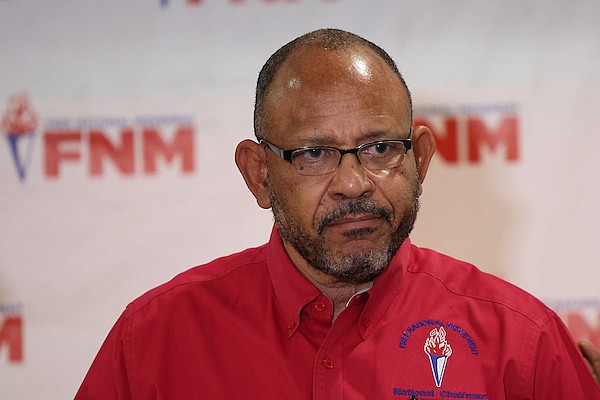
Free National Movement (FNM) Chairman Dr Dwayne Sands speaks during a press conference at FNM Headquarters on Sept 2, 2024. Photo: Dante Carrer/Tribune Staff
By NEIL HARTNELL
Tribune Business Editor
nhartnell@tribunemedia.net
The Bahamas is in “a far darker place than a decade ago” over the sale of unapproved and ‘grey market’ medicines, an ex-health minister asserted yesterday, adding: “The pirates are still here.”
Dr Duane Sands, also the Opposition’s chairman, told Tribune Business that the sale of prescription medicines without pre-approval from the purchaser’s doctor, plus the infiltration of so-called ‘grey and black market’ and counterfeit drugs, is “not an insignificant challenge” that has plagued The Bahamas for decades.
Disclosing that “some phamacies are worse than others” in dispensing medicines without a prescription, he added that price-controlled mark-ups at both the retail and wholesale level acted as an incentive for some to import and/or acquire drugs not authorised for sale in The Bahamas in a bid to increase profits.
Calling for regulatory oversight to be strengthened via Bahamas Customs and the Pharmacy Council, Dr Sands told this newspaper than when in Cabinet during the Minnis administration he had moved to enhance the latter’s staffing and resources in a bid to combat these problems, but warned that they will not be solved overnight.
Describing the cure as “a marathon, not a sprint”, he argued that it also requires a cultural and mindshift change where Bahamians no longer perceive the sale and consumption of non-prescribed, unregulated and counterfeit medicines as “a victimless crime”. The ex-health minister reaffirmed that the situation poses a danger to life and health given that someone can die, or be poisoned, from taking the wrong drug or a combination of medicines that react violently with each other.
“Unfortunately there is truth to the story,” Dr Sands said. “There are pharmacies that are in the business of prescribing and dispensing medicine without physician involvement. There are some worse than others. I believe it’s not an insignificant challenge. One of the problems is that you will have a whole lot of justification for not only that prescription but the distribution of grey market and/or black market medications.”
Pointing to economic motivations stemming from The Bahamas’ price control regime, he explained: “Let’s say I need to access a particular medication from a particular wholesaler, and the law says the mark-up can only be a certain dollar amount or percentage. There’s a maximum mark-up for wholesalers and a maximum mark-up for retailers.
“Suppose someone says they have a trailer load of drugs from Indonesia, Turkey, the Philippines, and all they have to do is change the packaging and re-seal the box. It’s from a recognised medicine brand, and you are now selling this product as if it is intended for this market. You don’t know about the supply chain, if it has been kept cold or been in someone’s back yard for six months, a year, but your profit margin - if you sell at the same price as if you bought from a legitimate wholesaler - these lower-cost ‘grey market’ drugs can generate potentially big profits. This is happening. It’s not insignificant.”
Dr Sands argued that the solution lies with increased enforcement and regulatory oversight of the entire Bahamian pharmaceutical industry, including its supply chains and imported medicine shipments. “It’s going to require a deep dive and real solution because someone is going to get hurt,” he told Tribune Business. “We have to strengthen the pharmical vigilance mechanism at the Ministry of Health and Wellness through the Pharmacy Council and Customs.
“There has to be an understanding that this is not a victimless crime. When you look at it with that perception, these [grey and black market suppliers] are Good Samaritans, these are Robin Hoods trying to help the poor people. I don’t know if that is necessarily the case. It’s primarily about profit. Sometimes the argument is the monopoly over pharmaceuticals in this country is challenging, and some of these private pharmacies cannot survuve because of competition.
“Whatever the argument, this is not a victimless crime,” Dr Sands added. “‘It’s OK, there’s a wink and a nod’, until something horrible happens and someone dies or gets poisoned through a drug-to-drug interaction. Without that level of physician involvement and pharmacy oversight, if that’s not followed somebody will take a drug that interacts with another drug and you have complications.
“We like to say we changed our motto from ‘Expulsis Piratis – Restituta Commercia’ (Pirates Expelled – Commerce Restored), which was our original pre-Independence national motto. Well, the pirates are still here.” Dr Sands said he had sought to boost enforcement when in government, adding: “We had been moving. We were moving to strengthen pharmical oversight and ensure the Pharmacy Council is appropriately staffed.
“This is not sprint. This is a marathon. We cannot take our eye off the ball. It also requires the public to participate in the discussion.” Dr Sands, though, said that too many Bahamians - struggling to afford healthcare costs and access the necessary care and medicines - are all too-willing to take a chance on acquiring non-prescribed drugs from pliant pharmacies and dispensaries.
“Occasionally that action may be reasonable,” he added, “but at other times it can actually be deadly. When you see someone who has not seen a doctor for five years, but they are getting their prescriptions filled every month, you have to ask how this is happening. This is not an issue about maintaining physician revenue; it’s about oversight.
“We have work to do. It demands that the level of vigilance be increased and we take a jaundiced view of anybody that contravenes the law. Not only the law, but also ethics and practice. The Pharmacy Act is pretty clear on what the rules are every step of the way.” Dr Sands said the growing use of generic or non-branded drugs is making the problem more difficult to police, while reassuring that he holds “no brief” for the large pharmaceutical manufacturers.
“We have to make sure the actions required to keep Bahamians safe with pharmaceuticals are happening because it needs to happen. It’s not happening as often as it needs to happen, and where we are now is a far darker place than a decade ago,” he told Tribune Business. “I’m sure the criticism would be ‘what did you do’ and so on and so forth. Well, it’s one of the reasons I’m involved in this sordid business called politics, but we have to get it sorted out.”
Ralph Munroe, Comptroller of Customs, told The Tribune that when large quantities of medications are imported to The Bahamas, the importer must present proper documentation showing their Business Licence and Tax Compliance Certificate. In the case of medication, the importer must also show evidence that they are an authorised importer of these products. While all “registered” pharmacies are licensed to dispense medications, only a handful of companies are authorised to import these products.




Comments
Use the comment form below to begin a discussion about this content.
Sign in to comment
OpenID