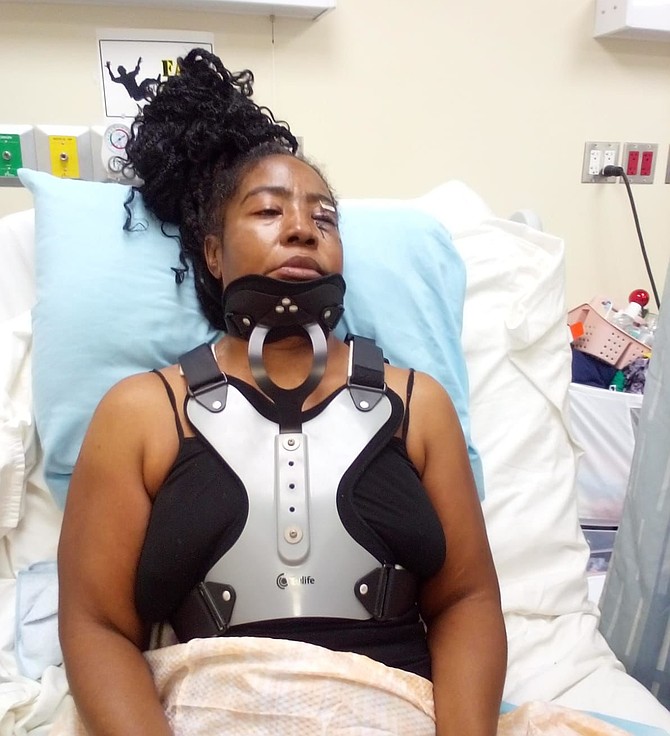
Anishka Pratt-Williams, car crash victim
By JADE RUSSELL
Tribune Staff Reporter
jrussell@tribunemedia.net
A CRASH that left a Grand Bahama preschool teacher with a broken neck and torn eyelids has thrown fresh light on what officials have described as a dangerous regulatory vacuum around ride-sharing services operating in The Bahamas, some falsely claiming to be “Uber” drivers.
Anishka Pratt-Williams had relied on a driver illegally offering ‘Uber services’ since September last year to travel home from work. Uber does not have a licence to operate in The Bahamas, and offering such services using private vehicles is illegal.
On January 26, her regular driver stopped at an establishment along the route and handed the keys to another man to complete the trip to Deadman’s Reef.
Heavy rain began to fall as they drove. Minutes later, the vehicle spun out of control and crashed into a tree.
“I ended up behind the driver’s seat with my legs stuck between the console of the car,” Mrs Pratt-Williams said yesterday. “I felt my head was bleeding, my eyes were bleeding. I didn’t realise that my neck was jammed or was broken as yet.”
Police and a passer-by with medical training stopped to assist before she was taken to Rand Memorial Hospital with two broken bones in her neck and torn eyelids that required 30 stitches.
The driver, whom family members allege had been speeding, was not seriously hurt. Mrs Pratt-Williams said he apologised repeatedly after the crash.
Doctors warned her family that the slightest movement could leave her paralysed or dead. Plans to airlift her to New Providence stalled because no bed was available at Princess Margaret Hospital.
Her husband, Samuel Williams, returned from a construction job on another island and was told a specialised neck brace could stabilise her enough to travel by commercial flight. He bought the brace from New Providence for about $2,300 using personal funds and donations. After wearing it for several days, doctors noted improvement in her X-rays and discharged her on Wednesday.
Questions about accountability quickly followed.
Mr Williams said the vehicle involved was a rental and claimed that the second driver was not listed on the insurance coverage. He said the operator initially promised financial help but later failed to follow through.
He provided The Tribune with the flyers advertising the ride-sharing services, offering ‘UberService, UberEats, UberErrands.’
When The Tribune asked the alleged business owner for proof of the required licensing to operate, the man declined to provide documentation.
Mr Williams described fake “Ubers” as “just a pretty word for hacking” and said allowing another person to take over the vehicle was “the height of negligence”.
Mrs Pratt-Williams said survival had strengthened her faith but also her resolve for accountability.
“I don’t want you to just think you can hurt me and just walk on by and live life with no consequences,” she said. “You don’t say sorry. You don’t say anything. You need to be held accountable some way somehow.”
In April 2025, the Ministry of Energy and Transport warned that the Road Traffic Department is the only legal agency authorised to issue grants for transportation for reward.
“Members of the pubic are advised that it is illegal to offer Uber or rideshare services to the public using private vehicles,” the ministry said in a statement in April 2025. “Further, the department is strongly warning the public that this practice is unsafe and dangerous.”
Despite that warning, a number of small businesses purporting to offer ride-share services have been appearing, some openly advertising online and distributing flyers that claim to offer “Uber” services.
Under Bahamian law, a driver transporting passengers for payment must hold a Public Service Driver’s Licence issued by the Road Traffic Department. The vehicle itself must be granted a Public Service Franchise, such as a taxi, livery, tour car or omnibus franchise, authorising it to carry fare-paying passengers. Operators must also hold a valid business licence from the Department of Inland Revenue, carry commercial passenger insurance rather than private insurance, and ensure the vehicle passes public-service inspections and displays the correct franchise plates and licence disc. Without those approvals for both driver and vehicle, transporting passengers for payment in a private car is unlawful.
While the department has repeatedly warned about the dangers of illegal ride-sharing, it has never publicly released data showing how many complaints it has received, how many prosecutions have been brought, or how many vehicles have been seized in connection with the practice.
The incident has renewed warnings from the Bahamas Taxicab Union.
Union president Tyrone Butler said yesterday that many people mistakenly believe they can operate small ride-sharing businesses without meeting requirements. He said the union has previously rejected proposals involving Uber because the model conflicts with existing laws and insurance standards.
Mr Butler said he shared details of Mrs Pratt-Williams matter with Acting Road Traffic Controller Linda Moxey, and she acknowledged receipt of the information. Attempts by The Tribune to reach Ms Moxey were unsuccessful after an initial phone call with her was abruptly disconnected.
For Mrs Pratt-Williams, the regulatory debate is now personal. Neither she nor her husband can work as she recovers and prepares to travel to New Providence next week for further medical evaluation.
“We don’t want an overflow (of money). We just want enough to be able to sustain ourselves during this time,” she said.




Comments
bahamianson 1 hour, 16 minutes ago
Thoughts and prayers are with you. I pray you have a speedy recovery. So sorry for the situation you are in.
Sign in to comment
OpenID