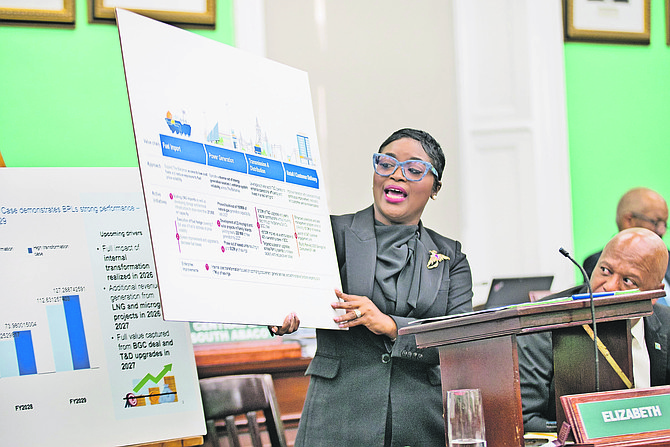
ENERGY and Transport Minister JoBeth Coleby-Davis shows a graph during the House of Assembly on February 4, 2026. Photo: Chappell Whyms Jr
By RASHAD ROLLE
Tribune News Editor
rrolle@tribunemedia.net
THOUSANDS of households paid at least 15 percent less for electricity in 2025 under the Equity Rate Adjustment (ERA) programme, Energy and Transport Minister JoBeth Coleby-Davis told the House of Assembly yesterday, saying the tariff reform is already delivering measurable savings for consumers.
Mrs Coleby-Davis said that, on average last year, 44 percent of residential customers paid bills that were at least 15 percent lower than they would have been under BPL’s pre-ERA tariff for the same level of consumption. Using a five percent benchmark, she said 82 percent of customers — about 78,252 accounts — were positively affected.
BPL’s records, she said, showed that 30 percent of residential customers had bills under $125 during the summer months, rising to as many as 60 percent in winter.
She said the ERA is projected to save consumers about $11.4 million annually, with a further $92 million in savings expected when the system transitions to liquefied natural gas (LNG), leaving “more than $100 million” in the domestic economy each year.
Mrs Coleby-Davis also pointed to improvements in reliability, saying outage frequency fell by about 45 percent in 2025, while outage duration dropped by 35 percent. On normal operating days, she said both outage frequency and duration declined by nearly 50 percent.
She attributed the improvements to metering upgrades, grid controls and the gradual replacement of temporary generation with repaired capacity, microgrids and permanent solutions.
She said expensive rental generators — long used to stabilise supply during breakdowns — are now being “phased out in a structured and responsible manner” as new capacity comes online, delivering recurring savings while maintaining reliability.
The minister linked those operational and consumer gains to resolutions before the House that would see the Government guarantee performance letters of credit tied to the LNG supply agreement and the development of the regasification terminal at Clifton Pier, along with a revolving line of credit to meet LNG obligations without emergency borrowing.
She said the guarantees formalise “controlled and managed risk” while supporting what she described as a cleaner, more reliable system that is already producing visible improvements in reliability and cost.




Comments
Use the comment form below to begin a discussion about this content.
Sign in to comment
OpenID