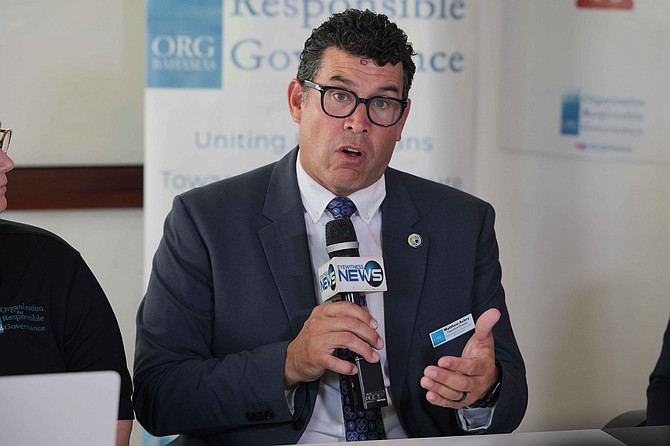
Matt Aubry Photo: Nikia Charlton
By LYNAIRE MUNNINGS
Tribune Staff Reporter
lmunnings@tribunemedia.net
THE Bahamas’ steady showing in Transparency International’s latest corruption index masks a deeper problem: despite years of legislative reform, many Bahamians still do not feel the impact of anti-corruption efforts in their daily lives, a governance advocate warned yesterday.
Matt Aubry, executive director of the Organisation for Responsible Governance, said the country’s score of 64 out of 100 in Transparency International’s 2025 Corruption Perceptions Index should be taken seriously, but not viewed as a definitive measure of lived experience. The Bahamas ranked 29th out of 182 countries, tying with the United States.
Mr Aubry said the index, while influential, reflects the views of a narrow group rather than the wider public.
“When we're thinking about the index itself, it's a measure of perception, and it's a measure of perception, from a somewhat limited perspective,” he said. “It is independent experts, it's business folks for the most part, but that also reflects that it's a barometer that others might look at.”
He added that the ranking can shape the type of investors the country attracts.
The Bahamas’ CPI score has remained largely unchanged over the past five years. The country scored 63 in 2020; 64 in 2021, 2022 and 2023; 65 in 2024; and 64 in 2025. The index measures perceived levels of public-sector corruption on a scale from zero, considered highly corrupt, to 100, considered very clean.
Mr Aubry pointed to several laws passed in recent years, including the Independent Commission of Investigations Act, but said the public has yet to see tangible benefits from those initiatives.
He argued that corruption and unfair systems disproportionately burden vulnerable communities, particularly in the Family Islands, and are closely linked to cost-of-living pressures. Despite new laws, he said, many Bahamians do not perceive meaningful change, echoing Transparency International’s broader concern that global leaders are failing to prioritise anti-corruption efforts.
Mr Aubry said delaying reform in favour of other political priorities mirrors an international pattern and entrenches inequality, harming historically marginalised communities. He said a fairer system could directly ease economic pressure by rewarding merit rather than political connections, while greater transparency would encourage small-business growth and innovation.
He also cited regional data highlighting persistent community-level concerns. A 2018 corruption barometer found that about 20 percent of respondents in The Bahamas reported having paid a bribe.
“We were listed as the highest in the Caribbean who just paid a bribe without even being asked. So we've ingrained some of that behaviour as this is how you get around a system that doesn't work in the way that we think it should work,” he said.
Mr Aubry said expanded electronic government services, such as online licence renewals and vehicle registration, could reduce opportunities for bribery by limiting face-to-face interactions, but warned that legislation alone is not enough without public education.
“We have to get past the language of corruption and freedom of information and get back to fairness and opportunity, which every Bahamian is looking for, is hoping for, the ability to succeed based on your own merit and your own capacity, is the heart of really tapping into our potential,” he said.
He described the CPI as “a good message” and “a good check and balance”, but said real progress will depend on fully implementing and resourcing reforms so that Bahamians see clear improvements in everyday life.




Comments
Use the comment form below to begin a discussion about this content.
Sign in to comment
OpenID