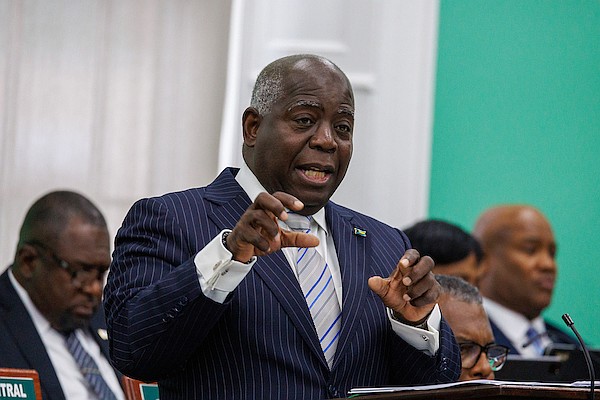
Prime Minister Philip Davis speaks in the House of Assembly on July 23, 2025. Photo: Dante Carrer/Tribune Staff
By NEIL HARTNELL
Tribune Business Editor
nhartnell@tribunemedia.net
Unpaid invoices and arrears owed by the Government increased by 97.6 percent, or almost $120m, year-over-year to hit $241.898m as a year-end 2025, the mid-year Budget disclosed yesterday.
Documents tabled in the House of Assembly revealed that sums owed to suppliers, vendors and other purveyors of goods and services to the Government had increased significantly and almost doubled compared to the $122.425m shown to have been due exactly one year before on December 31, 2024.
The 2025 year-end figures showed that close to three-quarters of this sum, or a combined $176.606m worth of unpaid invoices and arrears, were owed by just five government ministries and entities. The one with the largest liabilities was shown to be the Ministry of Works, which commissions and funds large-scale infrastructure and public works projects. It was shown as owing $46.327m in unpaid invoices that fall under capital expenditure, plus a further $21.562m in arrears, for a total $68.095m.
The Water & Sewerage Corporation was shown as owing $38.185m in unpaid invoices, while the Ministry of the Public Service had $18.251m in arrears, and $6.111m in invoices awaiting payment, for a total $24.362m on its books as at year-end December 31, 2025. That, though, represented a major 63.8 percent decrease on the $67.262m that the latter was said to be owing at year-end 2024 - with unpaid invoices having been reduced significantly from the $49.171m outstanding then.
Others shown to have built-up significant accounts payables at year-end 2025 were the Public Hospitals Authority (PHA), operator of the Princess Margaret Hospital (PMH), Rand Memorial Hospital and Sandilands Rehabilitation Centre, which was owing $22.609m via a combination of $16.689m in unpaid invoices and $5.919m in arrears. Bahamasair, too, had some $23.355m in outstanding invoices that required paying.
The mid-year Budget documents show that, in total, the Government owed $20.993m in invoices classified as recurrent spending; $59.936m in unpaid invoices relating to capital spending; and accumulated collective arrears worth $60.542m, while state-owned enterprises such as the PHA, Bahamasair and Water & Sewerage owed the largest collective sum at just over $100m.
These figures represent a one-time snapshot of the Government’s accounts payables, or sums due and owing to outside third parties, meaning that they do not represent a continuous trend and the situation may have changed significantly over the past two months.
However, the near-$120m year-over-year increase is likely to reinforce the suspicions of many in the Bahamian business community - especially those owed major sums by the Government for some time - that it is having critical cash flow and liquidity challenges when it comes to paying its bills in full and on a timely basis.
Elsewhere, the collective value of proposed financial guarantees being sought from the Government by its state-owned enterprises (SOEs) has declined by almost $236m from what the 2024-2025 mid-year Budget reflected. At that point, SOEs were looking to the Government to underwrite some $551.582m in financing for various projects ny promising to step in and pay if they defaulted on their loan/debt obligations but, one year later, this collective amount has fallen to $315.592m
That is still a hefty total, with the Bahamas Mortgage Corporation said to be pursuing the largest guarantee of some $142.5m - the purpose for which is unknown, although it could be to refinance existing bond debt. The Water & Sewerage Corporation is also seeking government underwriting support for a $52.944m guarantee, with the Bahamas Development Bank and PHA also after $35m and $31m, respectively.
Smaller sums are also being eyed by the Clifton Heritage Authority, which is seeking a $16m guarantee, and the Bridge Authority, whose requirements are for a relatively modest $8m.
Meanwhile, the Government also drew on almost 50 percent of the $50m Budget reserve appropriation placed within the Ministry of Finance’s Budget for 2025-2026. The Davis administration accessed $23.733m of this sum during the six months to end-December 2025, split into $9.987m to cover four different recurrent, or fixed cost, spending commitments and $13.746m in capital expenditures for school and road repairs.
Some fiscal observers, though, questioned the use of this Budget reserve for such purposes, arguing that the $50m represented monies set aside to cover unexpected issues that need to be paid, yet the uses should all have been known to the Government. Of the $9.987m used for recurrent purposes, some $3.774m was employed by the Department of Inland Revenue for “payment of lease agreements” while another $1.5m was paid to the Bahamas Air Navigation Services Authority (BANSA).
Of the remaining balance, some $2m was assigned to make overtime payments to Customs officers while another $2.713m was used by the Ministry of Finance for bond repayments - an expense it should have known was coming.
The Opposition has frequently used the Government’s travel spending and budget as a stick with which to bash the Davis administration. And it is likely to use the mid-year Budget documents for this purpose again, as some $883,685 has been re-purposed from allocations assigned to consultancy services and marketing and promotion in the Prime Minister’s Office’s budget to fund travel by Mr Davis and his officials to Caribbean-related conferences in Brazil and Ethiopia, plus to the UK to meet King Charles III and attend the United Nations (UN) general assembly.
In total, the Davis administration re-purposed - meaning it moved monies approved by Parliament to different Budget line items within the same ministry or agency - some $9m worth of recurrent spending during the 2025-2026 first half. Some $26.674m was also re-purposed on the capital budget side.
Another noticeable disclosures in the mid-year Budget were that the Bahamas Public Parks and Beaches Authority had exhausted almost 87 percent of its allocated $29m full-year subsidy during the first six months. Some $25.179m had been spent during the fiscal year’s first-half, which is especially noteworthy in an election year given that several sources have described the agency as akin to “street-level patronage” funded by the taxpayer.
Some $125.837m worth of Customs duty and excise tax breaks, on goods collectively valued at $472.736m, were granted during the 2025-2026 fiscal year’s first-half. The bulk of these concessions and exemptions, some $59.026m worth, were processed using the Hotels Encouragement Act.
The Government’s full-year spending forecast has not altered, with a projected $3.164m rise in recurrent expenditure cancelled out by a reduction of the same magnitude on the capital expenditure side. Those ministries receiving an increase in their recurrent budget include the Ministry of Health and Wellness, at $2.284m, and the Ministry of Tourism, Investments and Aviation at $1.95m.




Comments
Dawes 2 hours, 10 minutes ago
Ahh so the surplus will occur by not paying bills. Then a massive debt next year, but by then election over
tell_it_like_it_is 1 hour, 49 minutes ago
What a sad state of affairs! The government has no shame. SMH
Sickened 42 minutes ago
The PLP has no clue what fiscal responsibility is. I guess you just never learn how to balance a budget when you have an unlimited amount of money coming in. It must be nice to be irresponsible.
Sign in to comment
OpenID