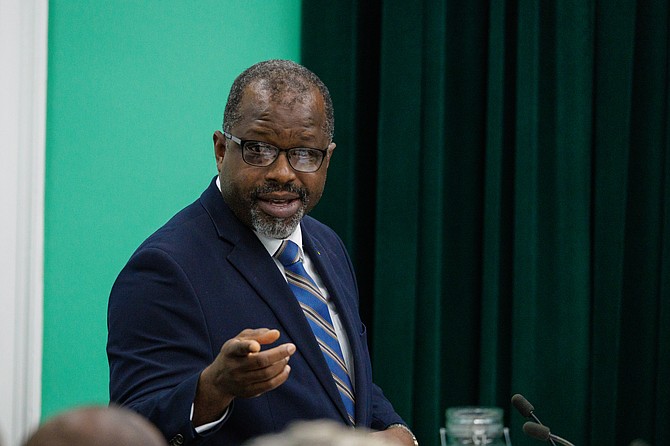
Minister of National Security Wayne Munroe. Photo: Dante Carrer/Tribune Staff
By LYNAIRE MUNNINGS
Tribune Staff Reporter
lmunnings@tribunemedia.net
National Security Minister Wayne Munroe yesterday dismissed claims that the government owed Colina $100 million after the Police Staff Association (PSA) said officers’ spouses and children were being denied medical services as a result of not being enrolled on the government’s health insurance plan.
Mr Munroe insisted police medical coverage remained active, adding that he had received the PSA memo but noted that the association had not provided detailed information about the affected officers, which limits the ministry’s ability to advocate on their behalf.
He explained that while the Defense Force and Correctional Services work directly with the ministry to resolve similar issues, the PSA has primarily relied on public statements rather than meetings with officials.
“I have given the memo to my permanent secretary for her to investigate,” he told The Tribune yesterday. “I am the advocate for the police, corrections, and defense force, I tell them that. So, I tell them if I'm their advocate and they have an issue come to me, let us know the facts and then we can advocate on that behalf.”
He emphasized that existing coverage remained active, noting that if the government truly owed Colina money, other public servants would also face denied services, which has not been the case.
"If the government owed this money, and that was a reason not to pay. Then nobody would get any services, including me, 'cause the policy that covers me, is the same as police. I would not have been able to go get my hypotensive medication on it, or go see the doctor on it.
"The defense force wouldn't be able to do it. The corrections wouldn't be able to do it. The other public servants who were covered by it wouldn’t be able to do it and none of them are saying the same thing as the police staff association, they are the only one saying it," Mr Munroe said yesterday.
These comments come as PSA chairman Ricardo Walkes said the issue affects officers who recently married or had children and submitted the required documentation to add dependants to their insurance. Despite providing the necessary information, officers discovered their families were not covered when seeking medical care at hospitals and clinics.
The association’s letter to members, dated January 7, described the matter as “urgent and troubling” and said the problem had persisted for more than a year. Walkes noted that the PSA was aware of at least 10 officers whose children were denied coverage and at least three officers whose spouses were unable to access medical services.
According to Mr Walkes, Colina informed him that the government owed the insurer funds and requested at least a partial payment of $30 million before enrolling dependants. He said warnings had previously been issued to the government regarding the consequences of non-payment, but the outstanding balance continued to grow.
Mr Walkes emphasized the financial and emotional strain the situation imposes on officers, noting that medical care can be prohibitively expensive. “This doesn't just affect the members of the police force but also corrections, the defense forces, customs, and other government employees,” he said, highlighting the broader implications for public servants.
Mr Walkes also said that affected officers were not warned about the lapse in coverage. He noted that Colina had previously offered the government a structured payment plan to reduce arrears and maintain enrolment for dependants, but no response had been received from government officials. He stressed that a timely resolution was critical to ensure officers and their families have access to necessary medical care, given the physical and emotional demands of police work.
The PSA has repeatedly sought meetings with the Prime Minister and other government officials to discuss the insurance issue but said it received no response. Mr Walkes warned that the denial of coverage poses serious risks to officers and their families, particularly given the hazards of police work, including potential exposure to infectious diseases such as tuberculosis or viral illnesses.
He suggested the situation mirrors last year’s dispute with Colina, when coverage was threatened due to unpaid bills.
Mr Walkes added: “Medical care is quite expensive, and then when you take your children to the hospital, no matter what the care is, anything out of pocket could be very costly, and this doesn't just affect the members of the police force but also affects corrections, the defense forces, customs and immigration, and some other government employees, so it goes across the board understood.”
He further noted that Colina was seeking a partial payment before enrolling dependants.
“Not all of the fees owed, at least make a payment. What they're saying is that they're expecting a payment of at least $30 million before they would enroll those persons into the plan.” He added, “I would just like to them to pay Colina what is owed to them. What the persons at Colina said to me is that they offered the government more of a payment plan to bring this bill down and keep it down. However, they haven't heard anything back from the government, either.”
The claims represent the latest instance in which the government has been accused of falling behind on payments to medical providers, following repeated concerns raised by doctors who say they are still awaiting reimbursement through the National Health Insurance scheme.




Comments
ThisIsOurs 1 month, 2 weeks ago
"if the government truly owed Colina money"
Isnt this a relatively easy question to answer? You dont run up 100million in bills in one month, surely someone in the accounting dept has notified somebody in a monthly report that health insurance premiums are behind.
Why do ministers and the PM always do this I have to investigate dance? If they dont know basic info about their ministries why are they ministers??
Sign in to comment
OpenID