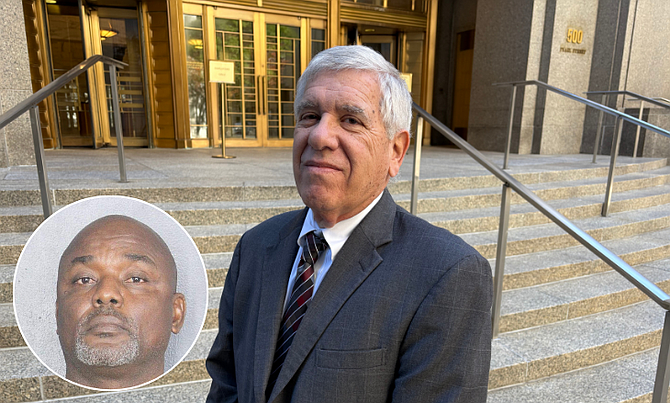
Martin Roth represents Darrin Roker (inset).
By TRIBUNE STAFF REPORTER
AS a former chief petty officer with the Royal Bahamas Defence Force was yesterday jailed for four years for facilitating cocaine smuggling to the US, his lawyer launched an astonishing attack on the Bahamian government, claiming the “entire system is infected with drug money and corruption”.
“The entire system in The Bahamas — the police, defence officials, government personnel — is corrupted,” said Darrin Roker’s lawyer, Martin Roth, before US District Judge Gregory Woods told the 56-year-old defendant, who had begged for mercy because of his terminal cancer, that his conduct warranted a prison sentence because he had used a “position of trust” to “enrich himself”.
Prosecutors also revealed that although Roker’s involvement in the case for which he was sentenced — involving 1,000 kilograms of cocaine — was in its latter stages, they believed he had in fact been involved in drug trafficking “previously for many years prior to that”.
DARRIN ROKER
Ultimately, the judge spared Roker, whose tearful wife Nicole was in the public gallery, from a jail term of up to 20 years because of his terminal prostate cancer diagnosis — a “powerful mitigating factor” that otherwise would have seen him imprisoned for far longer.
Roker’s lawyer Martin Roth admitted: “He (Roker) was weak. He wasn’t himself. In that moment of weakness, he joined the conspiracy and took the $20,000…”
“...It’s not easy when you are living in a culture where the entire system, almost every branch, is infected with drug money and corruption.”
Prosecutor Jonathan Bodansky also criticised The Bahamas and said that traffickers rely on “corrupt government officials and police” like Roker in order to ship their drugs to the US.
Roker had admitted one count of cocaine importation conspiracy and begged for mercy from the judge, saying he had “lost everything”.
Roker is the first of 13 people to be sentenced in a sprawling case involving corruption that includes numerous police officers and a “high-ranking Bahamian politician”.
Among the other defendants is Elvis Nathaniel Curtis, 51, a former Royal Bahamas Police Force chief superintendent who was the officer in charge of a police station in the airport.
The case has caused acute embarrassment for the authorities in Nassau and focused attention on The Bahamas’ failure to clamp down on drug trafficking.
At the federal court in Manhattan, Roker walked in wearing a tan-coloured, prison-issue top and pants, with shackles on his legs.
He smiled at his wife Nicole, who dabbed her eyes with a tissue throughout the proceedings, and two other family members.
Addressing the judge, Mr Roth said that Roker had become involved with the conspiracy near its end and attended just two meetings, in August and October 2024.
During the second meeting, Roker took a $20,000 bribe in exchange for information that would help drug traffickers avoid detection.
Mr Roth said that Roker had made a “fatal error” and called his decision “uncharacteristic bad judgement on his part”.
In addition, Roker had undergone gruelling radiotherapy for his cancer in early 2024 and was still recovering when he went back to work and took the bribe.
Mr Roth said that Mr Roker “doesn’t want to die in prison” and wanted to be released into the care of his wife.
Asked to address the court, Roker stood up and said that his cancer had been like a “monster” and that sometimes he sleeps for 23 hours a day.
Roker, a father of two whose adult children live in Canada, pleaded with the judge to give him “another chance”.
“That’s all I can ask, and thank God,” Roker said. “I want a chance to go back home to my family. I have lost everything in The Bahamas: my job, my pension. I have nothing else but my family.”
The court was later told that Roker had been fired from his job — he had joined the military in 1998 — and that he had therefore forfeited his pension and health insurance.
Prosecutor Bodansky painted a different picture of Roker and said his crimes were “extremely serious”.
Mr Bodansky said the drug deal Roker had agreed to provide information about involved 1,000 kilograms of cocaine.
According to Mr Bodansky, Roker shared the locations of US anti-drug boats so traffickers could avoid detection; promised to help recover any drugs dumped overboard; and advised traffickers on what type of vessel to use so they would not be caught.
In an ordinary case, Roker’s crimes would warrant a “substantial” term of imprisonment, but in light of his cancer diagnosis, prosecutors sought a five-year jail term.
Mr Bodansky said that while it was true Roker joined the conspiracy later on, they believed he had been involved in drug trafficking “previously for many years prior to that”.
As Judge Woods read out the sentence, Roker appeared nervous and briefly held his head in his hands.
The judge said the crimes were “very serious” and that the amounts of cocaine involved were “enormous”.
“He facilitated maritime drug trafficking by using his official position to obtain sensitive information about law enforcement operations” and providing it to drug traffickers, the judge said, adding: “He held a position of trust. His government placed him in a position of trust in the military.
“He used his role as a government official… to enrich himself.”
Judge Woods described Roker’s health challenges as a “powerful mitigating factor” and, in a warning to other defendants, said that without it he would have faced a “substantial period of incarceration”.
The fact that Roker became involved with the conspiracy despite having a successful career and having married his wife that same year was “problematic”, the judge said.
In addition to the four years in prison, Roker will have three years of supervised release, with the special condition that he must allow a probation officer to search his home and electronic devices if they suspect he is engaging in criminal activity.
The court also entered a formal money judgment ordering Roker to forfeit $20,000 — the amount prosecutors said he personally received from the conspiracy — after he admitted the proceeds could not be located. The forfeiture forms part of his criminal sentence and allows US authorities to pursue other assets of equal value if the money is not recovered.
Roker’s wife and Mr Roth both declined to comment after the case.
Also in court was Leroy F Major, the Consul General of The Bahamas in New York. He said he was there to “support” Roker and his family.
Five other defendants are currently in custody in the US, including Curtis and Prince Albert Symonette, 52, a former RBPF sergeant. Both Curtis and Symonette are accused of taking a $10,000 cash bribe in 2023 as a down payment for helping to get a future 600-kilogram cocaine shipment through Nassau airport to the US.
The other defendants who are in custody are next due in court on February 25, at which point Judge Woods has said he expects to set a trial date.




Commenting has been disabled for this item.