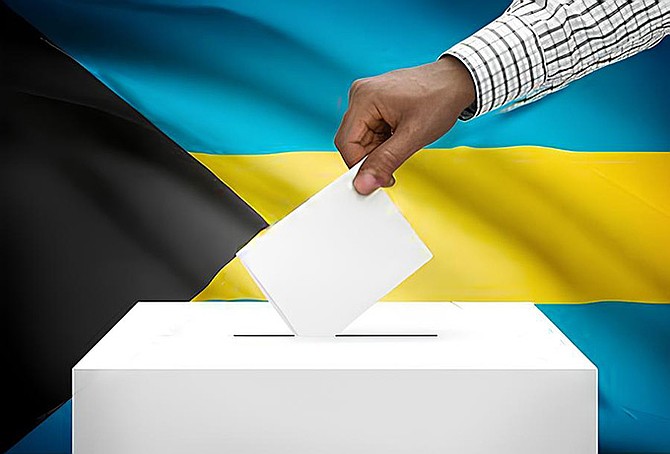
A ballot box. (Parliamentary Registration Department)
By LEANDRA ROLLE
Tribune Chief Reporter
lrolle@tribunemedia.net
AS The Bahamas edges closer to a general election this year, signs of voter apathy are emerging among some first-time voters, many of whom say they are unlikely to cast a ballot because they feel uninformed, unconvinced by political parties and doubtful that any election outcome will deliver meaningful change.
The mood among young voters comes as both major parties intensify election-readiness efforts amid speculation of an early poll.
The Tribune canvassed views at the University of The Bahamas on Friday, where several students spoke candidly about their voting intentions, impressions of political parties, and concerns about the country’s direction.
Rowan Sands, 19, a mechanical engineering student and first-time voter, said he remains undecided about whether he will vote and would need to do more research before making a decision.
He said party loyalty would not determine his choice, explaining that he would instead focus on individual candidates, their ideas and what they propose to bring to the country.
Reflecting on national issues, Mr Sands said The Bahamas needs stronger fiscal discipline, better infrastructure — particularly roads — and greater economic diversification.
“I think we need to branch out in terms of income, because tourism from, at least from COVID, we kind of found out that tourism isn't cutting it for the bulk of our needs,” he added. “So, we definitely have to expand and use more of our natural resources.”
Paige, 21, a nursing student, said she was not enthusiastic about voting and was unsure whether she would participate at all.
She said she does not feel adequately informed and believes political parties have failed to meaningfully engage and educate first-time voters about their plans.
She identified tourism, culture and the economy as areas requiring greater focus and expansion, and said the Davis administration could perform better. She added that the Progressive Liberal Party should only be granted a second term if it delivers on its promises.
Other students expressed deeper scepticism, saying they do not plan to vote because they see little distinction between political parties.
Tina, who recently turned 21, said she does not see the point in voting, arguing that outcomes remain the same regardless of who is in power.
“It don’t matter what party in power; it's always the same results,” she said. “I think the only thing that they usually change is just VAT, oh, we're gonna take VAT off of this and increase VAT on this.”
The architecture student said the government’s recent VAT cut announcement would not influence her vote, adding that she believes such measures often come with hidden consequences.
She said the country has significant untapped potential but criticised the concentration of essential services on a handful of islands. She highlighted the lack of hospitals on many islands and described conditions at Princess Margaret Hospital as poor and in urgent need of improvement.
“I think the citizens themselves need at least some type of union, because no party is doing great,” she said. “I think citizens for every country need to unite and just do something.”
Angel, another nursing student, said she is also apprehensive about voting, describing political parties as self-serving and disconnected from the needs of ordinary people.
“The people who get in power, they only look after their families,” she said. “I feel like they should do more for the community and the people who are in need.”
She was critical of the Progressive Liberal Party, saying that while it may appear effective on paper and during campaigns, it fails to deliver for the public. She said improvements are needed across government, particularly in healthcare.
“But if it comes down to me voting, I’ll vote for the FNM because I grow up around people who vote for the FNM,” she said.
An 18-year-old nursing student, who asked not to be named, was blunt about her decision not to vote.
“It don't make no sense,” she said. “Like, everybody just going back and forth with the PLP and FNM, and none of the parties are making sense to me, to be honest.”
Not all students, however, were dismissive of the electoral process.
Malik, an 18-year-old accounts major, said he plans to vote largely because of family pressure, though he admitted he does not fully understand the appeal.
He said he is undecided about which party to support, noting that the platforms often seem similar and confusing. Still, he said he is moderately satisfied with the Davis administration’s performance but believes more needs to be done, particularly with job creation outside tourism and another increase to the minimum wage.
“I would rate them around a seven,” he said. “Overall, the government’s service is a little bit good. I’ve noticed some great changes in government buildings and stuff.”




Comments
TalRussell 3 weeks, 6 days ago
I checked and there's no mood amongst either the governing "yellah" shirts or the king's opposition "red" shirts to ever have appointed an "ethics advisor."
Likes the two have the same mirror that blows first-time voting Long Islanders away-how much the two look so alike. --- Yes?
birdiestrachan 3 weeks, 5 days ago
They will do well to learn that sitting on one's backside and doing nothing accomplish nothing
joeblow 3 weeks, 5 days ago
... its not only first time voters that have apathy toward the next election! The only difference between the two parties is their names. They are equally committed to self service over national service!!
Sign in to comment
OpenID