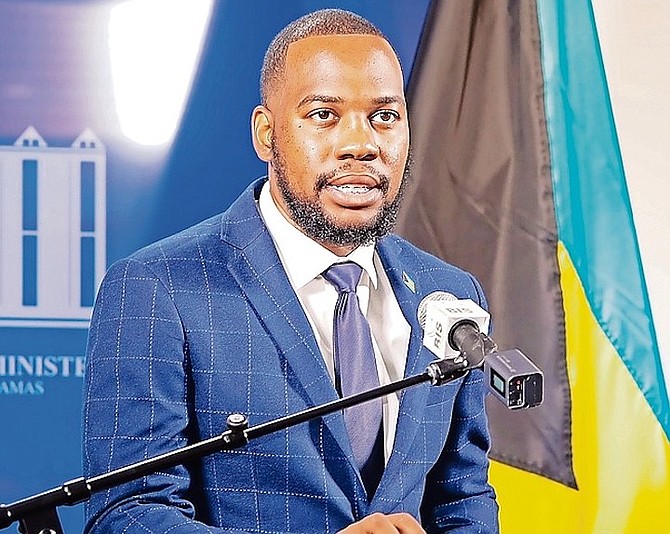
Director of communications in the Office of the Prime Minister Latrae Rahming. (File photo)
By NEIL HARTNELL
Tribune Business Editor
nhartnell@tribunemedia.net
Misgivings were last night voiced about the Government’s planned purchase of Grand Bahama Power Company after it was confirmed that the Prime Minister was referring to an “acquisition” as opposed to just taking regulatory “control” over the energy monopoly.
Latrae Rahming, the Prime Minister’s communications director, in messaged replies to Tribune Business said the memorandum of understanding (MoU) with Emera that Philip Davis KC revealed yesterday “sets out the framework” for purchasing GB Power from the Canadian energy giant although he did not provide further details.
“This is an acquisition,” Mr Rahming confirmed in response to this newspaper. Asked how the deal is being structured, and how much the Government is paying for what appears to be a controlling interest in GB Power based on the Prime Minister’s comments, he added: “This MoU sets out the framework for the acquisition to be completed. Once done you’ll have your answers.”
Mr Davis himself, when asked how quickly Grand Bahama businesses and households would feel the benefits of lower energy costs and rates as a result of the deal, replied that the deal set-up by the MoU will likely take two to three months to close. “As soon as the transaction is closed,” he promised, “and we estimate it will take about 60 to 90 days for the closing.”
The Prime Minister, in his address on the Government’s plans to revive Grand Bahama’s economy, was not clear over whether the MoU deal represented an acquisition of GB Power or simply his administration gaining more regulatory control and oversight of the utility in a bid to harmonise Grand Bahama’s electricity costs and future energy-related developments with the rest of The Bahamas.
He touted the MoU as the “first time” that the Bahamian government has gained “control” of GB Power since the Hawksbill Creek Agreement, Freeport’s founding treaty, was signed in 1955 and pledged that it would end “the long-standing disparity” between electricity prices on Grand Bahama and the rest of the country.
“This MOU reflects a shared commitment to explore a new path forward for energy in Grand Bahama. When completed, this would mark the first time the Government of The Bahamas could control the power company since the Hawksbill Creek Agreement was signed,” Mr Davis asserted yesterday.
“This is important because it will result in universal electricity rates across The Bahamas, ending a long-standing disparity between Grand Bahama and the rest of the country. It matters because it strengthens national energy planning. And it matters because it directly supports our broader energy reform agenda aimed at bringing down the cost of electricity for Bahamian households and businesses.
“This is not about control for its own sake. It is about fairness. It is about affordability. And it is about aligning energy policy with the needs of the people and the modern economy we are building,” Mr Davis said. “Lower energy costs mean lower costs of living. They mean more competitive businesses. They mean a stronger foundation for investment, job creation and long-term growth in Grand Bahama and across the country.
“This MOU represents progress. It reflects careful work, serious engagement and a willingness to do what previous administrations avoided. We are moving deliberately, responsibly and in the public interest.
Executives at both GB Power and the Grand Bahama Port Authority (GBPA), Freeport’s quasi-governmental authority which presently acts as the utility’s regulator, were tight-lipped on the Prime Minister’s announcement last night. Several promised to get back to Tribune Business last night but no responses were received before press time.
However, concerns and misgivings were voiced over the Government’s plans. Pastor Eddie Victor, head of the Coalition of Concerned Citizens, the long-time vocal GB Power critic, told Tribune Business that while he backed greater regulatory oversight and control from Nassau, the Government “doesn’t have a good track record” owning and operating electrical utilities.
Pointing to Bahamas Power & Light (BPL), he said: “If it’s a regulatory alignment then I am so happy if that’s all it is. If it’s ownership, it’s not the best scenario for Grand Bahama. First, the Government doesn’t have a good track record when it comes to power generation in Nassau and the Family Islands.
“Second, the best scenario for Grand Bahama, I believe, is for another private company to come in and purchase the Power Company and invest the monies to provide more affordable electricity rates but working in alignment with regulatory control for the rest of The Bahamas. It’s primarily from a management and administrative of view that I’m coming from for how the Power Company should be run.
“The Government doesn’t have a good track record on that. If they’re just taking regulatory control, if that’s it, it’s good news and we’ll see how it works out if that’s the case and how it proceeds from there,” Pastor Victor added.
“That company needs to get into the hands of another company that has the money and resources to turn the company into what it needs to be. That’s how I feel.” Another Grand Bahama source, speaking on condition of anonymity, said of the proposed government acquisition: “Damn, that is not good news.
“They can’t run their own place and now they’re going to come to ours. We have a mega union [in GB Power] and they get paid really well here. That’s going to be drama.” It is also unclear whether any deal will deliver the promised reduction in electricity bills and rates for Grand Bahama customers compared to the rest of The Bahamas.
The Prime Minister’s statement on GB Power, and the deal with Emera, was short on specifics and leaves numerous questions unanswered. One was posed by Dillon Knowles, the Grand Bahama Chamber of Commerce president, who told Tribune Business: “I doubt the have the ability to make the acquisition.”
Besides the unknown purchase price, and lack of clarity on how the deal is being structured and where the financing is coming from, it is also unclear whether the Government is acquiring all of Emera’s GB Power ownership or just a majority equity interest. The Canadian power giant secure 100 percent control when it bought out all Bahamian minority shareholders some years ago - some of whom elected to take Emera shares as compensation via Bahamian Depository Receipts (BDRs).
Among the unanswered questions, should the deal envisaged by the MoU complete, is whether it will be the Government - or some other entity such as Bahamas Power & Light (BPL) or a special purpose vehicle (SPV) - financing and making the acquisition. Both the Government, with an $11.5bn debt and cash flow woes, and BPL’s burden of $1bn in combined debt and capital needs, would appear to be ill-placed to fund what could be an eight or even nine-figure purchase price.
Other issues will likely be whether GB Power’s management and operations would be outsourced to the private sector, via a utility such as BPL, and whether it will be incorporated into the Davis administration’s wider energy reform plans involving BISX-listed FOCOL Holdings (Bahamas Utility Holdings) and Bahamas Grid Company (Pike Electrical). Union agreements, staffing levels and needed investment will also have to be addressed.
And, by purchasing GB Power, the Government will also insert itself into the ongoing Supreme Court battle over whether the GBPA or the Utilities Regulatory and Competition Authority (URCA) has ultimate supervisory authority over GB Power. The Government could find itself in a situation where an electricity utility that it owns is being regulated by the GBPA, whose authority is being disputed, and with which it is locked in a $357m arbitration dispute - a ruling upon which is expected imminently.
Some observers yesterday suggested that the GB Power move is at least partly designed to pierce, or hole, the Hawksbill Creek Agreement and the regulatory powers bestowed on the GBPA while also circumventing, and increasing the pressure on, Freeport’s quasi-governmental authority.
Emera set out the supervisory struggle in previous regulatory filings. “With $340m of assets and approximately 19,500 customers, GB Power owns 98 mega watts (MW) of oil-fired generation, approximately 90 kilometres of transmission facilities and 994 kilometres of distribution facilities,” it said.
“On June 1, 2024, the Electricity Act 2024 took effect. The legislation purports to remove the jurisdiction of the GBPA over GB Power, and to have URCA, another Bahamian regulator, regulate GB Power. The GBPA has opposed the legislated removal of its regulatory authority over GB Power, citing conflict with the Hawksbill Creek Agreement, the 1955 agreement with the Bahamian government that provided for the development and administration of the Freeport area.” The dispute is presently before the Supreme Court.
GB Power has also been struggling to have its proposed rate adjustment approved by the GBPA after the latter suspended its assessment of this after Grand Bahama suffered a series of outages and blackouts in 2024. Similar problems occurred last summer. The new tariff structure was designed to generate sufficient cash flow to finance some $53m in capital improvements GB Power planned for its network infrastructure over the three years to end-2027.
Of the $53m in planned capital investments, some 55 percent of this sum will be allocated to grid modernisation - substations; protection and control; and battery storage. Of the remainder, one-quarter or 25 percent is planned to go on energy Infrastructure such as generation, engine overhauls, capital spares and upgrades, with the final 20 percent “sustaining capital” for facilities, IT and customer service enhancements.
GB Power has consistently asserted that 75 percent of its customers will experience either no increase or a decrease in overall electricity costs under the proposed new three-year tariff structure despite the request for a 6.32 percent base rate rise. The base rate rise is expected to be offset, or cancelled out, by a forecast reduction in the fuel charge component of consumers’ bills.
Under the original plan, residential consumers who use less than 600 KWh (kilowatt hours) per month would see a modest $1 reduction in their all-in total monthly electricity costs in 2025 when compared to current rates.
However, residential consumers using above 600 KWh per month were forecast to see a slight increase in their monthly bill of $1. And commercial customers using from 1,000 KWh per month to 50,000 KWh per month would have seen their all-in cost jump by between $3.10 to $67.97, or 0.79 percent to 0.37 percent, based on GB Power’s submission.
While estimates for commercial customers will vary based on their specific demand, GB Power’s estimates showed all classes of customers - from the smallest residential user to the large industrials - will see their total monthly energy costs rise in 2026. The extent of the increase will range from $2.64 to $803.91 (largest users), representing a rise of between 4.05 percent and 4.52 percent in percentage terms.




Comments
realitycheck242 4 weeks, 1 day ago
This article title is misleading " The Government is in a Acquisition ATTEMPT of the power company, The deal is far from done. It seems we are in the politricing season where anything goes. (discussions with a MOU does not mean a deal is done) The Grand lucayan sale is proving to be a farce, The people of the Bahamas are not fools.
Sickened 4 weeks, 1 day ago
What is going on here??? Is the PLP actually trying to scare away all of their voters in Grand Bahama? Are they throwing this election? Why on earth would they announce such a scary proposition to the people of Grand Bahama so close to election time? The government run BPL has been an utter disaster and only gets worse every year under either administration. BPL bills are high plus they are unreliable. And the PLP wants to bring this catastrophe to GB. The people of GB must have crapped their pants thinking that the government intends on doing the same thing to them.
Holy Moly what a crazy announcement.
moncurcool 4 weeks, 1 day ago
Could some reporter do a simple story that compares the rates of electricity between BPL and. Emera. I am flabbergasted this is not a art of the story to see if this STUPID thing thus OLD DAY government is trying to do. I am sick of hearing people talk about Emera rates hign and no comparison to the rest of The Bahamas is shown anywhere.
Last thing needed is GB to try get it off the ground is the government taking over the power company.
Dawes 4 weeks, 1 day ago
In addition what the state of the power lines / supplies are etc. If Emera is higher however this is due to them mainlining their lines and supply then it maybe OK. If they are higher and they have a massive maintenance debt that will need to be paid by customers then not OK. We all know BPL is over a billion in debt which is on us, and that doesn't even take into account the amount they need to spend to bring their fixed assets up to par.
TalRussell 4 weeks, 1 day ago
'Tis twirling around me upstairs'....'tis only … 28 January and Freeporters' being hit with this!
Sign in to comment
OpenID