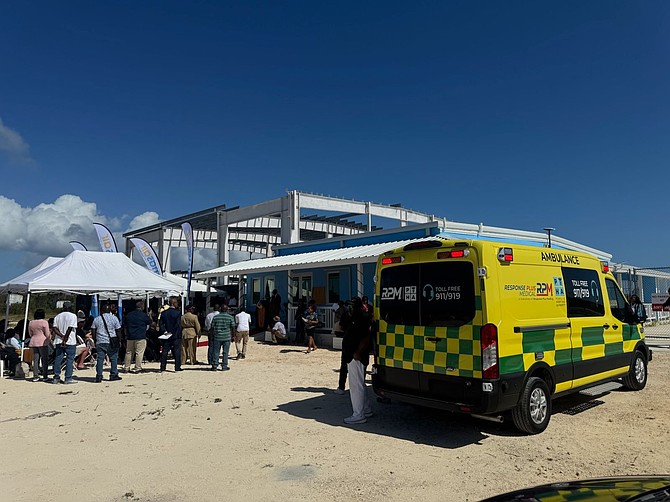
An aviation-spec ambulance deployed at newly opened Mayaguana International Airport as part of Heads of Agreement between the Government of The Bahamas, Bahamas Aviation Climate and Severe Weather Network (BACSWN) and Response Plus Medical (RPM).
By FAY SIMMONS
Tribune Business Reporter
jsimmons@tribunemedia.net
AN aviation-spec ambulance has been deployed to the newly commissioned Mayaguana International Airport, in keeping with the terms of a Heads of Agreement between the Government of The Bahamas, Bahamas Aviation Climate and Severe Weather Network (BACSWN) and Response Plus Medical (RPM).
Prime Minister Philip Davis said of the deployment the ambulance is a part of the broader national aviation and emergency preparedness strategy.
He explained that the ambulance forms part of a wider plan to equip airports across the Family Islands with aviation-specific emergency response capabilities. This includes positioning air ambulances at strategic locations to meet standards established by the International Civil Aviation Organization (ICAO).
“Part of the initiative of the government is to ensure that we comply with some of our international obligations,” said Mr Davis.
He noted that compliance with ICAO requirements is critical not only for safety but also for the country’s ability to collect overflight fees — revenue generated when international aircraft traverse Bahamian airspace
“Part of that is for what they call the overflight fees — to collect those, we are to provide emergency recovery services, including having air ambulances at the airport in case of emergency from an air tragedy,” said Mr Davis
The ambulance is the first of an estimated 50 bound for The Bahamas facilitated through BACSWN’s strategic alliance with Response Plus Medical (RPM), the largest pre-hospital care and emergency medical services provider in the Middle East. The first vehicles are earmarked for Cat Island, San Salvador and the islands of MICAL.
Their deployment forms part of a strategic collaboration between RPM and BACSWN to strengthen the country’s emergency response capabilities to meet to resolve the glaring deficiencies in its mandatory obligations under the Chicago Convention.
Each ambulance will be outfitted with modern medical equipment and aviation-grade safety features intended to strengthen emergency medical services across the country’s 173,000 square miles of archipelagic airspace.
BACSWN has been tasked by the Government of The Bahamas with establishing the Caribbean’s first NextGen Meteorological Watch Office. The facility will have the capacity to track flights in real time, coordinate crash response and search and rescue
operations, and provide live meteorological updates affecting flight and vessel movements across the country’s 173,000 square miles of archipelagic airspace.
The initiative is intended to support the safe, efficient and timely movement of commercial, cargo and private aircraft operating within The Bahamas’ sovereign airspace, in keeping with the country’s binding obligations under the ICAO.
The deployment to Mayaguana represents Phase One of a broader initiative aimed at correcting infrastructural deficiencies that prevent some Family Islands from adequately responding to emergencies. Phase Two will include the introduction of water and air ambulances, along with the refurbishment and construction of aviation-graded clinics throughout the archipelago.
BACSWN officials said the project management company overseeing the initiative is expected to enter shortly into an agreement with the Department of Public Health to regulate the services and provide institutional support. That support will extend beyond equipment to include training and staffing where necessary.




Comments
Use the comment form below to begin a discussion about this content.
Sign in to comment
OpenID