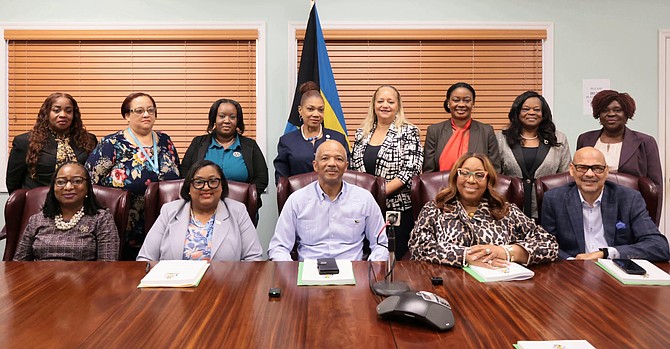
SEATED (from left): Donette WIlliamson, undersecretary, Ministry of Social Services, Information & Broadcasting (MOSSIB); Phedra Rahming-Turnquest, Per- manent Secretary, MOSSIB; Minister Myles LaRoda, MOSSIB; Dr Marisa Mason-Smith, chair, Protection Against Violence Commission (the Commission); Pastor Dave Burrows, deputy chair, the Commission. Standing: Sheryl Forbes, Women’s Desk, Dept of Gender & Family Affairs (DGFA); Vechenda Roberts, education & training officer, DGFA; Markayla Major, office assistant, DGFA; Desiree Clarke, National Council for Persons With Disabilities, commission member; Jewel Major, Office of the Attorney General, commission member; Sharmie Farrington, DGFA director; Rev Roslyn Astwood, Bahamas Christian Council, commission member; Portia Sands, deputy director of Culture, commission member.
THE government has formally appointed the Protection Against Violence Commission, activating a key enforcement body under the Protection Against Violence Act, 2023, nearly three years after the law was gazetted.
The appointments took effect February 1, 2026, according to a press release issued after a press conference that was not open to the media.
The Act was designed to strengthen protections for women, children, people with disabilities and other vulnerable groups. With the Commission now installed, officials say the law moves from policy to execution.
At the event, Minister of Social Services, Information and Broadcasting Myles LaRoda framed violence as a threat not only to people but to national stability.
“Each of us can speak to the love of a mother, grandmother, or mother figure who shaped our lives,” he said. “When she is harmed, the family is harmed. When the family is harmed, the community weakens. And when communities weaken, national progress is compromised.”
He said the Commission gives institutional force to the Act, converting legislative intent into coordinated action. Referencing the Beijing Declaration and Platform for Action, he argued that social development cannot advance without elevating women to equal status and strengthening families as the core unit of society.
Marisa Mason-Smith, chair of the newly appointed Commission, said the body will now shift from strategy to implementation. She credited earlier contributors, including Dr RubyAnn Nottage, Dr Sandra Dean-Patterson, Dr Robin Roberts and other experts who developed the National Strategic Plan to Address Gender-Based Violence. She also cited Jewel Major and her team in the Office of the Attorney General, who led the legislative drafting process.
“Today,” Mrs Mason-Smith noted, “we move from planning to purposeful execution. The experts have laid the groundwork. The legislation is in place. Now we will implement with resolve to eliminate violence and protect our people.”
Co-Chair Pastor David Burrows described the challenge as generational.
“The problem is expansive and difficult to correct,” he said. “But when we inform, educate, and reach our people — when we give direction to the upcoming generation so they do not fall into the patterns of previous generations — we create impact. And when we create impact on lives, we have done our duty.”
Desiree Clarke, representing the National Council for Persons with Disabilities, said people living with disabilities are often more susceptible to violence and exploitation. She stressed the need for protection strategies to be inclusive by design and said disability inclusion must remain central to the Commission’s mandate.
Dr Roslyn Astwood of the Bahamas Christian Council said the Commission’s work must be grounded in moral accountability and compassion, while Deputy Director of Culture Portia Sands said confronting violence strengthens rather than undermines Bahamian identity by reinforcing respect for family and communal responsibility.
According to the release, the Department of Gender and Family Affairs, led by Director Sharmie Farrington, will carry out the Commission’s administrative functions, including coordination and oversight.
The government described the Commission as a whole-of-society mechanism rooted in law, strategy, culture and faith. Its mandate centres on protecting women, children, persons with disabilities and other vulnerable people, which officials said is essential to the strength of families and communities across The Bahamas.




Comments
Use the comment form below to begin a discussion about this content.
Sign in to comment
OpenID