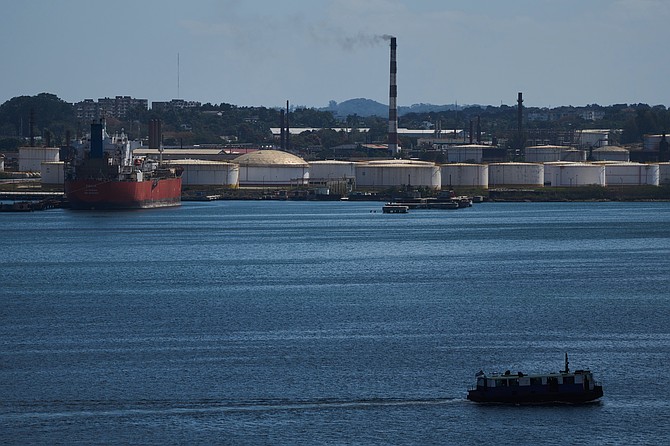
A ferry crosses Havana Bay past the Nico Lopez oil refinery where a Cuban tanker is anchored in Havana, Cuba, Thursday, Feb. 26, 2026. (AP Photo/Ramon Espinosa)
By KEILE CAMPBELL
Tribune Staff Reporter
kcampbell@tribunemedia.net
BAHAMIANS living in or travelling to Cuba say daily life on the island has become far more difficult after the United States cut off Venezuelan oil shipments — previously the country’s largest fuel source — triggering widespread blackouts, transport disruptions and rising tensions among residents.
Bahamian ambassador to Cuba, Dr Elliston Rahming, who has been stationed in the country since February 2022, said the fuel shortage has created “tremendous” problems across the island, affecting everything from electricity generation to the transport of food.
He said prolonged power outages have become common.
While Bahamian foreign affairs officers stationed in Cuba are coping, Dr Rahming said daily life has changed sharply without diesel.
“In the past, you can just turn your generator on, and you're fine, but in the absence of diesel, your generator is stuck, so you're in darkness as much as everybody else,” Dr Rahming said.
He said gasoline is being distributed in limited quantities, but diesel — widely used across the country — is currently unavailable.
“The situation is bad, but it's not entirely unbearable,” he said.
Dr Rahming said the shortage has had severe knock-on effects because most vehicles in Cuba run on diesel, including the trucks that move agricultural produce.
“Probably 70 percent of the vehicles in Cuba are diesel operated, so that has had a deleterious impact on transport and real goods, because most of the trucks that carry stuff from the farm to the farmers market or to the food store — almost all of them are diesel operated,” Dr Rahming explained.
“So you can imagine the difficulty in getting produce that's been harvested to their designated location.”
Even with the disruption, he said Cubans have shown remarkable resilience.
“They still find a way to get to work. Schools are still open, but most of the schools are within walking distance where students live, so that's not a big problem,” he said.
Dr Rahming said embassy officials met Bahamian medical students in Cuba about a week ago and found them coping despite the circumstances.
Some expressed concerns about storing perishable food during power outages, but he said none had asked to return home.
“These students are very committed to their educational pursuit, and so far they've not allowed this hiccup to discourage them,” Dr Rahming said.
He added that a fuel tanker is expected to arrive within days, which could ease the situation.
Others with direct experience in the country said the crisis is increasingly visible in everyday life.
Diana Saint Fleur, 32, who frequently travels to Cuba, told The Tribune the situation worsened during a recent three-week stay while her father awaited surgery.
She said the procedure was postponed because of the fuel shortage affecting hospital operations.
“When I went the first week, the hospital had postponed my father's surgery. We had to wait another week because they said they had fuel issues within the hospital,” Ms St Fleur said.
“While we were in the hospital, the power kept switching on, switching back off.”
She said some areas experienced up to eight hours without electricity each day, while internet service also became unreliable because of the outages.
Transportation has also become far more difficult, she said.
The cost of using her usual rideshare service rose sharply during the trip, increasing from about 1,000 pesos to nearly 4,000 pesos. A taxi ride that typically cost about $30 rose to around $50.
“Because of the fuel problems, sometimes it's even difficult to get to the airport — you can't find a taxi to get to the airport,” she said.
“My normal drivers that normally carry me around had to cancel with me. They can't get any fuel.”
Ms St Fleur said tourist districts such as Vedado appeared to maintain more stable electricity, while residential areas experienced frequent outages.
She said the difference was noticeable enough that she considered staying in a hotel instead of her usual Airbnb, despite the higher cost, because hotels appeared to have more reliable power.
Food supply has also been affected, she said, as fishermen struggle to obtain fuel for their boats.
Beyond the practical difficulties, she said the shortages have changed the atmosphere in the country.
“You can feel the tension in the street with the people, the stress. They are very depressed,” she said.
Bahamian entertainer Kirkland “KB” Bodie, who frequently visits Cuba, said he hears similar accounts from people on the ground.
He last travelled to the country in January and said the situation described to him by residents is severe.
“It's rough, from what I've gathered. I speak to my people almost every day,” he said.
“The energy has stopped, so that means the garbage trucks can't move. That means public transportation can't move. You're talking about only emergency things can be on at that point. The airport maybe can be on, the hospital can be. Basically everything is almost at a standstill.”




Comments
Use the comment form below to begin a discussion about this content.
Sign in to comment
OpenID