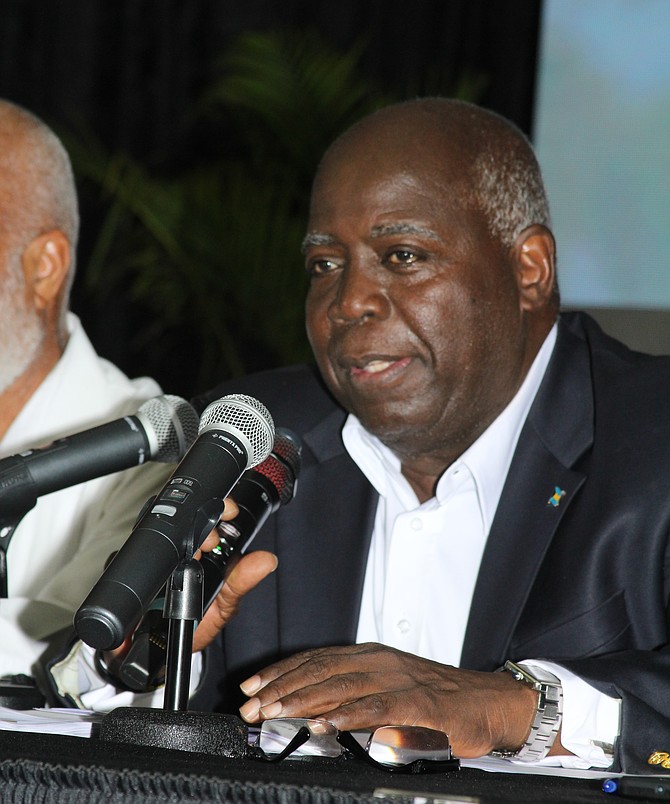
PRIME Minister Philip ‘Brave’ Davis speaks concerning the arbitration over GBPA during a forum in GB on March 9, 2026. Photo: Vandyke Hepburn
By FAY SIMMONS
Tribune Business Reporter
jsimmons@tribunemedia.net
The Prime Minister last night accused the Grand Bahama Port Authority’s (GBPA) two owners of asset stripping by transferring its productive economic assets to an affiliated entity and leaving Freeport’s quasi-governmental authority a regulatory shell with minimal income.
Philip Davis KC said that, by switching assets such as the Grand Bahama Development Company (DevCO) and Freeport Harbour Company to the control of Port Group Ltd, the Hayward and St George families had left the GBPA - the entity that signed the Hawksbill Creek Agreement - without sufficient income to uphold its governance and development responsibilities, and properly maintain Freeport, while still retaining the power to collect licence fees from Freeport businesses.
Speaking at a town hall meeting in Grand Bahama, he said last week’s arbitration ruling represents a major shift in the balance of power between the Government and the GBPA. “After that ruling, make no mistake about it; the balance of power has shifted,” said Mr Davis. “The decades of licence fees with too few visible returns, those days are over.”
Mr Davis argued that structural changes made over decades left the GBPA responsible for obligations under the Hawksbill Creek Agreement without the productive assets needed to fulfil them.
“Starting in the 1990s, the productive assets of the Port Authority - the harbour company, the development company, the road builders, the Power Company, the sanitation company - were quietly transferred out of the entity that held the legal obligations and into a separate holding structure, Port Group Ltd,” he said.
“Most of the assets were moved into a parallel structure, one that carried no obligations under the Hawksbill Creek Agreement, while the Port Authority - the entity that does carry those obligations - was left with the ability to regulate but without the assets to develop. “What was left behind in that shell? The power to collect licence fees from every business in this room. And not much else.”
Mr Davis argued that the arbitration ruling confirms the GBPA still carries enforceable financial obligations under the Hawksbill Creek Agreement. “The financial obligation is real and enforceable, and I believe that the ‘we can’t pay’ defence has limits,” he said.
“When you hear the Port Authority - and those allied with the Port Authority - say it does not have the money to meet significant financial claims, remember what I told you about the deliberate transfer away of productive assets. It is quite possible that a court asked to enforce a payment obligation against the Port Authority would not be blind to that history.”
The Prime Minister said the arbitration tribunal also rejected the GBPA’s attempts to challenge the Government’s authority over key regulatory areas in Freeport.
“They were seeking, for alleged breach, over $1bn - your money, Bahamian taxpayer money - arguing that the Government of The Bahamas had no right to be involved in licensing, Immigration, Customs, utilities, land acquisition, environmental regulation or development approvals in Freeport,” Mr Davis said. “They brought eight separate counter-claims. They lost on seven of the eight claims.”
According to Mr Davis, the tribunal ruled that the Government’s legislative and regulatory authority applies across Freeport, effectively closing long-running disputes over governance. “For decades, the Port Authority has made claims of exclusive authority. That argument is gone,” he said.
“An independent panel said, on the record, that the Government governs. The Port Authority retains its operational and administrative role, but it operates within Bahamian law, not above it.”
Mr Davis also said the ruling confirms that the Utilities Regulation and Competition Authority (URCA) has regulatory authority over electricity and telecommunications in Freeport.
Looking ahead, he said the next phase of the legal process will determine the size of annual payments that could be owed to the Government under a financial review mechanism contained in the Hawksbill Creek Agreement that runs until 2054.
“The Government will negotiate in good faith while being clear-eyed about the leverage we have gained,” said Mr Davis. “The annual payments the Port Authority will be liable for could be very, very substantial.”
He added that the Government remains open to negotiation rather than further litigation if it leads to renewed development commitments for Grand Bahama.
“We are open to negotiating rather than litigating, because a genuine change of ownership and a real development commitment for Grand Bahama would serve this island better than more legal combat,” Mr Davis asserted.
He said the deadline to respond to the Tribunal was extended to allow the parties to time to review. “We were supposed to answer the tribunal by last week Friday. We got extended to the seventh so that we'll have time to review and have the numbers re-looked at, and we will tell the tribunal where we are and re-engage them again,” said Mr Davis.




Comments
Use the comment form below to begin a discussion about this content.
Sign in to comment
OpenID