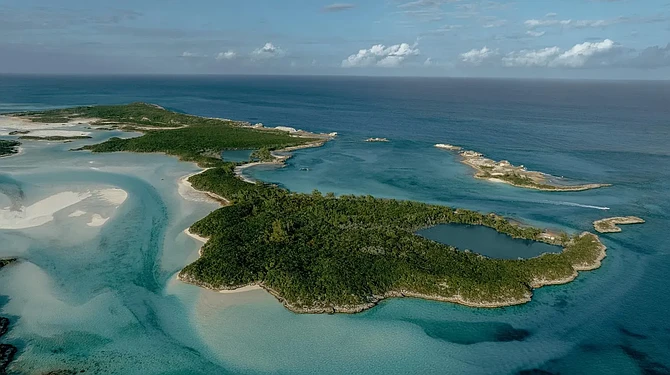
Samson Cay
By NEIL HARTNELL
Tribune Business Editor
nhartnell@tribunemedia.net
The $200m Rosewood Exuma project “did not initially meet standards for sustainable development”, the Government’s top environmental regulator has revealed, while also being challenged for citing Nassau Harbour and Arawak Cay as comparisons for its likely environmental impact.
Dr Rihanna Neely-Murphy, the Department of Environmental Planning and Protection’s (DEPP) director, in a January 16, 2026, affidavit supporting her agency’s position against the Judicial Review challenge mounted to overturn Rosewood Exuma’s certificate of environmental clearance (CEC), argued that intervention by the regulators had brought the project “into alignment” with sustainable principles.
In particular, she said the developer, Miami-based Yntegra Group, had “reduced the scope and overall footprint” of the Sampson Cay-based development, which has drawn significant opposition from its immediate neighbours, Turtlegrass Resort & Island Club and Over Yonder Cay’s owner. However, the Davis administration had approved the project “in principle” despite it then not fully conforming with sustainable development “standards”.
“Turtlegrass speaks to a ‘shifting series of plans’ associated with the development,” Dr Neely-Murphy said. “It should be noted that the Bahamas Investment Authority (BIA) gives ‘approval in principle’ and subject to the approvals from the relevant regulatory agencies. Once this occurs, the DEPP process begins….
“The fact that the environmental documents have evolved from the initial concept submitted to the BIA and presented publicly in January 2023 to the current documents supporting the issuance of the CEC gives credence to the CEC process. The project, while approved in principle as a development the Government supports for implementation, did not initially meet with the standards for sustainable development or strike the balance…
“The CEC process brought the project in alignment with more environmentally-sound principles, reduced the scope and overall footprint of the project, while allowing the project to proceed. The DEPP does its work, and developers decide for themselves whether they wish to proceed subject to those conditions or not proceed,” Dr Neely-Murphy added.
“In the instances where compliance may be out of reach for a developer, the projects do not receive a CED and are not allowed to proceed as prescribed. Further, DEPP reviews all questions, comments and concerns brought by the public concerning a development of any scale. The applicable mitigation or adaptation measures are required for implementation.”
Dr Neely-Murphy also dismissed arguments by Turtlegrass and its principal, Bob Coughlin, that the CEC consultation process needed to be restarted and relaunched after Yntegra altered the size and location of its service dock which - along with dredging of Sampson Cay’s North Bay - have proven the most controversial aspects of the Rosewood Exuma approval process.
“I do not consider that the change to the location and footprint of the service dock and sea break in the North Bay necessitated starting the public consultation process afresh,” she said, adding that there had been extensive discussions with Mr Coughlin and Turtlegrass given that they were the party set to be most impacted.
The DEPP chief, though, said Turtlegrass withdrew from a meeting called by her agency to address the service dock issue. “I reject the idea that the consultation on this needed to be held in a public forum, especially where the objection to this specific aspect was almost singularly coming from Turtlegrass and its agents,” she added.
Felipe McLean, Yntegra’s president, has repeatedly stated that environmental sustainability and best practices are at the heart of Rosewood Exuma’s development plans and that the CEC process and DEPP’s requirements have been met at every stage. He has also asserted that the developer has sought to accommodate Turtlegrass’ requests where possible, including adjusting the size and location of the North Bay service dock and reducing its dredging footprint by some 75 percent.
Dr Neely-Murphy, meanwhile, also rejected Turtlegrass’ complaints that “no proper analysis” of alternative locations for the service dock were considered. She argued that this had been “considered extensively”, and said: “As a result, the service dock was move further to the north-east of North Bay, further away from the Turtlegrass development,
“The developers considered a site in the south-east of East Sampson Cay for the service dock. However, it was not considered feasible due to the topography in the south and the narrowness of the island between the north and south, which would not allow for the safe passage of heavy equipment and the creation of service roads in addition to the main road associated with development traffic.”
Turtlegrass’ fears that “the recreational potential of North Bay will be devastated” by the Rosewood Exuma project were also dismissed by Dr Neely-Murphy, who compared the area to Junkanoo Beach, Arawak Cay and the Nassau Cruise Port in the capital. “Vessels already traverse the area,” she said of North Bay. “The back-of-house facilities will be constructed in a way that they do not create an eyesore for the neighbouring beach-goers.
“I would also note that Junkanoo Beach in New Providence sits squarely between Arawak Cay container port and the Nassau Cruise Port. The entrance channel for vessels to these areas is directly opposite the beach, yet daily, tourists and residents use this beach and many have made a living along the beach as a result. Using this example, the fact that vessels move past a beach does not devastate the recreational potential of an area.”
The appropriateness of this comparison was challenged by Eric Carey, the former Bahamas National Trust (BNT) executive director and consultant to Turtlegrass, who alleged in a February 9, 2026, affidavit: “I deny that the examples of Nassau Harbour and Junkanoo Beach are a fair or relevant comparison to the North Bay at Sampson Cay for the purposes of assessing environmental and recreational impacts of the proposed development by Yntegra.”
Whereas Nassau is a long-established commercial shipping port that attracts major maritime traffic, Mr Carey said North Bay “by contrast is a small, environmentally sensitive coastal and marine environment” whose tourism business relies on current conditions to be maintained for nature-based tours and low-density use. As a result, the comparison to Nassau “understates the potential differences in safety risk and environmental impact.
“The routine presence of large commercial vessels within a confined channel that is currently used for swimming, snorkelling, small recreational craft and guided tours raises foreseeable safety concerns for recreational users which do not arise in the manner described in Nassau harbour, where commercial and recreational uses are spatially separated,” Mr Carey alleged.
“I deny that the presence of vessel use in Nassau harbour, or the examples cited, demonstrate that Yntegra’s proposed development will have no impact on marine life or recreational use at North Bay. Rather, they are materially different contexts.”




Comments
Use the comment form below to begin a discussion about this content.
Sign in to comment
OpenID