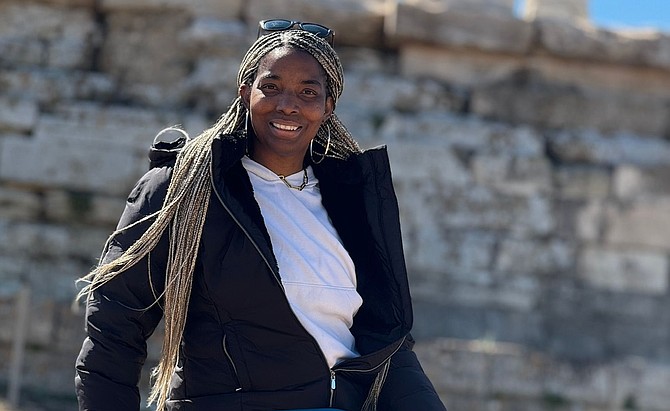
Keva Williams
By EARYEL BOWLEG
Tribune Staff Reporter
ebowleg@tribunemedia.net
WITH Kuwait’s airspace closed and the alternative a $6,000 road trip out of the country, Bahamian teacher Keva Williams says she is not afraid of death as she remains in the Gulf nation amid rising tensions with Iran.
The airspace has been closed for about two weeks. Ms Williams received an email from the Bahamian embassy in the UAE advising that there were no confirmed evacuation plans.
She said she felt somewhat disappointed with the response but understands the embassy’s limitations.
The 44-year-old is not considering leaving Kuwait due to the high costs and logistical challenges involved. Instead, she is trusting in her faith while remaining in the country.
She lives alone with her dog and has no other family in Kuwait.
“There haven't been a lot of casualties, praise God. I know that we're being protected — I am — because of my faith and making sure that I am praying and keeping abreast of the news without being consumed by it,” she said.
“Because a lot of other teachers have been listening to the news and constantly isolating themselves and things like that, which makes them more afraid. I find that for me, I am rooted strongly in my faith. If it's my time, then the Lord knew that was my time.”
Ms Williams moved to Kuwait in 2016 after teaching in Guatemala in order to earn more money to pursue a master’s degree, which she said was not possible while living in The Bahamas.
The educator said Kuwait City is easy to live in, with convenient deliveries, affordable cleaning services and a generally good quality of life.
She began her teaching career in early childhood education, later moved to elementary school and currently works as a middle school drama teacher at the American International School of Kuwait.
However, life in the Gulf nation changed on February 28 after an Iranian strike. Iran launched a wave of missiles and drones across the Gulf targeting countries that are part of the Gulf Cooperation Council (GCC) and host US military assets.
“I was at my neighbour’s apartment. We heard the sirens going off and we didn't quite know what was happening,” she said.
“We’ll always remember that day. We turned on the news and heard they were retaliating against US bases or any country in the GCC that had bases or strongholds. They attacked Bahrain first, then Kuwait, Abu Dhabi, Qatar and Dubai.”
The weeks since have seen numerous strikes in the region, including the death of six American soldiers after a drone struck a command centre at Shuaiba Port.
Ms Williams said the Kuwaiti government has been intercepting drones and ballistic missiles. Yesterday, officials revealed several drones targeted Kuwait International Airport.
She noted that the strike occurred at an older section of the airport, adding that upgrades to the facility mean other areas could still support operations once airspace reopens.
A separate drone incident struck a residential building, injuring two people. Ms Williams said the strike was not near her home and she did not hear it because she was asleep.
“They have been giving ways to leave the country via road travel. However, the citizens themselves are not worried because they've been through something like this before with the Gulf War back in the 90s, so they're not concerned,” she said.
“Until they are concerned, I'm not going to be worried about it. Our school is also taking good care of us. They're having wellness checks. Every day we log on to check on everybody’s well-being and make sure everyone is taking time to breathe.”
Despite the tensions in the Middle East, Ms Williams said life in Kuwait has remained largely uninterrupted. She can still communicate with family and friends abroad and has not been deprived of essential services.
The country is also in the final two weeks of Ramadan, with daily routines adjusting to the fasting period.
She said she finds comfort in the international community at her school, which includes Americans, Canadians, British citizens and other nationalities. The school is currently on spring break.
However, her threshold for considering leaving would be if US troops were deployed on the ground in Iran.
“It is expensive to go on this long road trip because once you get to the border — the only one open is the Saudi Arabia border — you have to travel from there to the airport and pay for your own transportation,” she said.
“Then you have to pay for your flight out, which could get cancelled. If it gets cancelled, you then have to pay for housing wherever you are and more expenses. And once you get out, how do you get back in once the airspace is open? Then you have to come back and go to work.”
She has considered a contingency plan if tensions escalate, including travelling to a nearby country during spring break so she could return easily if classes move online.
“I also have a pet, which makes it very hard because they need certain tests and paperwork to get out. So we’ve started that process. I've made sure they're up to date on all their shots so we can cross the border if needed.”
Ms Williams said she has also explored visa options for travelling through Saudi Arabia, noting that some officials are unfamiliar with The Bahamas when processing applications.
“The Saudi embassy and Saudi border authorities are being really reasonable because they are expediting visas. You can get one within 10 to 15 minutes, and it's good for three days to make the journey into their country and fly out. If you get a longer-term one it's more expensive, but they are very good about expediting visas. The costs may be high, but if I need to, I will have to.”




Comments
Use the comment form below to begin a discussion about this content.
Sign in to comment
OpenID