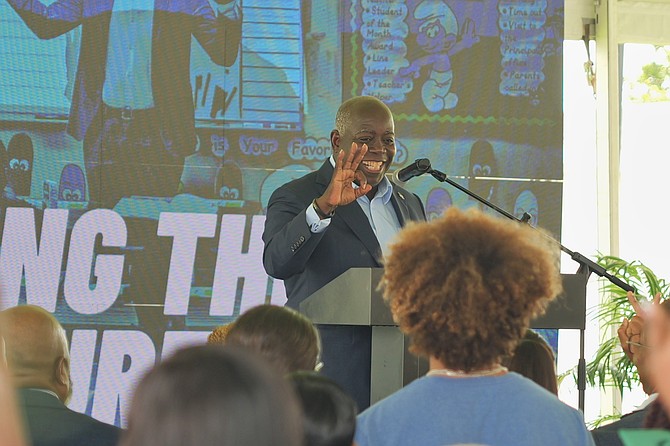
Prime Minister Philip Davis speaks at the opening of the Fort Charlotte Technology, Arts and Culture Centre on March 12, 2026. Photo: Nikia Charlton
By JADE RUSSELL
Tribune Staff Reporter
jrussell@tribunemedia.net
PRIME Minister Philip “Brave” Davis confirmed the next general election will be soon, though he remained tight-lipped on the specific date it will be called.
“All I can say is that the elections would be soon,” Mr Davis told reporters yesterday. “That’s all I’d be prepared to say at this time.”
The prime minister’s comments came after Progressive Liberal Party (PLP) chairman Fred Mitchell unexpectedly announced that a general election will be held “within the next few weeks”. The announcement, made in a voice note, sparked political anticipation that voters could be heading to the polls this spring.
Mr Mitchell asserted that the election campaign will heat up and that the Bahamian people will shortly be asked who should govern them for the next five years. However, Mr Davis took a more coy approach when asked about the chairman’s comments, telling voters to “stay tuned”.
Mr Davis said the party will be promoting its message, its record of work and its plans for the future this election season.
“When I reflected on what we have done over the last four years, it's tremendous,” he said. “I'm proud of the accomplishments, but we want to ensure that it's been impactful. And we're going to demonstrate how we intend to make it more impactful for those who are still not feeling what we have done.”
Political observers have questioned whether the PLP can maintain its support in Grand Bahama. For years, residents of the island — once dubbed the second city — have complained of being neglected by the government. Although the Davis administration has made headway in efforts to revitalise the island’s economy, many residents still say they do not feel any change.
The government and the Grand Bahama Port Authority have also been locked in a years-long dispute over governance in Freeport under the Hawksbill Creek Agreement, which recently went to arbitration. While the tribunal rejected the government’s $357m claim for administrative costs, both sides have said the ruling favours their position.
Asked whether there were fears the GBPA matter could affect support in Grand Bahama, Mr Davis said he believes Grand Bahamians will support the PLP. He added that the matter has made residents see the party as a “serious party”.
Meanwhile, Tall Pines MP Dr Michael Darville also told reporters yesterday he is ready for the election.
Before a general election is called, Parliament is typically prorogued, meaning the current session is formally ended by the Governor-General on the advice of the prime minister. Prorogation stops parliamentary business but does not end the life of Parliament, and members of the House of Assembly remain in office.
An election becomes necessary when Parliament is dissolved, either early on the prime minister’s advice or automatically when the five-year constitutional term expires. Once Parliament is dissolved, the Governor-General issues writs of election for each constituency directing returning officers to hold the vote. The writs set the key dates for the election.
By law, nomination day must be at least seven days after the writ is issued, and polling day must be at least seven days after nomination day, meaning the earliest an election can be held is roughly two weeks after the writs are issued. In practice, Bahamian elections are typically held three to four weeks after Parliament is dissolved.




Comments
Use the comment form below to begin a discussion about this content.
Sign in to comment
OpenID