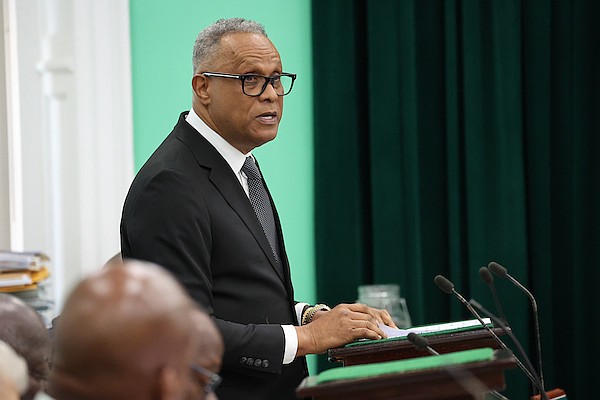
Minister of Health and Wellness Dr. Michael Darville speaks in the House of Assembly on March 26, 2025. Photo: Dante Carrer/Tribune Staff
By LYNAIRE MUNNINGS
Tribune Staff Reporter
lmunnings@tribunemedia.net
THE Public Hospitals Authority has admitted it fell short in its care of a deaf patient at Princess Margaret Hospital, while Health Minister Dr Michael Darville said the allegations, if true, breached the law.
The response follows The Tribune’s reporting of the case of Ginika Gibson, a culturally deaf patient who was reportedly unable to communicate effectively with healthcare providers or understand her treatment after a car accident and was initially denied access to her interpreter.
“I read in one of the dailies with great concern about a disabled patient at the Princess Margaret Hospital who was denied a sign language interpreter while receiving medical care,” Dr Darville said in the House of Assembly yesterday. “If these allegations are true, this is certainly a violation of the Persons with Disabilities Act, and the PHA must address this matter with a sense of urgency.”
“I assure the general public that this not a Ministry of Health and Wellness policy at any of our healthcare institutions. After preliminary investigations, the PHA has released a press statement clearly outlining their findings, and I encourage every Bahamian to read it.”
For its part, the PHA apologised and said the expected standard of care was not met.
“We extend our sincere apology to the patient and her family for the distress and frustration caused,” the PHA said. “We strive to ensure open and effective communication with every patient entrusted to our care. We regret that, in this instance, that standard was not fully met.
“Upon becoming aware of the matter, senior management intervened to assess the situation and ensure that the patient received the appropriate support and attention. Immediate steps were taken to address the concerns raised and to reinforce communication protocols within the care team,” the statement read.
The authority added: “We always pursue opportunities to improve our service; the need to strengthen how we support accessible communication and consistently uphold patient autonomy. Access to clear communication is not optional; it is fundamental to safe, dignified, and effective care.”
The incident has prompted discourse about accessibility in healthcare, particularly for deaf and hard-of-hearing patients.
According to the Bahamas National Association for the Deaf and Hard of Hearing, Ms Gibson’s request for a qualified sign language interpreter was initially denied, with communication instead routed through her next of kin despite her being a competent adult.
Interpreter Tamiko Brown said she faced resistance from hospital staff and was first told her services were unnecessary. When she later gained access to Ms Gibson, she said the patient was in pain, confused and unaware she was receiving medication through an IV.
The association warned that failures like this undermine informed consent and increase the risk of misdiagnosis and improper treatment, stressing that interpreters are essential in healthcare settings.
The group said between three and five percent of the population is deaf or hard of hearing, warning that many could face similar barriers if gaps in the system are not addressed.
Under the Persons with Disabilities (Equal Opportunities) Act, people with disabilities are entitled to equal access to healthcare and information in accessible formats, and the denial of reasonable accommodation, including interpreter services, is considered discrimination.




Comments
Use the comment form below to begin a discussion about this content.
Sign in to comment
OpenID