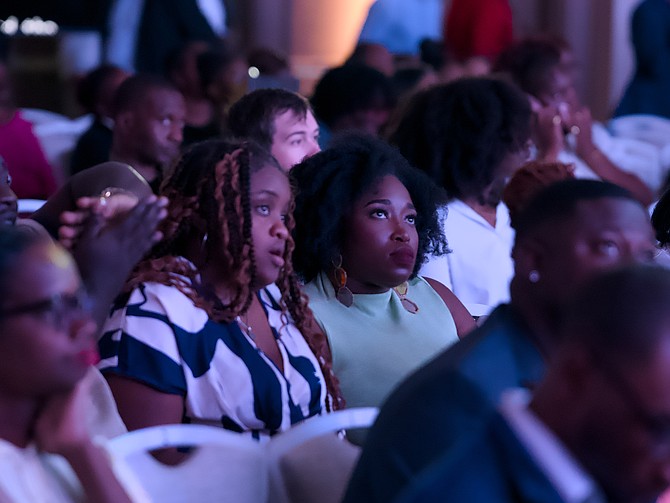
PARTICIPANTS look on during the Govt’s 242 Influencers & Creative Conference at Baha Mar on March 29, 2026. Photo: Chappell Whyms Jr
By JADE RUSSELL
Tribune Staff Reporter
jrussell@tribunemedia.net
QUESTIONS about how Bahamian creators will earn from their content lingered after the government’s 242 Influencers and Creative Conference, with some attendees leaving without clear answers on monetisation.
The event, held Sunday at Baha Mar, brought together emerging influencers and established creators, including some with followings exceeding 100,000. The government said it aimed to unlock earning opportunities in a sector where Bahamians face long-standing barriers on platforms such as TikTok, Instagram and Facebook.
While some attendees welcomed the conference as a step forward, others said it fell short, arguing there is still no structured plan to help Bahamians tap into the digital economy in the same way creators in the United States do.
Patrick Robinson II, a content creator since 2013, photographer and artist, said the event felt like a “pep rally,” with speakers repeating familiar advice about authenticity, consistency and engagement.
“I was hoping there would be a question-and-answer segment where creatives could have had a dialogue with those present, but that was not the case,” he said, adding that many attendees felt the conference did not match expectations.
Another digital creator, Rukcus Mann, described the event as a “Bahamian Content Creator Pacifier.” He said some useful information was shared and that issues around gatekeeping were raised, but key concerns were glossed over.
“In general, Bahamian creators are not really respected for our craft and contributions to Bahamian culture,” he said. “Many of us have been told to go and get a ‘real job’ and our respective crafts and disciplines are generally seen as a frivolous waste of time.”
The government does not control major social media platforms, most of which are based in the United States, limiting the reach and earning potential of Bahamian creators. Algorithms often favour US-based content, leaving local creators largely confined to domestic audiences.
Prime Minister Philip Davis, in his keynote address, said he will direct government agencies to hire Bahamian influencers for public information campaigns, with dedicated funding. He also said the government is engaging with platforms to help Bahamians earn income.
Rukcus Mann, however, questioned the timing of the conference, which comes just ahead of the next general election. He suggested the event was used to build public support.
“Mr Prime Minister wasn't shy about it,” he said, adding that the initiative felt conditional.
He said the creative community also shares responsibility for limited monetisation, noting that while some take the industry seriously, others do not.
“Too many us focus on the show and entertainment, and not enough of us focus on business and industry and it shows.”
The conference featured presentations by CAPAS, AI for Creators and The 4 Cs Framework for Creator Success. A panel on building domestic brand power included Deputy Prime Minister Chester Cooper.
Some attendees praised a panel featuring Bahamian influencers Baha Yogi, Vocab, Das Quay, Bodine and Zhane'o, who spoke about achieving financial success.
Others said they left still questioning how most creators would be able to monetise their work.
Content creator Magaso242, who also streams on Twitch, said some panels were useful, but key questions remained unanswered. He said he later spoke with Ambassador-at-Large for Technology and Artificial Intelligence Greg Michelier, who offered some reassurance that efforts are underway.
“The mixer was where I was able to meet and discuss things with people, so it wasn't a total loss,” he said.
He also criticised a panel featuring the deputy prime minister, saying its focus on tourism content was expected but disappointing.




Comments
Use the comment form below to begin a discussion about this content.
Sign in to comment
OpenID