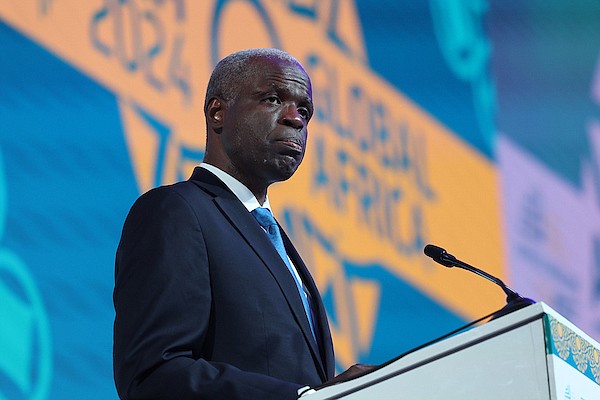
Central Bank Governor John Rolle speaks during the Afreximbank’s 31st Annual Meeting at Baha Mar on June 12, 2024. Photo: Dante Carrer/Tribune Staff
By NEIL HARTNELL
Tribune Business Editor
nhartnell@tribunemedia.net
The Central Bank yesterday warned The Bahamas’ 2026 economic growth prospects may “significantly erode” if the Middle East war becomes protracted although it reassured that this nation’s $2.898bn foreign currency reserves “provide a meaningful cushion” for increasingly expensive fuel imports.
The banking regulator, in its report on February 2026’s economic developments, warned that - while The Bahamas’ economic outlook remains “positive” - risks related to inflationary pressures stemming from increased global oil and fuel prices have increased due to the fall-out from the US and Israeli assault on Iran.
However, it said electricity costs - apart from Grand Bahama - should “stabilise” in the short-term due to Bahamas Power & Light’s (BPL) move to hedge, or lock-in, the price of two million barrels of oil at an all-in cost of $70 per barrel.
The consequences of the Middle East conflict are now set to impact the Bahamian economy and people, with petroleum retailers forecasting that gasoline prices are set to jump above $6.50 per gallon as early as today as the oil price effect feeds through the supply chain to reach this nation (see other article on Page 1B).
Retailers forecast that gasoline prices are likely to rise by $1.02 per gallon due to the increased cost of imported fuel shipments, while diesel is expected to increase by $1.59 per gallon.The latter would take diesel prices to around $7 per gallon on New Providence, immediately negatively impacting transportation businesses such as taxis, livery drivers and jitneys as well as many companies with commercial vehicle fleets.
Current pump prices already range widely across New Providence, with gasoline listed at $5.32 at Esso, $5.53 at Rubis, and $5.77 at Shell. Based on Tribune Business calculations, a $1.02 per gallon rise will equal between a 17.7 percent to 19.2 percent increase if this occurs across all three petroleum chains.
“Risks to the outlook, including for inflation, have increased, as subsiding trade policy uncertainties have been displaced by escalated geopolitical tensions in the Middle East and associated higher global oil prices,” the Central Bank said yesterday. “The growth outlook, while still positive, could also significantly erode if the Middle East conflict becomes protracted.”
The International Monetary Fund (IMF) had forecast that the Bahamian economy would expand by 2.2 percent this year, down from an estimated 2.8 percent growth in 2025, as it trends towards its projected long-run average potential of around 1.5 percent following the post-COVID reflation.
The Central Bank emphasised that The Bahamas will be impacted in at least three ways by the Middle East conflict’s fall-out. The first, which will now start to bite, is the fuel price shock driven by crude oil costs, which yesterday hit $116 per barrel on the Brent crude index before declining slightly to $112. Given that oil is such a key commodity, and employed in the production of multiple goods and services as well as for fuel, no economic sector will be spared.
Increased fuel prices, as well as increasing ground transportation costs, will also raise shipping and freight charges. The Bahamas, as an open economy highly dependent on imports for all it consumes, is especially vulnerable as higher shipping prices will translate into a greater cost of foods and other goods, thus fuelling inflation and the post-COVID cost of living crisis that many families have struggled to cope with.
The second impact will be on tourism, which is The Bahamas’ major industry. Increased prices and inflation, as well as higher air fares, could undermine traveller confidence and their disposable incomes, harming both visitor arrivals and their in-destination spending in this nation, although this could be offset - at least somewhat - by this country’s relative proximity to the US, which is its major source market generating 90 percent of tourists.
Finally, foreign direct investment (FDI) in The Bahamas could be impacted if major global central banks, such as the US Federal Reserve and European Central Bank (ECB), raise interest rates to combat inflation in their economies. This could raise the cost of foreign currency financing for investors eyeing Bahamas projects, potentially forcing them to abandon and delay their plans. The Bahamian government’s floating rate foreign currency debt could also become more expensive.
“The economy is exposed through several well-defined external channels,” the Central Bank confirmed. “These include increased energy price pressures and higher transportation and freight costs, which would increase the cost of imported goods and services, including motor vehicle fuel. That said, the fuel price hedge should stabilise electricity costs in most of The Bahamas in the near-team.
“The Bahamian tourism product, which still has a net positive growth outlook for 2026, also faces potentially eroded demand, particularly from weakened US consumer confidence. Conversely, the industry could encounter upside benefits as geographic proximity to the US cushions the relative cost of travel to The Bahamas vis-à-vis more distant destinations.
“Otherwise, the financing conditions for foreign investments and public sector foreign currency debt operations could become more challenged if the major central banks are prompted to raise interest rates to calm global inflation concerns.”
The Central Bank, though, said increased foreign currency demand associated with purchasing more expensive oil imports poses no threat to the Bahamian dollar’s one:one peg with the US dollar.
“The Bahamas maintains healthy external reserves, which provide a meaningful cushion for increased oil import costs. This preserves the stable outlook for the currency. In addition, the domestic banking system remains well-capitalised against any new credit risk, should these emerge, hence the financial stability assessments remain sound,” the Central Bank said.
“Based on the current outlook and the strength of buffers within the financial system, the Central Bank will retain an accommodative policy stance for private sector credit and pursue policies that ensure a favourable outturn for external reserves and financial stability. Further, through its Monetary Policy Committee (MPC), the Bank will continue to observe developments within the foreign exchange market and, if required, adopt measures to support a sustainable outcome for foreign reserves.”
Giving more detail on the external reserves, the Central Bank said: “In February, external reserves grew by $48.4m to $2.898bn, exceeding the $39.6m accumulation in the preceding year. Contributing to this outturn, the Central Bank’s net foreign currency sales to the public sector decreased to $17.9m from $41.9m in the prior year.
“This more than offset the reduction in net purchases from commercial banks to $54.3m from $65m in the previous year. Conversely, commercial banks’ net intake from their customers increased to $55.3m from $23.5m a year earlier.”




Comments
LastManStanding 3 hours, 33 minutes ago
Not just Bahamian growth but worldwide the longer this war drags on. If this drags into summer we will be likely looking at 150 oil and that will have very adverse effects on the global economy. We are potentially heading into a severe recession simply because the American political scene is completely captured and owned by Zionists and the AIPAC lobby. It's quite embarrassing and sadly they will gladly take the rest of the world to hell with them.
Sign in to comment
OpenID