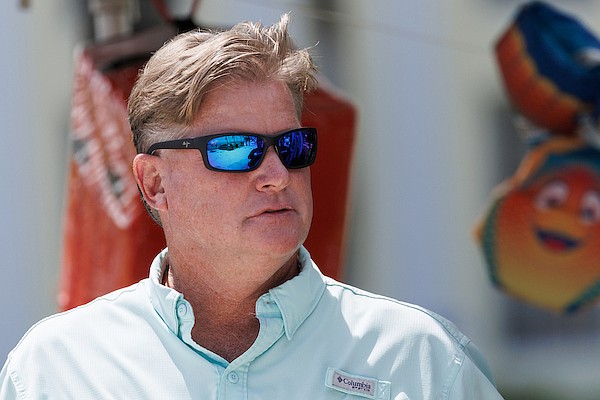
Association of Bahamas Marinas President Peter Maury during the BASRA Boating Safety Day at Montague Beach on September 6, 2025. Photo: Dante Carrer/Tribune Staff
By NEIL HARTNELL
Tribune Business Editor
nhartnell@tribunemedia.net
Bahamian marinas fear they will lose $25m in direct revenue as a result of boating fee hikes and cumbersome regulatory processes, it was revealed yesterday, with the industry also blaming these woes for the cancellation of next month’s Bahamas Charter Yacht Show.
Peter Maury, the Association of Bahamas Marinas (ABM) president, told Tribune Business that a recent survey of its members also disclosed that around 1,000 jobs could be endangered by the sharp “40 percent” decline in both charter and cruising arrivals as he warned: “The Bahamas is not the most popular destination right now.”
The cancellation of the fourth annual Bahamas Charter Yacht Show emerged as Chester Cooper, deputy prime minister and minister of tourism, investments and aviation, finally announced that the Government will “review” the fee increases and regulatory changes that were implemented on July 1, 2025, following six months of warnings and advocacy by maritime and tourism stakeholders about their likely damaging impact.
While Mr Cooper said the review (see other article on Page 1B), for which no start or finish dates were given, will assess the “competitiveness” and “impacts” of The Bahamas’ boating regulatory regime, several marina and tourism sources - speaking on condition of anonymity - told this newspaper that any reforms will almost certainly come to late to save the peak 2025-2026 winter season, one saying simply: “I think the damage is done.”
Another added of the Government: “About time they understand the error of their ways but, to be honest, a lot of charter boats have moved on never to return or at least it will take years before this reversed. Not that it is the be all, but we make the economy go round in the Exumas and Abacos for sure. Two big charter companies - 30 boats each in Abaco alone - are closing shop because it’s too expensive to operate.”
Another casualty is the 2026 Bahamas Yacht Charter Show, which was scheduled to be held from January 28 to February 1 in the New Year. In an online notice that was shared with Tribune Business, it was announced: “We regret to inform you that the 2026 Bahamas Charter Yacht Show has been cancelled due to circumstances beyond the control of the ABM.
“While we are saddened by this decision, we sincerely appreciate your understanding and look forward to welcoming you back in 2027.” Mr Maury linked the cancellation directly to the new and increased boating fees, and bureaucratic entry processes that visiting vessels have to navigate, as The Bahamas’ resulting loss of competitiveness means the Show cannot attract sufficient boats to make it economically viable.
The ABM chief argued that the greatest losers from the Show’s cancellation will not be the marinas but, instead, the spin-off and support Bahamian-owned businesses that support the sector. These firms, ranging from boat cleaners and carpet cleaners to provisioners, numbered around 40 exhibitors at last year’s event, and Mr Maury explained that the Show provided a one-stop platform for them to show what they can do to boat owners, captains and brokers.
Noting that Bahamian exhibitors at the previous three Shows, which first launched in January 2023, are typically not present at international boat shows, Mr Maury said of next month’s event: “We did cancel it.
“Last year, at this point we had 40 boats. Right now, we have less than 20. We were just going to be paying more money to have the show. There’s no boats. We need a minimum of 25 boats, and we’re not even close to that. I think they said they have 12, and it’s a month before.”
The ABM president said the small number of exhibiting boats meant the 2026 Show was unlikely to be financially and economically viable, especially after a major sponsor, Safe Harbour, which operates a number of Florida-based marinas, pulled out.
Show organisers must “put a guarantee” on the “block” of rooms they have reserved at Atlantis, as well as marina slips, and with reservations and attendance unlikely to match they had little choice but to give up these bookings and reclaim their funds prior to passing the ‘30 days before occupancy’ deadline at which point their money goes ‘hard’ and cannot be recovered.
“Last year we lost; we didn’t lose a lot, but we lost some money,” Mr Maury recalled, “and this year we were going to be losing thousands. The marinas are already losing enough money because of the fees and everything else. We cancelled. We talked to the Ministry of Tourism, Bahamas Yacht Brokers Association…
“The whole point of the show was to feature Bahamian companies. We charged $100 for Bahamian companies to be in the show, and if we don’t have a major sponsor we cannot charge them more because they cannot pay more. It’s a real loss. It’s no Florida boat show, but it’s a couple hundred thousand to the local economy in room sales, restaurant business.
“Last year I cannot remember where it ended up. We had around 100 brokers and close to 40 boats. The year before we had 180 brokers and 80 boats. Everybody was shopping in the food stores, getting rooms, and we were actually growing. Then this happened.”
Linking the Show’s woes, and attendance drop-off, directly to the increased boating fees, Mr Maury added: “The brokers can’t sell charters in The Bahamas. They’ve seen a 40 percent reduction in bookings for The Bahamas while the Caribbean region has seen a 25 percent uptick. It’s not hard to figure out. It’s just maths.
“The problem is also the processing [entry/clearance of visiting boats into The Bahamas]. I have realised a lot of Bahamians don’t understand what these boats go through. They think these boats are getting all the fish and other stuff.” The ABM president said boat captains, owners and brokers he has spoken to have contradicted the belief that the extra costs involved in bypassing The Bahamas in favour of the Caribbean, particularly fuel expenses, mean vessels have no choice but to remain in this nation’s waters.




Comments
DreamerX 3 months, 1 week ago
Love that for them.
Dawes 3 months, 1 week ago
so at 10% VAT that's $2.5 million less for Goverment, and throw in couple thousand more in business license. Hope the new fees cover all this.
IslandWarrior 3 months, 1 week ago
Again, be careful about the motivation driving the advocacy.
In 2017, the Khaled bin Sultan Living Oceans Foundation pushed public attention onto a problem that The Bahamas cannot afford to ignore: a material share of fishing pressure is routinely hidden behind “tourism” and “recreational” cover stories, while the economic upside is extracted and the ecological cost is left behind. Dr. Nicola Smith’s catch-reconstruction work demonstrated that what is officially reported can understate what is actually being taken—driven heavily by tourism demand and non-traditional channels that do not show up cleanly in standard reporting. (c) Pew Charitable Trusts
Now apply that reality to what many Bahamians see on the water: so-called “charter” operations and visiting vessels that clear as pleasure craft or tourist excursions, but behave like commercial operators—running repeated trips, landing volume, and feeding supply chains that are not transparent to the public. This is not hypothetical. Bahamian reporting in 2025 describes illegal charter fishing as “much larger than people think,” and documents arrests and vessel seizures tied to illegal commercial fishing and charter operations. (c) The Tribune
That is why visibility requirements matter. If a foreign vessel is over 50 feet, The Bahamas requires AIS to remain active at all times while in Bahamian waters, and non-compliance triggers penalties.
The Islands of The Bahamas
When people claim AIS is “the problem,” and then choose not to come, or choose to operate in ways that avoid tracking, do not treat that as an innocent inconvenience. Treat it as a signal: some activity depends on low visibility, weak monitoring, and the ability to work the gaps in enforcement.
The Bahamas is not obligated to subsidize that behaviour with its reefs, fisheries, and sovereignty.
Documentary reference (Vimeo link you can share):
https://vimeo.com/250664113
'Watch da road'. @Chester.
bahamianson 3 months, 1 week ago
Well, you know, Bahamians should be happy that the numbers decrease by 40% . That means less white foreigners are coming. We all know how Bahamians want foreigners to leave the Bahamas. They do not need the foreigners money. Hello , when you need money infused into the economy, it also comes with the people whom invest it. You can’t love the money and hate the white foreigner. Need to use your brain and stop being racist or discriminating the foreigners. Stop the foolish talk . We should welcome all people and their money.
whatsup 3 months, 1 week ago
AGREED. I have noticed over the years that Bahamians only see 'dollar bills' when they see me.
IslandWarrior 3 months, 1 week ago
Here is what Peter Maury is not saying:
-
AIS (Automated Identification System) Is Now Required - Everywhere
The biggest universal change? All vessels above 50 ft must have their AIS (Automated Identification System) on at all times while in Bahamian waters. That includes when you’re docked, underway, or just passing through. Miss this requirement and you could be looking at a $1,000 fine. So, double-check that your AIS is installed, working, and transmitting before you enter Bahamian territory. Owners without AIS equipment will have to retrofit vessels to comply.
Cruise the Bahamas Often? The New FDCC Might Be for You Regulation 89B has been inserted into the principal regulations in the new bill, stating that the comptroller may issue a Frequent Digital Cruising Card (FDCC) when an application is submitted and processed under regulations 90, 91(3), (5) and (6), 91B and 92. Think of it as a fast pass for pleasure vessels. Once approved, the FDCC allows unlimited entries over a two-year period. You’ll still need to report to Customs on arrival, but you’ll be issued a Pleasure Craft Request (PCR) number to streamline future visits.
-
FDCC Fees (valid for 2 years from issuance date):
This does not cover payable custom fees such as Attendance & Travel Expenses or overtime and travel with regard to the attendance of an Immigration Officer.
-
Fuel Cost Comparison (Mid-Size Yacht Benchmark)
Assume a 55–65 ft motor yacht, average burn 60–80 gallons/hour at cruise.
Bahamas (Miami → Bimini round trip)
Time: ~4 hours total
Fuel burned: ~240–320 gallons
Fuel cost (@ $5.50/gal): $1,300–$1,760
US Virgin Islands (Miami → St. Thomas one way)
Time: ~44 hours
Fuel burned: ~2,600–3,500 gallons
Fuel cost: $14,300–$19,250 (one way)
This is not close. The fuel delta alone dwarfs any Bahamas permit fee.
- People like Peter Maury came up in the '80s drug running days' so a AIS (Automated Identification System) would be see as "cumbersome regulatory processes" - so Chester should be mindful of what is motivating Peter's advocacy. ;)
Watch Da Road
DWW 3 months, 1 week ago
well said
birdiestrachan 3 months, 1 week ago
Thank you Island warrior. Mr maury cancalled the boat show spite . He insults common sense. He says the biggest loaser the biggest loosers are the boat cleaners not the marinas . He also has problems with clearance absolutely. Necessary.October 21 2025 Yatch man charged For fire arms
IslandWarrior 3 months, 1 week ago
A nation that cannot regulate, monitor, and fairly charge for the use of its territory, land or sea, is not exercising sovereignty; it is surrendering it.
The FDCC and AIS requirements represent a rational, internationally aligned step toward protecting Bahamian interests while continuing to welcome legitimate visitors who respect the jurisdiction they enjoy. Regulation is not exclusion. It is the lawful assertion of control over national space, resources, and responsibility.
Those who benefit most from The Bahamas should, at a minimum, contribute to its protection, management, and sustainability. For decades, this balance has been skewed against the Bahamian people. Our goodwill, geography, and restraint have too often been treated as entitlements rather than privileges.
We have been repeatedly leveraged and sidelined by powerful external and internal actors alike. Some Residence of and exclusive residential enclaves, in the west, operate as though national rules are optional. The cruise industry extracts billions in value while resisting proportional contribution. Foreign aviation authorities dictate airspace behavior that affects Bahamian sovereignty. International shipping uses Bahamian waters as a free shortcut to feed the United States and Europe, imposing environmental and security risks without commensurate compensation.
Our seas are among the most productive fishing grounds in the Atlantic, yet species such as Atlantic mackerel and yellowfin tuna are harvested to supply global markets with limited benefit returning to the country whose ecosystem sustains them. Marine exploration proceeds under the banner of “research,” while value, scientific, commercial, and pharmaceutical, is exported abroad. Even sand theft and seabed exploitation persist as under-enforced realities.
A current example underscores the stakes. Rare Bahamian marine sediments yielded the discovery of Bahamaolide A, a complex polyketide molecule with potential applications in treating disease and infection. The breakthrough, published after five years of intensive research, demonstrates that The Bahamas is not merely a backdrop for global science, but a source of irreplaceable biological and chemical value. Yet without firm regulatory control, such discoveries risk becoming another chapter in the long history of extraction without equitable return.
This is the broader context in which maritime fees, AIS monitoring, and structured access must be understood. These measures are not punitive, reactionary, or anti-visitor. They are corrective. They reflect a nation moving, belatedly but necessarily, from passive tolerance to active stewardship.
Sovereignty is not rhetoric. It is exercised through law, enforcement, data, and fair contribution. Any party that genuinely respects The Bahamas must also respect its right to govern, protect, and benefit from what is indisputably its own.
realitycheck242 3 months, 1 week ago
IslandWarrior .... You are a genius ....I could not have said it better..... Failure to protect our marine environment with the new policies could result in the Bahamas becoming a marine waistland like the coastal waters around Florida and its keys.We must stop the onslaught.
realitycheck242 3 months, 1 week ago
Lets look at the bigger picture. President Trump new economic policies including tariffs has all American citizens tightening their belts. Inflation has gone up everywhere. Boating traffic has decreased by 50% at all marinas along the East coast. The Bahamas being an offshoot would also see a decrease in boating traffic. Trump policies is more of a reason for the decrease than the New government requirements.
DWW 3 months, 1 week ago
What about that libel law suit Mr. Maury? Care to comment? I still say we are giving away access to the most beautiful place in the entire earth for pennies. It is a priviledge and an honour to get to enjoy the waters of the Bahamas. if they want it they will pay for it. The yacht show was a farce anyway, who went to it maybe 12 people? Let us once again look at how much wealth these 'visiting boaters' have and let us again consider that if they are really spending that much time in the Bahamas it is now relatively inexpensive to duty the boat in and register it locally. stop with the 80's mentality. This is not xenophobia so called "bahmaianson" this is protection of the single most valuable asset this country has. stop giving away your daughters for pennies, demand what you are worth man.
IslandWarrior 3 months, 1 week ago
The core point is simple: Bahamian households are paying up to $18 per pound for seafood, in our own country, while visiting vessels can pay a small, renewable permit fee ($100-$300) and then remove hundreds and thousands of pounds of value from the same waters. That is not “tourism”; it is extraction dressed up as leisure. A flat permit structure might look harmless on paper, but in practice it rewards capacity: the larger the boat, the more range, storage, and poundage it can take, yet the fee remains trivial compared to the market value of what is being removed. The end result is predictable: locals pay premium prices, while outsiders enjoy discounted access to the resource and leave Bahamians to carry the scarcity, the monitoring burden, and the long-term depletion risk.
-
So when a figure like Peter advocates that boaters should “not come” because The Bahamas is tightening controls, I do not treat that as principled advocacy. I treat it as pressure to keep Bahamian waters cheap and easy to work. If your business model depends on minimal fees, minimal visibility, and minimal accountability, then the problem is not Bahamian policy, the problem is the model. Bahamians are not obligated to subsidize anyone’s private seafood supply chain while we pay up to $18 per pound at home.
'Watch da road'. @Chester.
Jetflt 3 months, 1 week ago
The Bahamian Government has, since Independence in 1973, learned how to do one thing, and only one thing, very well..............screw the people that positively impact the Bahamian economy. This stupid government was warned time and time again about these fees, but they don't listen, they will do what they will do. Now they want to backtrack and review the fees??? Damage is done fools.
IslandWarrior 3 months, 1 week ago
You wrote: “screw the people that positively impact the Bahamian economy.” That is pure propaganda language, broad, emotional, and deliberately vague, because the moment you get specific, the argument collapses.
So let’s get specific. Who are these “people”? The ones who benefit from Bahamian stability, Bahamian protection, Bahamian waters, Bahamian infrastructure, Bahamian emergency response, and Bahamian environmental management, then rage when the bill comes due?
Because this is what your comment actually says: “Keep The Bahamas cheap, keep it lenient, keep it easy to exploit, and don’t you dare enforce rules that inconvenience us.” Then you call the country “stupid” for exercising sovereignty.
No. The damage was not caused by fees. The damage is caused by decades of outsiders acting like The Bahamas must compete by discounting itself, discounting its waters, discounting its rules, discounting its dignity. A serious country does not run on begging and appeasement. It runs on enforcement, fair pricing, and respect for jurisdiction.
So I will ask you again, clearly: who are these “life-giving people”? Name them. And if your answer is “the ones who leave when they can’t get special treatment,” then congratulations, you just described exactly why the Bahamas must regulate harder, not softer. @Chester @sovereignty @dont_backdown @Bahamas
Sign in to comment
OpenID