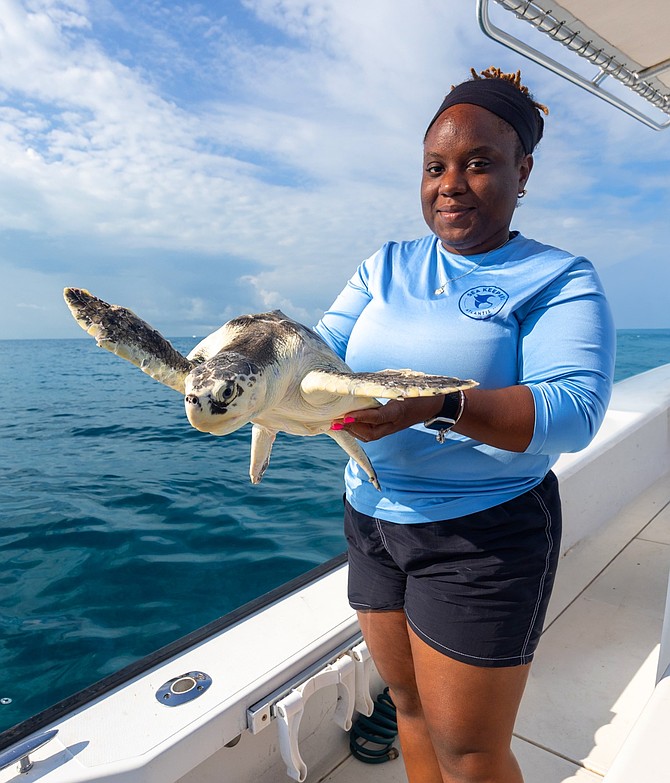
“Lucky” the turtle was released in waters off New Providence on April 8, 2026. Photo: Mikali Paul/Bahamas Visual Services
By Alesha Cadet
Tribune Features Reporter
acadet@tribunemedia.net
THE journey back to the ocean is rarely straightforward, but for one small sea turtle, it has been nothing short of extraordinary.
Information provided by the public relations team at Atlantis Paradise Island outlines the story of Lucky, a critically endangered Kemp’s ridley sea turtle whose survival has marked a rare and hopeful moment in marine conservation, arriving just in time for Earth Day.
Lucky was discovered last autumn along the rocky shoreline of Halifax, Nova Scotia, far from the warm waters where his species typically thrives. Cold, weak and barely responsive, he had become what scientists describe as “cold-stunned”, a condition that leaves young turtles immobilised when ocean temperatures drop too low. In that region, survival under such circumstances is almost unheard of.
The team noted that his rescue marked the first time in Canadian history that a cold-stunned Kemp’s ridley sea turtle has been found alive and successfully rehabilitated. Volunteers from the Canadian Sea Turtle Network, who patrol the coastline during the colder months, spotted the turtle and brought him into care, where he slowly regained strength under veterinary supervision.
That recovery set in motion the next phase of his journey. Atlantis Paradise Island officials explained that once Lucky was deemed stable, efforts began to identify a suitable facility in a warmer climate where he could continue rehabilitation before being released back into the wild. Atlantis Paradise Island, with its marine habitat and specialised veterinary care, was ultimately selected.
“The team was ready for their trip to Atlantis Paradise Island on February 24, but the weather had other ideas. Halifax received nearly 12 inches of snow that day with wind gusts up to 60 mph. But luck was on their side, and after 2,700 miles from Halifax to Toronto to The Bahamas, the group touched down and met our team at the airport.
"Lucky boarded our SeaKeepers rescue vehicle, was driven to Atlantis and arrived at our Fish and Turtle Hospital to recover in quarantine until ready to be released,” said team members at Atlantis.
The next day, the Atlantis veterinarian and aquarist team conducted a proper intake: measurements, weight, physical exam and blood tests.
This Earth Day, Lucky’s story serves as a reminder of the fragile balance within marine ecosystems and the far-reaching impact of conservation efforts that stretch well beyond borders.
All those involved in his survival efforts believe the move to warmer waters was a critical step in preparing the young turtle for life back in the ocean, allowing him to regain natural behaviours and rebuild the strength needed to survive on his own.
Resort officials also explained that Kemp’s ridley sea turtles – the world's most endangered species of sea turtle, as well as the smallest – typically hatch along beaches in the Gulf of Mexico, where large groups of females gather offshore before coming ashore to nest. From there, they make their way into the ocean, often finding shelter among floating sargassum, where they feed and grow before eventually migrating to coastal waters.
"Sometimes, juvenile sea turtles aren’t strong enough to navigate winds and tides and get pushed too far north, too late in the year. When water temperatures drop, these turtles become “cold-stunned,” meaning they are weak, immobile and float on top of the water. The waves often strand them on shore.
"In Halifax, where Lucky was found, it’s very rare for any sea turtle to survive the ordeal,” said the local team members.
On April 8, following weeks of observation and care, Lucky was given a final health check by Atlantis veterinarian Deandra Delancey-Milfort.
The Atlantis SeaKeeper team then transported the turtle offshore, where he was successfully returned to the waters just off Paradise Island.For those involved, the moment marked the culmination of months of collaboration across borders, climates and organisations, all centred on the survival of a single animal.
Lucky’s story may have begun with a wrong turn into dangerously cold waters, but it ends with a powerful example of what can happen when people come together in service of the natural world.
On a day dedicated to the planet, it stands as a quiet but meaningful reminder that even the smallest lives can inspire global effort, and that second chances in nature are worth every mile.
• The species is named after Richard M. Kemp, a fisherman from Key West, Florida, who first submitted the species for identification in 1906.




Comments
Use the comment form below to begin a discussion about this content.
Sign in to comment
OpenID