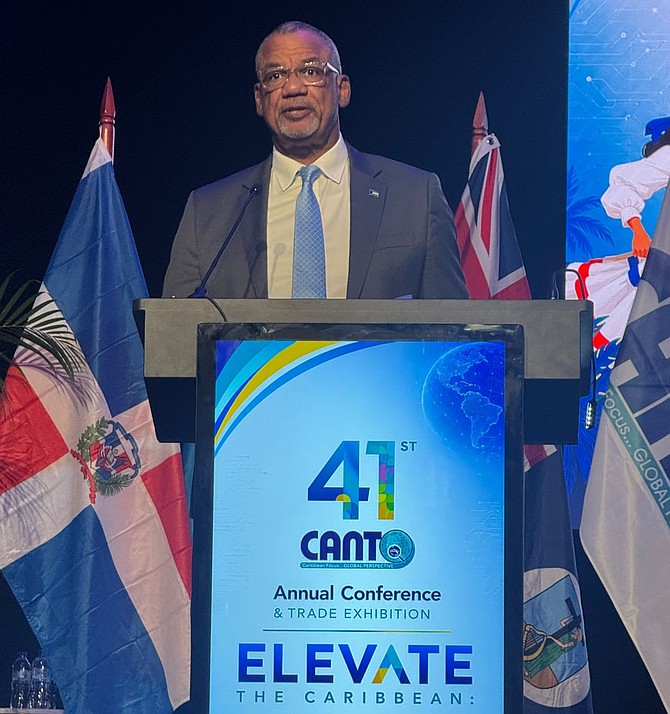
Minister of Economic Affairs Jerome Fitzgerald
A Cabinet minister says The Bahamas and wider Caribbean must retain sovereignty and control over their digital development or face a new form of “colonisation”.
Senator Jerome Fitzgerald, minister of economic affairs, used his address to the 41st CANTO regional communications conference to challenge Caribbean governments, technology providers and regional stakeholders to rethink their approach to digital development. He warned that connectivity and technology adoption must not come at the expense of ownership, control and national sovereignty.
Speaking on the theme ‘Who holds the Keys? Digital colonisation and the Caribbean claim to sovereignty’, Mr Fitzgerald’s address examined the growing influence of data, cloud infrastructure, artificial intelligence (AI), algorithms and digital platforms on the Caribbean. He questioned whether the region is building genuine digital capability or creating new forms of dependency.
The minister recalled remarks made by Prime Minister Philip Edward Davis at the 40th annual CANTO conference in Nassau the previous year on the issue of digital colonisation in the Caribbean.
“Today, I want to explore who holds the keys of our digital revolution, who should hold them and what can we do to protect ourselves from the digital colonisation he spoke about while preserving our sovereignty,” Mr Fitzgerald said.
“The issue before us is no longer whether the Caribbean will become digital. It will. The issue is who, in the digital Caribbean, will hold the keys, and whether the Caribbean truly remains sovereign.”
He warned that the Caribbean is entering the digital age through an architecture that risks reproducing aspects of the colonial economic model and “extraction without ownership, participation without power, and dependence presented as development”.
Mr Fitzgerald said Caribbean countries generate data, governments purchase digital systems, consumers pay subscriptions and Caribbean land and energy may host infrastructure, while intelligence, intellectual property, profits and governing authority associated with those systems can accumulate elsewhere. “Value flows outward. Rules flow inward,” he added.
The minister stressed that digital transformation must be measured not simply by connectivity or access to technology, but by the region’s ability to understand, govern, control and recover its critical digital assets and systems.
“Digital consumption is not digital sovereignty,” Mr Fitzgerald said. “Connectivity is not capability. Hosting is not ownership. And dependence does not become development merely because the dependency is fast.” He defined digital sovereignty as the ability to own, combined with the power to know, choose, refuse and recover information.
Among the questions Caribbean governments must consider, Mr Fitzgerald said, are where critical information resides, who can inspect it, who controls encryption keys, which laws can compel its disclosure, whether systems can be moved if prices increase or providers withdraw, and how quickly essential government functions can be restored following major disruption such as a hurricane.
“If we cannot audit a critical system, replace its provider and keep essential services running after disruption, then sovereignty exists in our anthem but not in our architecture,” Mr Fitzgerald said. “We occupy the house. We pay for the house. We may even have built the house. But someone else holds the keys.”
Mr Fitzgerald said these issues are particularly evident in discussions surrounding data centres, and the concessions and resources that may accompany major technology investments.
He challenged policymakers to consider what capability, ownership, resilience, tax revenue and recurring value will remain in the Caribbean after land, electricity, water, roads and other resources have been provided.
“Should we give the land, provide the power, supply the water, build the road, grant the concessions, and then pay rent to use services generated from our own resources while the knowledge and profits leave our shores?” Mr Fitzgerald asked.
He said the decisions being made today will determine whether the region is pursuing genuine digital transformation or “simply an extraction agreement with a different branding”.
Mr Fitzgerald emphasised that the Caribbean’s size should not be viewed as its greatest obstacle. “Being a small state is not the decisive fact. Fragmentation is, and fragmentation is a political choice,” he said.
“Digitally, our traffic moves through the same submarine cables. Our economies run on the same networks. Our vulnerabilities cross borders in milliseconds. A cyber attack does not respect the water between us. Neither does an algorithm.
“Alone, each island approaches a platform as a customer. Together, we approach it as a market. Alone, each government bargains for a facility. Together, we can bargain for an ecosystem. Alone, we ask for access. Together, we can require reciprocal agreements.”
Mr Fitzgerald outlined four priorities he has identified for strengthening Caribbean digital sovereignty. He called for the establishment of a Caribbean Digital Sovereignty Compact to establish a regional baseline for data centre incentives, resource obligations, cyber security, data protection, government cloud contracts, portability and disaster recovery. Such a framework, he added, should prevent investors from playing one Caribbean country against another for strategic resources.
Second, the minister proposed a Federated Caribbean Cloud and Compute Network, consisting of resilient nodes distributed across several islands and linked through diverse cables and network hardware, additional renewable energy generation, shared cyber security capabilities and treaty-protected protocols and back-ups.
“Our risk will be distributed, and our sovereignty should be too,” he said. Mr Fitzgerald also called for major technology contracts to be treated as matters with constitutional and sovereignty implications. Public contracts, he said, should require open standards, usable data exports, independent audits, Caribbean-controlled encryption, exit rights and knowledge transfer.
“Public money must purchase public capability,” Mr Fitzgerald said. Finally, he called for Caribbean data to be treated as an economic, cultural and national security asset.
He pointed to health records, agricultural knowledge, speech patterns, music, archives and images, warning that the Caribbean’s collective knowledge and cultural assets should not simply become proprietary intelligence elsewhere without Caribbean participation in the resulting value chain.
Mr Fitzgerald said the issue has become more urgent with the rapid development of artificial intelligence (AI), questioning whether systems developed elsewhere adequately reflect Caribbean accents, histories, cultures and values.
“We should use these global tools, but we must also build Caribbean datasets, evaluation standards, models and research institutions,” he said. “We must be authors of technology, not merely subjects inside it…. It is not enough to only ask who holds the keys. We must be able to change the locks.”
Mr Fitzgerald also highlighted the growing cyber security implications of artificial intelligence, adding that the same technologies capable of drafting documents can be used to clone voices, forge official statements, enhance phishing attacks and continuously probe networks for vulnerabilities.
He pointed to ransomware attacks on government systems, telecommunications breaches and leaked citizen data as evidence of the Caribbean’s exposure, and called on telecommunications operators and other technology stakeholders to strengthen regional co-operation by pooling threat intelligence, sharing monitoring and response capabilities, establishing common standards for critical infrastructure and deploying AI for cyber security defence.
Mr Fitzgerald also called for investment in engineers, AI and cyber security specialists, data stewards, lawyers, regulators, economists and public officials capable of interrogating contracts and algorithms and, when necessary, saying ‘no’.
He also proposed the development of a Caribbean AI laboratory, owned by the region and capable of training models using Caribbean languages, archives and history on computing infrastructure under regional control.
“We do not wait for capability before negotiating. Every negotiation must build capability,” he said. Mr Fitzgerald characterized this as the post-colonial approach required for the digital age.
“Post-colonial does not mean anti-foreign. It means anti-subordination. It does not mean rejecting capital. It means disciplining capital toward sustainable development in our national and regional interest,” he added.
Mr Fitzgerald warned that political independence alone does not guarantee sovereignty in a rapidly-changing technological environment.
“When we gained political independence, we acquired flags, Parliaments, constitutions and seats among nations. Those achievements were hard-fought and profound. But sovereignty is never fixed in the annals of time. Power moves. Each generation must identify where it has moved and build institutions capable of meeting it there,” he said.
Power is increasingly moving into code, compute, cloud, data, algorithms, standards and infrastructure,” Mr Fitzgerald added. “The next colonial office may have no building in our capital,” he warned. “It may exist in a platform’s terms of service.”
He added that authority could increasingly be exercised through an algorithm that cannot be inspected, a cloud service that cannot be exited, or an account that can be switched off without appeal. “The decree may come as a software update,” Mr Fitzgerald said.




Comments
Use the comment form below to begin a discussion about this content.
Sign in to comment
OpenID