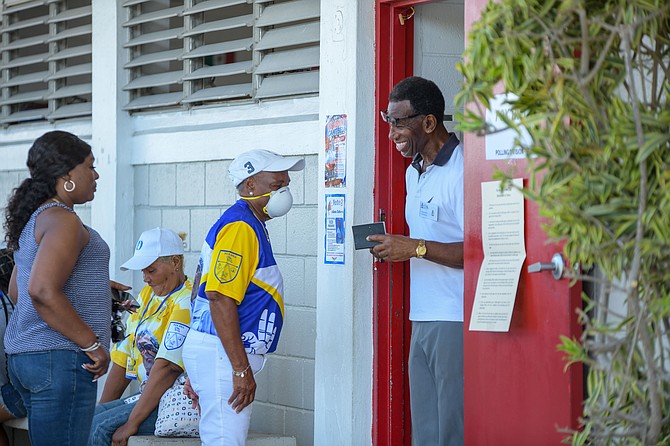
A voter heads into a polling division at Sandilands Primary School on May 12, 2026. Photo: Shawn Hanna
By RASHAD ROLLE
Tribune News Editor
rrolle@tribunemedia.net
CARICOM election observers have warned that xenophobic rhetoric targeting Haitians may have discouraged some Bahamians from voting in the 2026 general election, while stakeholders also raised allegations of vote-buying, partisan use of state resources and attempts to influence the electoral process in favour of the incumbent.
The regional mission also called for the Parliamentary Registration Department to be made independent of government after some stakeholders alleged problems with the voters’ register and advanced polling were deliberate attempts to influence the election in favour of the incumbent.
The findings are contained in CARICOM’s final report on the May 12 election, which nevertheless concluded that the poll was peaceful and transparent and that the results reflected the will of Bahamians.
Among its more striking findings, the mission said stakeholders criticised xenophobic rhetoric directed at the Haitian community and people of Haitian descent, including reported scapegoating over crimes involving identity-document fraud.
The report said such narratives, including some attributed to one of the parties contesting the election, had stoked fear among affected communities and could potentially discourage voters, particularly young voters of Haitian descent, from exercising their franchise.
CARICOM recommended stronger measures to ensure minority communities, particularly people of Haitian descent, can vote in a safe and inclusive environment, including targeted public education and initiatives encouraging respectful campaigning.
The mission also recorded allegations of vote buying and the use of state resources for partisan purposes as stakeholders complained about substantial spending by the major political parties.
Concerns were yet again raised about gaps in requirements for disclosing interests in government contracts and the absence of campaign finance legislation.
CARICOM did not find that vote buying had occurred and did not identify which parties were the subject of the allegations.
But it recommended legislation requiring political parties to disclose their funding sources, imposing limits on campaign spending and establishing effective penalties for vote buying and misuse of state resources.
The mission itself said the size of campaign billboards and banners varied noticeably between the governing party, opposition and independent candidates and that its observations confirmed reports of substantial financial resources being spent on the election.
Beyond campaign conduct, the report raises broader questions about the independence and preparedness of the machinery responsible for running Bahamian elections.
CARICOM recommended converting the Parliamentary Registration Department into an independent election management body with legal and operational safeguards against political influence.
The department currently falls under the Ministry of National Security for administrative purposes.
The report said the need for an independent elections body emerged repeatedly during stakeholder consultations.
Some stakeholders argued that the PRD’s reporting relationship with a government ministry could create the potential for undue political influence over its decisions, particularly during elections.
Some also expressed the view that problems with the voters’ register and advanced polling were deliberate attempts to influence the election in favour of the incumbent.
They also complained about an attempted movement of advance-poll ballot boxes to the Parliamentary Registration Department on May 5 without what they considered sufficient notice.
The report also referred to perceptions of political alignment and potential government influence over staff recruitment at the PRD.
CARICOM did not endorse claims that the election was manipulated.
Indeed, the mission ultimately praised the PRD’s administration of Election Day, saying voters were able to cast ballots peacefully, polling workers performed professionally and police maintained law and order.
It concluded that the election result reflected the will of the people.
But the report records significant concerns about the voters’ register before polling day.
Stakeholders alleged that foreign nationals appeared on the register with fraudulently obtained voter identification cards and passports, and complained about inadequate address verification for new voters.
They also raised concerns about the PRD’s perceived failure to meet the statutory deadline for issuing the voters’ register and purported administrative errors that left registered people off the list.
The number excluded was reportedly in the thousands.
Other voters were allegedly assigned to incorrect polling locations.
CARICOM recommended stronger address verification, biometric checks to reduce duplicate or fraudulent registrations and regular audits of the voters’ list.
Advanced polling also attracted criticism.
Stakeholders reported long lines, lengthy waits and multiple constituencies being placed at single polling locations.
They also complained about the purportedly illegal extension of voting hours and insufficient arrangements for elderly voters, pregnant women and people with disabilities.
The report said the compressed election timetable may also have limited the PRD’s ability to complete preparations, including comprehensive training of polling workers.
CARICOM wants the department to operate year-round, with continuous worker training and earlier logistical planning.
The Boundaries Commission was also drawn into the report.
Some stakeholders questioned the recent constituency delimitation exercise, including whether demographic data justified some of the changes.
CARICOM recommended reinforcing the commission’s independence to ensure constituency boundaries are drawn fairly, transparently and impartially.
The report also records dissatisfaction with the media environment during the campaign.
Stakeholders said the governing party and main opposition received free airtime on state media while smaller parties and independent candidates apparently did not.
They also described a general perception of limited media impartiality, with several outlets viewed as aligned with the two major parties.
The mission was further told that ownership of at least one major media outlet was linked to an election candidate.
CARICOM recommended election regulations guaranteeing state-media airtime for smaller parties and independent candidates and impartiality rules for media outlets backed by monitoring and enforcement.
The Parliamentary Registration Department was also criticised for poor communication.
Stakeholders complained that information about the voters’ register, polling locations and advanced-poll procedures was late, inconsistent or unclear.
The report pointed out that during the 2026 election period, the PRD’s website still prominently featured information from the 2021 election and contained minimal updates about the current poll.
CARICOM recommended sustained voter education and more timely publication of electoral information.
The report also highlighted a sharp fall in voter participation.
Turnout was 66.4 percent, compared with an average of 88 percent in previous Bahamian elections, which the mission described as relatively low.
That was despite growth in the voters’ register from 194,494 people in 2021 to 209,264 this year.
Stakeholders also complained that political parties’ engagement with young people was symbolic rather than substantive and warned that limited youth participation could deepen disengagement from democratic institutions.
CARICOM’s assessment of Election Day itself was far less critical.
Its teams observed 317 of the 322 polling divisions across New Providence and Grand Bahama and found most polling stations opened on time, had adequate supplies and had sufficient police presence.
There were some inconsistencies, including polling divisions where voters’ fingers were not checked for ink and differing practices over whether thumbs were inked before or after voting.
The mission said those inconsistencies did not disrupt voting.
It found no evidence of campaigning or attempts to influence voters within 100 yards of polling stations and concluded that the counting of ballots was conducted in accordance with the law.
The PLP won 33 of the 41 House of Assembly seats and the FNM won eight. Neither the Coalition of Independents nor any independent candidate secured a seat.
The result was broadly accepted, although Coalition of Independents leader Lincoln Bain later pursued an election challenge in Pinewood.
The report said the COI filed petitions involving Pinewood and Fort Charlotte in June, citing alleged polling irregularities in Pinewood and concerns that newly elected Fort Charlotte MP Sebastian Bastian held government contracts that were not properly disclosed under constitutional requirements.
The 12-member CARICOM observer mission was led by Saint Lucia Chief Elections Officer Herman St Helen and met with Prime Minister Philip “Brave” Davis, FNM leader Michael Pintard, Mr Bain, independent candidate Hubert Minnis, Police Commissioner Shanta Knowles, Parliamentary Commissioner Harrison Thompson and representatives of civil society and the media.




Comments
Use the comment form below to begin a discussion about this content.
Sign in to comment
OpenID