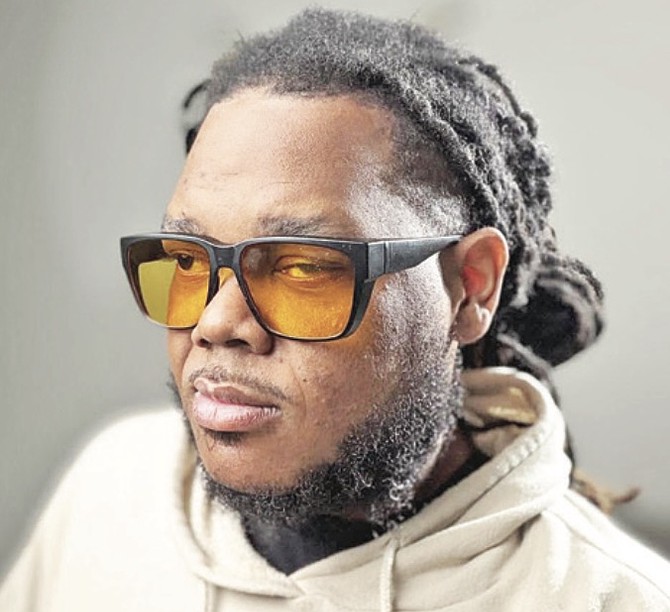
Terrel Kelly
By KEILE CAMPBELL
Tribune Staff Reporter
kcampbell@tribunemedia.net
A BAHAMIAN family living in Jacksonville, Florida, is appealing for public support after 37-year-old father-of-five Terrel Carey was left unable to work by end-stage kidney disease, diabetes and severe vision loss.
The family has launched a GoFundMe campaign as it faces eviction and mounting medical and household expenses.
Mr Carey’s wife, Waydelle Carey, said in a Facebook post that the household went from two breadwinners to one after his vision loss left him unable to work. She said a rent repayment plan requiring payments of more than $1,000 every two weeks recently fell through.
The family has five children: Mr Carey’s 15-year-old child from a previous relationship, an eight-year-old boy, a five-year-old girl and two-year-old twin daughters.
Mrs Carey said the family was seeking assistance to remain in its rented home while paying for medical care not fully covered by insurance.
A former Tribune photogratpher, Mr Carey said his health crisis began in the summer of 2024 after severe headaches led him to hospital, where doctors diagnosed him with hypertension and found signs that his kidneys were failing.
He said doctors kept him in hospital for several days after tests produced abnormal kidney function readings. A biopsy was later performed to determine the stage of his kidney disease, and doctors estimated that his kidneys would reach complete failure by December.
Mr Carey said his condition became an emergency after excessive fluid accumulated in his body, slowing his movement and leaving him “fatigued 110 percent of the time”, struggling to breathe and feeling constant pressure on his chest.
Mr Carey was photographing a wedding in Tallahassee when his primary care physician called about his latest laboratory results. He said the doctor told him to go to hospital immediately because he was at risk of dying.
Upon returning to Jacksonville, he began dialysis through a catheter placed near his neck before undergoing surgery to create a fistula in his left arm for haemodialysis treatment.
Mr Carey later transitioned to peritoneal dialysis, allowing him to undergo treatment at home. He said it was less physically taxing than in-centre haemodialysis, which left him extremely drained, with slurred speech and difficulty walking.
“When you’re done with your treatment, you feel extremely drained,” he said. “As soon as I get home, the only thing I could do was probably manage to eat something, and then I had to go to sleep.”
Mr Carey said losing his vision had been the most difficult part of his illness because it deprived him of his independence and ability to work.
Before his illness, he worked as a photographer and videographer and created online content that helped him provide for his family. However, his deteriorating vision eventually prevented him from continuing.
Mr Carey said he attempted to document his health journey through videos about dialysis, medical appointments and transplant evaluations, hoping the content could eventually generate income. Further deterioration in his left eye discouraged him from continuing.
His right eye is completely blind, while his left eye retains only enough vision for him to perceive light and shadows. He compared his remaining sight to trying to look through wet wax paper.
Mr Carey said the GoFundMe appeal would help cover household expenses, medication and specialist care not fully covered by his insurance. Appointments with a low-vision specialist could cost between $200 and $300, he said.
He said he needed continuing specialist care to help him adjust to severe vision loss and learn to navigate with a white cane.
Mr Carey said seeking financial help had been difficult because he was accustomed to providing for himself and his family. Although relatives had offered support, he said assistance from friends and others had sometimes been inconsistent.
Mrs Carey said relatives had helped the family despite having limited resources of their own, but the situation had placed a strain on everyone.
“We need help and, pride aside, I’m asking,” she said. “I’m putting myself out there in an even more vulnerable way, just seeking some help, seeking some support.”
She said her husband continued to help care for their two-year-old twins despite undergoing treatment every night.
Mr Carey said his children had also helped him adjust to his vision loss.
During family outings, his eight-year-old son and five-year-old daughter sometimes held his hands and guided him when he needed to turn.
“They remind me that they love me,” he said. “They remind me that I’m a great father.”
He said their encouragement helped him continue, although the emotional burden remained difficult.
“It gets heavy sometimes,” Mr Carey said.
Mr Carey said the emotional toll of his illness and loss of independence had led to depression and suicidal thoughts.
He recalled crying before dialysis treatments and feeling that he did not want to continue, saying the physical and emotional burden had become overwhelming.
He said therapy had helped him manage depression and thoughts of self-harm, while transitioning to dialysis at home had relieved some of the stress.
Mr Carey said depression was not limited to the initial diagnosis and could remain with kidney patients for years as they adjusted to relying on treatment that prolongs life but does not cure the disease.
“The beginning part of it was definitely a life change,” he said. “It’s the most depressing part of your experience, but people still experience depression, or they are still depressed even years later dealing with kidney disease.”
Mr Carey is being evaluated for a possible kidney and pancreas transplant because of his diabetes. He said he hoped the procedure could address his diabetes and possibly benefit the limited vision remaining in his left eye, although he acknowledged that his vision loss might not be reversible.
“At the end of the day, I just want to be able to live long and still enjoy life,” he said. “I understand that the situation with my blindness might not be something that can be reversed, but I’m not saying that I’m not hopeful that it can.”




Comments
Use the comment form below to begin a discussion about this content.
Sign in to comment
OpenID