By KEILE CAMPBELL
Tribune Staff Reporter
kcampbell@tribunemedia.net
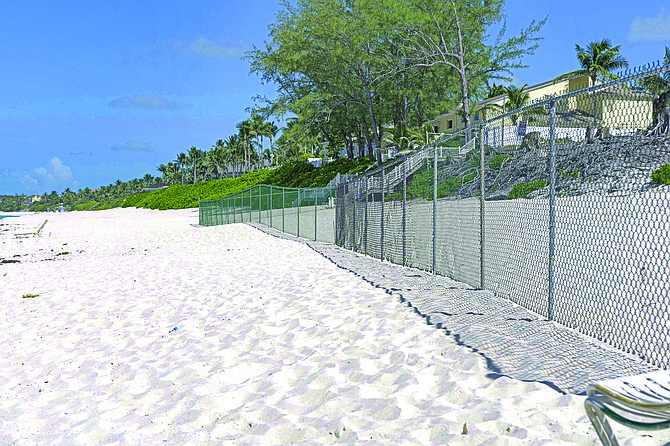
A FENCE erected across part of Cabbage Beach this week will be removed after vendors who have worked there for decades warned that it threatened businesses they rely on to raise families, pay mortgages and put children through school.
The Ministry of Tourism described the developer’s decision to erect the fence as “regrettable” and said the Department of Environmental Planning and Protection had intervened.
The ministry said it had previously met the developers to discuss their plans and understood that a site walkthrough would take place before proposed works proceeded so their impact on vendors could be assessed.
Instead, vendors said they arrived at the Paradise Island beach and found workers erecting the fence without being told how they would continue operating.
Once the fence is removed, the ministry said discussions will continue among the developers, DEPP, affected vendors and ministry officials on “the appropriate way forward”.
The ministry said it has “zero tolerance for the economic displacement of Bahamians whose livelihoods depend on participation in the tourism economy” and reminded the developers of their commitment to compensate affected vendors and ensure Bahamians benefit from economic opportunities generated by the development.
The dispute erupted as vendors feared the enclosure would leave too little room between the fence and shoreline for their stalls, chairs, umbrellas, rental equipment and customers, particularly when the tide rises.
Ishmael Sutherland, 50, has worked at Cabbage Beach for 32 years and said vendors had previously been assured they would be accommodated after the adjoining property was acquired for a proposed Four Seasons development.
“We wouldn’t be able to rent nowhere,” Mr Sutherland said. “We wouldn’t be able to work.”
He said vendors regularly move equipment farther inland to prevent it from being taken by the sea and feared the fence would prevent them from using that space.
Mr Sutherland said they had been told that vendors who wanted to relocate would be offered different locations, while those who wished to remain would retain access to the beach.
He said they also understood that vendors would be compensated for business lost during construction.
Twenty-two vendors operate at Cabbage Beach, according to Mr Sutherland, with some employing additional workers.
“This is our business. This is our livelihood,” he said. “We got children. We got to take care of.”
He said the vendors’ association planned to seek urgent discussions with the developers and would pursue the issue through lawyers and formal channels.
For Varnell Tamika Williams, 49, the dispute concerns a livelihood she has depended on since childhood.
“We born here. We live here. We make this beach,” Ms Williams said. “I help make this beach. I’ve been on this beach when I was a little girl. I raised my three daughters off this beach.”
She said vendors use their earnings to meet mortgages, rent, school fees, vehicle expenses and ordinary household costs, meaning any disruption would also affect their families, employees and other businesses.
“Our families live off the beach,” Ms Williams said. “Our money trickle down to everybody.”
She stressed that the operators maintain business licences, pay National Insurance contributions, hold health-related documents and receive Ministry of Tourism identification.
“We do this like this a normal job,” she said.
Ms Williams criticised the lack of consultation before the fence appeared, saying even ministry officials with whom vendors regularly dealt could not initially explain what was happening.
“Why y’all didn’t notify us?” she asked. “Why y’all didn’t say nothing?”
She said simply removing the fence would not resolve vendors’ broader concerns about what will happen during construction.
Ms Williams called for a temporary area where vendors can continue earning, assistance with their stalls and assurances that they will be able to return after the hotel is completed.
“They need to come to the roundtable with us and ask us how best they could help us,” she said.
Maurice Major, 53, said he has worked at Cabbage Beach for 31 years after inheriting a business established by his late mother, whom he described as one of the beach’s original vendors.
He called on Prime Minister Philip “Brave” Davis and Tourism Minister Glenys Hanna-Martin to intervene and referred to previous assurances that vendors would be allowed to remain.
“Their land is within the four stakes up there,” Mr Major said. “They can do whatever they want to do up there, but they can’t own our beach.”
“It’s a public beach,” he said. “This beach is not private. That’s what they have to remember.”
Free Town MP Lincoln Deal also backed the vendors, saying they deserved to be consulted and treated fairly in decisions affecting their livelihoods.
“Cabbage Beach is in Free Town, but it is also one of our country’s most iconic public beaches,” Mr Deal said. “We must protect public access, respect Bahamian livelihoods and ensure that development never comes at the expense of our people.”
Jet-ski operator Auderly Smith, 30, who said his connection to the beach dates to 2007, feared water-sports operators would also be affected if access to the shoreline were reduced.
“You see where the fence is?” Mr Smith asked. “See where the waterline is?”
The Ministry of Tourism said development and Bahamian economic participation should not be treated as competing interests.
“Environmental protection and economic opportunity can and must coexist,” the ministry said. “The way forward requires consultation, cooperation and a solution that protects the beach while safeguarding the livelihoods of Bahamians.”




Comments
ted4bz 1 month, 2 weeks ago
She was on that beach from she was a little girl. You see that's exactly it. The government in its attempt to update things to make it look civilized Not only do so many uncivilized things, but also destroy traditions and customs and Interrupt the flow, destroying the Economy and the income of many.
TalRussell 1 month, 2 weeks ago
Popoulaces' beaches being fenced off is a topic seldom stated and hardly ever discussed, but one that profoundly affects society: the colony's many. -- yeah?
Sign in to comment
OpenID