By NEIL HARTNELL
Tribune Business Editor
nhartnell@tribunemedia.net
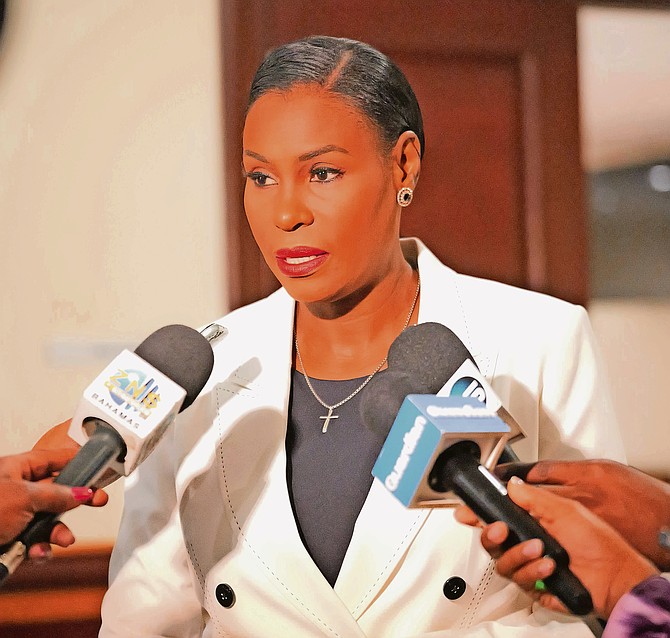
A CABINET minister last night hailed 2025 second half workforce data as showing “the labour market has found a more stable footing” with the economy expanding fast enough “to absorb virtually everyone looking for work”.
But Pia Glover-Rolle, minister of labour and the public service, told Tribune Business that - while the 8.8 percent and 8.7 percent national unemployment rates for the 2025 third and fourth quarters were among the lowest in Bahamian history - “more progress can be made” to drive the jobless rate even lower.
She added that the second Davis administration is basing its strategy to expand employment opportunities further on “three pillars” - increased training and education, so that workers gain more skills to boost their income-earning capacity; job creation through local and foreign direct investment (FDI), accompanied by a crackdown on work permits where Bahamians are qualified and available to do the job; and increased opportunities for Family Island residents.
Meanwhile Kwasi Thompson, the Opposition’s finance spokesman, told this newspaper that while the increase in the number of employed Bahamians - from 222,575 in the 2025 third quarter to 226,025 just three months later - was positive he also had concerns about the more than 26,000 deemed to be under-employed.
Pointing out that simply having a job is sometimes not enough, especially amid the ongoing cost of living crisis, he called on the Government to bring major investment projects out of the pipeline to “shovel ready” status much more quickly. And the east Grand Bahama MP added that extra focus needs to be placed on enabling young Bahamian digital content creators to receive proper compensation for their work. Mrs Glover-Rolle, speaking to the overall Labour Force Survey and relatively low jobless rates below 9 percent, said: “We see this as a positive signal, but we also note that more progress can be made. An unemployment rate sitting in the 8 percent range is among the lowest rates this country has recorded in many years.
“It sits well below what we saw when we first came to office in 2021, and it continues a downward trend that has held steady throughout the past five years. Two consecutive quarters in that range tells us the labour market has found a more stable footing. That stability is what allows the Government and private sector to confidently plan further job creation so we can drive that number even lower.”
As for the number of jobs created during the 2025 second half exceeding the pace of workforce expansion, the minister added: “This is one of the more encouraging signals in the data. Employment grew by 3,450 persons over the two quarters, and the labour force grew by 3,350.
“That means the economy generated enough opportunity to absorb virtually everyone who entered the job market looking for work. It also matters that women accounted for a majority of the labour force growth. That tells us more Bahamian women are stepping into the workforce and they are successfully finding opportunities.
“When we see new entrants being absorbed like this, it points to real demand in the labour market. The corresponding decline in discouraged workers reinforces that.” Outlining how the Government plans to expand employment opportunities, Mrs Glover-Rolle said: “Our approach to expanding employment rests on three pillars.
“First, we have training and education, so we can move people from being unskilled to skilled, and from being considered unemployable to being genuinely qualified for employment opportunities.
“Second is job creation through sustained foreign and domestic investment, with billions of dollars in projects ongoing or in the pipeline, paired with consistent enforcement of the law ensuring that qualified Bahamians get first consideration for opportunities before a work permit is issued to a non-Bahamian,” she added.
“Third, we are expanding opportunity across the archipelago so that training initiatives and jobs are not limited to New Providence and Family Islanders are included. For the more than 26,000 workers who reported that they are under-employed and looking for more work, the solution remains the same.
“As hotel, construction, infrastructure and other projects move from approval to execution across our islands, the better-paying jobs and additional hours and shifts those workers are looking for will follow,” Mrs Glover-Rolle said.
“However, workers must also better qualify themselves to take advantage of these emerging opportunities, and that is why I continue to encourage workers across the nation to take advantage of free training opportunities at BTVI, the National Training Agency, Upskill, the National Apprenticeship Programme and other training programmes, so they can be ready to participate in the progress happening throughout the nation.”
Mr Thompson, meanwhile, pointed to the 26,195 under-employed Bahamians who are working but want more hours or better employment opportunities.
"Every Bahamian who gets a job is good news, and we welcome that. But this report also reminds us that having a job is not always enough. A job with too few hours, too little income or no real opportunity for advancement is not enough,” he argued, adding that employment statistics tell only part of the story.
"The real questions Bahamians are asking are simple,” Mr Thompson said. “Can I afford my groceries? Can I save to buy a home? Can I put something aside for my children's future? Can I build a better life? Those are the questions that truly measure the strength of an economy.
"We need a national strategy that makes it easier to start and grow a business, improves access to financing, cuts unnecessary red tape and helps Bahamian businesses sell their products and services around the world. Government should also engage directly with global digital platforms such as YouTube, TikTok and banks, together with international payment providers, so Bahamians have the same opportunities to earn income as entrepreneurs in other countries."
Mr Thompson welcomed the Government's commitment to mandatory timelines for development approvals, but said these alone would not solve the problem.
"Mandatory timelines will only work if we fundamentally change the way government operates,” he said. “Digital government must move from aspiration to implementation. Applications should be submitted once, government agencies should communicate electronically, and applicants should be able to track approvals every step of the way.
"Every unnecessary delay means investment delayed, businesses delayed and opportunities delayed. We should use technology to eliminate red tape, speed up approvals and get projects moving. The next chapter of our economy must be about creating more owners, more innovators and more employers. That is how we create lasting prosperity for Bahamian families. That should be our national focus."




Comments
Use the comment form below to begin a discussion about this content.
Sign in to comment
OpenID