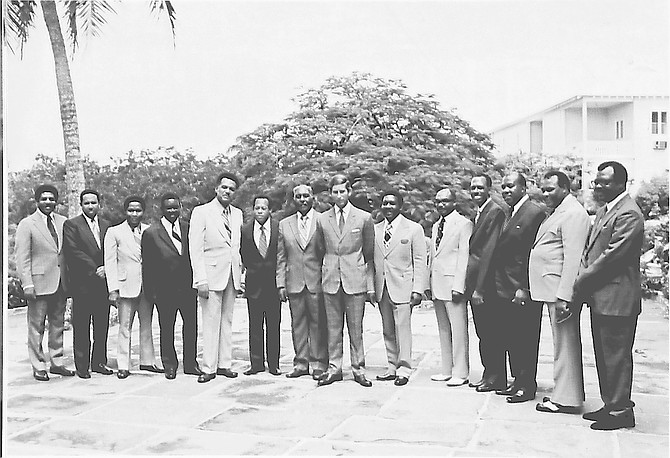
His Royal Highness Prince Charles, now King Charles III, poses with members of The Bahamas' first Independence Cabinet in July 1973. Pictured (left to right) are Anthony Roberts, Paul Adderley, Darrell Rolle, Livingston Coakley, Clement Maynard, Arthur D. Hanna, Sir Milo Butler, His Royal Highness Prince Charles, Sir Lynden Pindling, Carlton Francis, Loftus Roker, Clifford Darling, Simeon Bowe and Secretary to the Cabinet Rodney Bain. (Identifications by Sean McWeeney, KC)
By A FELICITY DARVILLE
WHEN His Royal Highness Prince Charles arrived in The Bahamas aboard the Royal Yacht Britannia on July 5, 1973, he came as the representative of Her Majesty Queen Elizabeth II to witness the most defining moment in the nation's history - the birth of an independent Bahamas.
Just days later, on July 10, thousands of jubilant Bahamians gathered at Clifford Park, where the Union Jack was lowered and the black, aquamarine and gold flag of The Bahamas was raised for the very first time.
Prince Charles stood alongside Governor Sir John Paul, Governor-General-designate Sir Milo Butler, Premier Sir Lynden Pindling, who would become the country's first Prime Minister, and members of the first Independence Cabinet as history unfolded before their eyes.
Throughout his visit, the young Prince participated in official ceremonies and celebrations, including a colourful sailboat regatta held in his honour at Fort Montagu on July 7, where he delighted in the pageantry, vibrant colours and unmistakable spirit of Bahamian culture.
He later remarked on the colour and vibrancy of Bahamian celebrations and the warmth of the Bahamian people.
Long before he became King Charles III, the Prince developed a genuine affection for The Bahamas, returning on numerous occasions over the years. He was particularly fond of Windermere Island, off the coast of Eleuthera, where he could enjoy the privacy and tranquility that accompanied life in the Family Islands. There, away from the pressures of royal life, the future King found a rare sense of freedom that few public figures of his stature could experience elsewhere.
While visiting Eleuthera, Prince Charles was known to enjoy the simple pleasures of island life. He appreciated the quiet beaches, where residents respectfully afforded him his privacy, and he looked forward to homemade Bahamian bread prepared by a local baker whose recipe would later become world famous.
It was these authentic experiences, far removed from royal ceremony, that endeared The Bahamas to him.
One memorable evening during one of Prince Charles' visits to The Bahamas perfectly illustrated that spirit.
According to the recollections of Denver Broncos player Ed Smith – the first Bahamian to play in the National Football League (NFL) - and Allan Ingraham, one of the first free agents ever signed to the NFL, Prince Charles expressed a wish to experience an ordinary Bahamian evening away from official protocol.
Smith owned Cumberland House, an intimate boutique club located near Government House that featured soft music, fine food and relaxed conversation.
Both Smith and Ingraham lived nearby, making Cumberland House part of their regular stomping grounds and a natural gathering place for friends.
Lord Louis Mountbatten, the Prince's great-uncle and mentor, quietly visited the establishment to observe the atmosphere before approaching Smith with an unusual request. Prince Charles, he explained, hoped to visit the club without the customary royal formalities.
With Mountbatten's approval, the two imposing football players walked from Mountbatten House with the Prince to Cumberland House.
For the next two hours, there was little indication that one of the world's most recognisable young royals was among them.
Prince Charles chatted comfortably with patrons, laughed easily, and even invited a young Bahamian woman named Angie onto the dance floor for several dances. There were no elaborate ceremonies or rigid protocols - just conversation, music and fellowship.
Those present recall that he spoke with everyone as though he were simply one of the boys enjoying an evening out with friends.
After spending those enjoyable hours at Cumberland House, the Prince quietly returned to Mountbatten House, leaving behind a story that has been fondly shared for generations.
More than five decades later, that evening remains a reminder that the man who would one day become King Charles III valued genuine human connection as much as royal tradition.
As The Bahamas celebrates 53 years of Independence, the photographs from July 1973 preserve more than constitutional history. They capture a young Prince who embraced the warmth of the Bahamian people, admired their vibrant culture and discovered something deeply personal in these islands.
Perhaps it is no coincidence that one of his favourite places was Eleuthera - an island whose name means "freedom".
Here, away from the pomp and pageantry of royal life, the future King found exactly that: the freedom to simply be himself among friends.
It is a testament to the warmth and hospitality of the Bahamian people that, long before he wore the Crown, Prince Charles found a home away from home in The Bahamas.




Comments
Use the comment form below to begin a discussion about this content.
Sign in to comment
OpenID