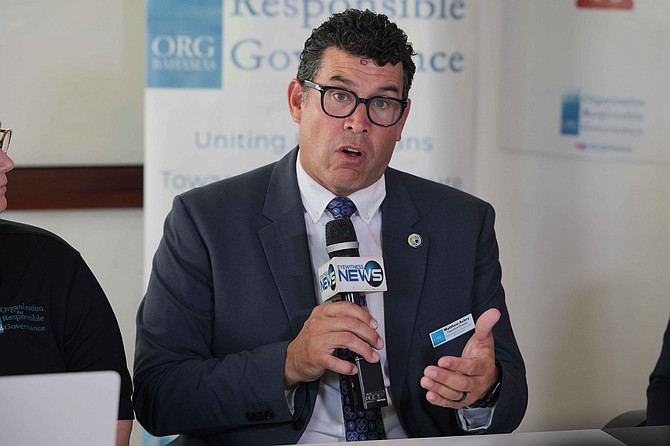
Matt Aubry Photo: Nikia Charlton
By NEILL HARTNELL
TRIBUNE Business Editor
nhartnell@tribunemedia.net
A former Bahamas National Trust (BNT) chief yesterday argued regulators were wrong to “dismiss” the need for an Environmental Impact Assessment (EIA) study on a Green Turtle Cay project that has sparked an online protest petition attracting over 900 signatures within hours of launch.
Eric Carey, who now heads his own environmental consultancy, told Tribune Business that the circumstances surrounding the proposed Gillam Bay site selected by the developer, Reginald Curry, should have prompted the Department of Environmental Planning and Protection (DEPP) to mandate that an EIA evaluation be conducted and made public.
The environmental advocate, who confirmed that he was waiting on a copy of the development plans after being “asked” by Green Turtle Cay residents to review them, said the location’s status as “newly-accreted land” from the accumulation of coastal sand, plus its reputation as a haven for birds and other wildlife and use for recreation by locals, were all factors that weighed in favour of an EIA being submitted.
Mr Carey told this newspaper it was “kind of strange” and “somewhat deficient” that DEPP had decided otherwise, with the environmental regulator’s officials telling Green Turtle Cay residents at last week’s Town Hall meeting that the agency determined the project did not meet the legal threshold for triggering an EIA because it involves construction on pilings as opposed to excavation, mining and marine works.
While conceding that the law gives DEPP discretion to decide whether an EIA is required for any development, the ex-BNT executive director said: “The determination made by DEPP that no EIA is required for this project at Gillam Bay, I find it kind of strange for virgin land, an area discovered to be used by lots of shore birds and wildlife over the years….
“I find the determination by DEPP that an EIA is not required, I find that somewhat deficient. The impact on the environment should require a formal EIA and things that determine whether the impact is acceptable. I don’t think DEPP should sit in Nassau, send someone up for a quick view and say they don’t need an EIA.
“I think this, because of the circumstances, should dictate an EIA is required - newly-accreted land, an area used by wildlife, an area used by local people for recreation,” Mr Carey reiterated. “They are sufficient factors that should trigger an EIA process. I am not in agreement with that; the requirement for the EIA to be dismissed and done away with. I don’t support that in this case.”
Gillam Bay is shaping up to become the latest development and environment-related controversy in The Bahamas, with Green Turtle Cay residents - including local government and council executives - asserting they had been blindsided by the project’s progress and the approvals granted by Nassau-based regulators.
Mr Curry has received a certificate of environmental clearance (CEC) from DEPP to proceed with his proposal to construct construct nine 1,900-square foot villas, a single-storey clubhouse with a restaurant and bar, an administrative office and a back-of-house facility at Gillam Bay.
But many on Green Turtle Cay, alleging they only became fully aware of the project at Thursday’s Town Hall meeting, voiced frustration over the perceived lack of transparency and Nassau seemingly dictating, and imposing its vision, of development on Family Island communities without locals and those affected having any say.
Similar under-currents existed almost 20 years ago, when opposition arose over the Baker’s Bay project citing largely environmental concerns, and little has been done to address these issues which continue to surface over foreign direct investment (FDI) projects in the Family Islands.
An online petition launched on change.org, urging the Davis administration to maintain “the current construction pause” until all permits and compliance requirements are met, and a “legal review” conducted, had within hours gained 943 signatures by the time Tribune Business went to press.
The petition, in calling for “an independent review of the environmental assessment and approval process” and for “meaningful time and weight” to be given to Green Turtle residents’ concerns, said: “This petition is led by a collective of Bahamian citizens who believe Gillam Bay is a national treasure worthy of protection.
“It reflects the voices of Bahamians who care deeply about preserving our country's natural heritage, and who want decisions affecting our islands for generations to come to be made with transparency, accountability and respect for the law…. Once an irreplaceable coastal ecosystem is destroyed, it cannot simply be rebuilt. The decisions made today will shape Green Turtle Cay for generations to come.
“We are asking that any development proceed only if and after every legal requirement has been met, environmental impacts have been independently and transparently evaluated, and the people who will live with these decisions have been meaningfully heard. Responsible development and environmental stewardship ca - and should - go hand in hand.”
Mr Carey told Tribune Business: “Clearly this is a project that the local government, local council and local community seems very much opposed to. It appears most of the people believe this area should remain as green space, something for the community to enjoy, rather than be used as commercial space. In that regard, I align myself with local communities who feel strongly about what happens in their area.
“They feel dictated to by central government. It appears they are going against the wishes of the local community. I think we are way past that now. There are one or two projects where the local community may be overruled, but this one, based on what local people are saying, appears to have been rammed down their throats.”
Mr Carey argued that local government councils in the Family Islands, as well as residents in those locations, “need to become more powerful” and assertive of their rights - even if it ultimately requires legal action to be initiated against approvals for projects that are not desired.
The ex-BNT chief, who works as an advisor for Turtlegrass Resort & Island Club, cited the outcome of a recent Exuma town hall meeting on the $200m Rosewood Exuma development where local residents had voiced strong opposition to dredging. However, the Town Planning Committee “completely ignored the views of local people and determined, from a Nassau-centric way of doing things, that they were going to ignore that.
“Local government is going to have to start taking out class action lawsuits against central government as this is the only way their voices will be heard or otherwise they will be dictated to.” Mr Carey also urged Bahamian law firms to offer their legal services “pro bono”, meaning voluntarily and without payment, to hard-pressed Family Island communities when legal redress through the courts is the only option in development and environment-related cases.
Meanwhile, Matt Aubry, the Organisation for Responsible Governance’s (ORG) executive director, told Tribune Business that the Gillam Bay development and handling of its approvals process are another example of how trust can break down between citizens and government institutions.
Pointing to The Bahamas’ recent signing on to the Escazu agreement, which commits this nation to “the public’s right to access information”, plus transparency and accountability in environmental matter, he added that ORG and other non-profit advocacies have been pushing for local communities to play an increasing role in developments that affect them.
“It’s advantageous for developers,” Mr Aubry said, “so they know what the community’s issues and concerns might be, so they can put that in their plans and not go too far and back up. It’s also good for government so that contentious issues don’t become ‘he said, she said’, and it becomes collaborative, working in partnership to solve problems.”
The ORG chief, adding that “trust plays a critical role in good governance”, said development projects offer “a critical opportunity to further trust so persons understand what the process is, what their role and the rules are, and they are not at the mercy of the decision by an entity that is acting with all the best intent but not at the level where the community.
“If you don’t know information or if something is being proposed, this starts every project off on the wrong foot,” Mr Aubry said.
The Gillam Bay petition on change.org states: “A proposed large-scale development threatens to permanently alter this sensitive environment, and with it, one of the beauty spots that draws tourists here in the first place. Many local Bahamian citizens, longtime visitors and second home owners have expressed that this development would fundamentally change the character of Green Turtle Cay and could influence whether they return in the future.
“Plans for this development were first signalled in 2022, when a road bringing water and electricity was extended to the developer's existing business on No Name Cay. Since then, the scope has grown considerably. The broader Green Turtle Cay community first learned the full scope of the proposal during a town meeting held on July 16, 2026…
“This is to be developed on approximately three acres of Crown Land, which the developer has been granted permission to build on 40 percent [of]. Community members have raised questions regarding the process through which development rights for the site were granted, and have requested greater transparency surrounding those decisions,” the petition added.
“The sequence of events raises important questions about compliance with the established approval process and should concern anyone who values transparency, accountability and the rule of law, regardless of their position on the development itself. And if procedural deficiencies are identified after irreversible work has commenced, the consequences may be significant for the community, the developer, the environment and public confidence in the regulatory process….
“We recognise the importance of investment and economic opportunity in The Bahamas. But development should never come at the expense of transparency, local consideration and our environment. Sustainable development requires that environmental protection, community interests and economic growth exist together - not that one be sacrificed for another.
“Many local Bahamian citizens, residents and stakeholders alike have serious, justifiable concerns about whether every statutory requirement, environmental review and public consultation has been properly completed before this project proceeds. These questions deserve clear, transparent answers, and decisions of this significance should be made only after all legal processes have been fully satisfied.”




Comments
Use the comment form below to begin a discussion about this content.
Sign in to comment
OpenID