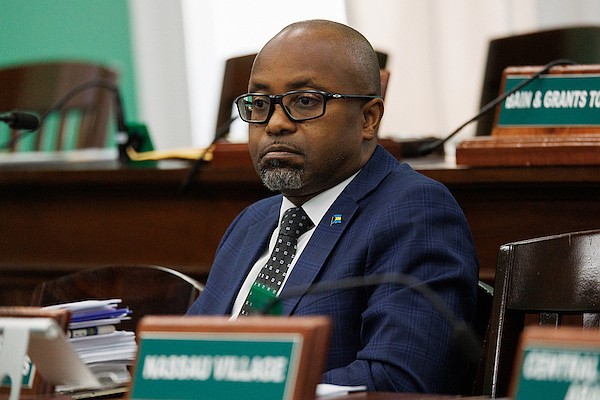
East Grand Bahama MP Kwasi Thompson speaks in the House of Assembly on July 30, 2025. Photo: Dante Carrer/Tribune Staff
By NEIL HARTNELL
TRIBUNE Business Editor
nhartnell@tribunemedia.net
The Opposition’s finance spokesman yesterday urged that “the Government must not relent” until Donald Trump’s 12.5 percent tariff on Bahamian exports to the US is eliminated and removed, adding that “we cannot just look at this as business as usual”.
Kwasi Thompson, the east Grand Bahama MP, responding to Tribune Business inquiries called on the Davis administration to go beyond routine diplomacy and instead treat the situation as “a national economic priority” given the potential negative impact for the affected export industries and those employed by them.
A previous government position paper, submitted to the US Trade Representative’s Office as part of The Bahamas’ bid to ward-off the Trump administration’s plan to levy tariffs on goods made by this nation and 59 others, on the basis they have failed to ban imports made with forced labour, warned that $985m worth of exports to the US could be impacted based on 2024 trade data.
This figure includes $50m-$60m in annual crawfish sales, plus other products, by Bahamian fisheries; $55.7m worth of Polymers International’s styrene polymers; plus $39m in “pearl products”. The Bahamas’ greatest physical goods export to the US was listed as refined petroleum, valued at $610m, which likely represents products blended and refined at Buckeye Bahamas, while other categories included ‘documents of title’ worth $95.2m.
While the Bahamian economy is largely a services exporter, with this segment making up the bulk of annual economic output or GDP, Mr Thompson nevertheless agreed that goods exports to the US represent a valuable source of foreign currency earnings and that the Trump tariff impact will be felt disproportionately by Family Island communities that rely heavily on affected industries such as fisheries.
The Government had hoped reforms to the Customs Management Act, passed alongside the 2026-2027 Budget prior to end-June 2026, and which prohibit the importation of goods to The Bahamas “if there are reasonable grounds to believe” they have been made with forced labour, would have been sufficient to address US concerns.
Prime Minister Philip Davis KC signalled as much during the 2026-2027 Budget debate, but Mr Thompson said the “reality” now faced by The Bahamas is that the Trump administration has turned threat into “reality”. As a result, he urged that “every diplomatic and economic resource should be brought to bear” to secure the 12.5 percent tariff’s removal at the earliest opportunity to preserve the competitiveness of Bahamian exports in the country’s largest overseas market.
“I raised this issue during the Budget debate that this threat was looming, and the Government as I understand passed the legislation to seek to deal with the threat,” Mr Thompson told Tribune Business. “Unfortunately, this threat has now become a reality.
“I think the Government has to move with urgency to engage with the US and also the Bahamian public and all the businesses affected. They must treat this as a national priority because this is a tariff that affects businesses and, with every business that is affected, we have to look at the workers, the families and the communities that will be affected.
“This must be treated as a national priority. We cannot just look at this as business as usual. It cannot just be a matter of diplomacy. The Government must treat this as a national economic priority. That was the reason why I raised it during the Budget debate. I raised the alarm for the businesses and for the industries that will be severely affected but, unfortunately, the US has taken action. So the Government must treat this as a national economic priority.”
The first Davis administration appeared to take the threat seriously. Ryan Pinder KC, the then-attorney general, submitted The Bahamas’ national position during the US Trade Representative’s Office’s first round of consultation on the forced labour tariffs, arguing that the dominant share of total Bahamian imports enjoyed by US goods undermines the notion they are being squeezed out by cheaper products made with forced labour.
He added that The Bahamas “respectfully requests that the US Trade Representative’s Office makes a negative determination that any of the Government's acts, policies or practices are actionable under Section 301 of the Trade Act 1974, or alternatively, suspend the investigation to allow time to see if a satisfactory solution may be reached between our two nations”.
Danya Wallace, director of legal affairs in the Attorney General’s Office, was also dispatched to Washington D.C. to testify on one of the panels at the US Trade Representative’s public hearings. She also affirmed that Bahamian law and the constitution prohibit forced labour practices within the domestic economy.
“Under the constitution of The Bahamas itself, there is something enshrined within the constitution at Article 18 that prohibits slavery and forced labour, and in reading that Article 18, it reads in similar form to the Article 2 of the International Labour Organisation (ILO) protocol of 1930, and so we have that as the highest form of legal enforcement,” Ms Wallace said.
“We also have within our domestic law, both under the Employment Act as well as the Industrial Relations Act, protections and safeguards for employees, as well as the right to have a bargaining agent and representation. We also have before us the Trafficking in Persons Prevention and Suppression Act, and in the most recent TIPPS report of 2025, The Bahamas maintained its Tier 1 standard in that regard.” This, though, appears to have cut little ice with the Trump administration.
“The decision by the United States to impose a 12.5 percent tariff on Bahamian exports is deeply disappointing and represents a serious challenge for Bahamian businesses that rely on access to the US market,” Mr Thompson said in yesterday’s statement.
“Several weeks ago, I expressed concern that the issues raised by the US posed a real risk to Bahamian exporters and urged that this matter be treated with the urgency it deserved. Unfortunately, those concerns have now become a reality. Our focus must now be on protecting the Bahamian businesses, workers and families who will bear the consequences while securing the earliest possible removal of these tariffs.
“Every day these tariffs remain in place, Bahamian exporters are placed at a competitive disadvantage. When our exporters lose business, it is not only companies that are affected. Fishermen, factory workers and many other Bahamians whose livelihoods depend on these industries also feel the impact. Reduced exports mean fewer opportunities for businesses to grow, invest and create jobs, particularly in communities that depend on these industries,” the east Grand Bahama MP added.
“The Government has indicated that it has strengthened our laws and is engaging with the US. That engagement is necessary, but engagement alone is not enough. The Government must now make the removal of these tariffs an immediate national priority.
“This matter cannot be treated as routine diplomacy. Every diplomatic and economic resource should be brought to bear to secure the earliest possible removal of these tariffs while working closely with affected industries to minimise their impact. The Government must not relent until these tariffs are removed. The longer they remain in place, the greater the uncertainty for Bahamian businesses, the greater the risk to jobs, and the greater the cost to our economy,” he continued.
“Behind every export shipment are Bahamian workers, families and communities that depend on these industries for their livelihoods. Protecting those jobs and opportunities must remain our highest priority. At the end of the day, Bahamian businesses and workers need these additional tariffs removed. That must now be the Government's focus.”
International economics commentators have suggested Mr Trump seized on the 1974 Trade Act’s section 301 as a stronger weapon to support his tariffs, and get around the US supreme court’s rejection of his previous ‘Liberation Day’ tariffs, by grounding them on allegations other countries have failed to crack down on forced labour.
They have described the evidence against The Bahamas and others as flimsy at best, but almost impossible for them to disprove. However, legal challenges against the latest tariffs have already been launched on the basis that the US has failed to conduct a thorough-enough investigation to make the claims against The Bahamas and 59 other states stand-up.
Dr Duane Sands, the Opposition’s chairman, questioned whether The Bahamas’ hiring of Cuban doctors and medical practitioners - which the US has branded as akin to forced or slave labour, because the majority of the wages are paid to a Castro government entity as opposed to the workers themselves - may have factored into the US decision.
“The Bahamas and Bahamians should defend The Bahamas and Bahamians as first priority,” he told Tribune Business, “looking out for the interests of The Bahamas and Bahamians. That said, we have to be honest with ourselves: What did we know, when did we know it, and what did we do? This is more than feigned indignation. Did the response meet the concerns?
“It’s critical to businesses who continue to export products out of our economy. Hopefully we’ll get to the point where the administration sits down with the Trump administration and it responds to the issue to mitigate the potential problem. What we need to do is make sure this economy is growing at a rate to deal with the many challenges we have, and it’s not growing at the rate we need it to.
“This tariff may not seem that grand to some people, but it could be the straw that breaks the camel’s back. I’m hoping this results in let’s roll up the sleeves, sit down, engage and get this problem resolved. Let’s see whether we can get The Bahamas down to zero or a nominal tariff scenario.”




Comments
birdiestrachan 1 month, 2 weeks ago
Did the Fnm fellows and their newspaper jump for joy over this matter??
licks2 1 month, 2 weeks ago
This tariff is not for the Bahamas as a nation. . .there is not forced labor work in the Bahamas per se . . . this is targeting our economic relationship with China!!
The FNM knows that we have no forced production facility in our nation!! All we need to do is take the 59nation list and see how many of those nations we have a significant import relationship with!!
The FNM them seem to have lost any sense of good common sense!! The Bahamas is caught in the mid of a stupid trade war between USA and PROC. I hope this FNM clown crew have a solution for this USA Policy. They damn did not have a clue when they were in government. . .now they expect that the FNM fine a solution!!
Sickened 1 month, 2 weeks ago
You will be waiting a long time for Trump to make a friendly gesture towards us.
Sign in to comment
OpenID